Appearance
Nightwater Lanes
Nightwater Lanes is already awake when most visitors first see it.
At dawn, bakers are pulling the first trays from ovens that never fully cooled. Dock crews climb toward the harbor carrying steaming cups from shops that opened before sunrise. Couriers sort packets beneath painted awnings. Boarding-house windows open one by one above the street. Actors cross between rehearsal lofts carrying rolled scenery. Children carry bread home through alleys already crowded with handcarts. A printer hangs fresh broadsheets beside yesterday’s theatre bills while a muralist on a scaffold begins repainting a patch of wall faded by salt air.
By noon, Nightwater is one of the busiest pieces of lower Windrider.
Theatres run matinees. Language tutors work above coffee houses. Tailors repair sailors’ coats beside costume makers sewing improbable stage garments. Lodging keepers argue over beds. Laundries steam. Cheap kitchens feed porters and apprentices. Translators write letters for travelers who cannot write them themselves. Musicians rehearse behind open shutters. Locksmiths, cobblers, instrument repairers, employment brokers, printers, pawn dealers, grocers, clinic workers, couriers, food sellers, painters, teachers, and landlords conduct perfectly ordinary business in streets whose reputation elsewhere in Windrider rarely acknowledges how much ordinary life happens here.
Then the light changes.
As the sun drops behind the higher city, Nightwater undergoes what its residents call the Second Lighting.
Lantern keepers replace clear shades with colored glass. Painted shutters fold around ordinary lamps. Mirrors above doorways redirect red, violet, blue, amber, and green light into narrow passages. Some theatres change their signs. Other businesses close their front rooms and open different doors. Supper kitchens replace daytime counters. Gambling moves upstairs. Musicians who spent the afternoon rehearsing begin performing. Bathhouses become louder. Private dining rooms fill. Couriers change routes. Certain apothecaries stop selling from the front counter while other customers begin arriving at the side.
The district does not become another place.
It reveals another version of itself.
By night, Nightwater becomes more permissive, more theatrical, more intoxicated, more erotic, more secretive, and more dangerous. Psychedelic light shimmers in old drainage channels and on wet paving. Actors and dockworkers mix with wealthy patrons, smugglers, sailors, playwrights, gamblers, travelers, thieves, private investigators, clergy, musicians, couriers, and people who have come specifically because Nightwater offers things that cannot be obtained comfortably elsewhere.
The criminal world moves closer to the surface after the Second Lighting.
It never owns all of what lies above it.
Nightwater is not a criminal district pretending to be legitimate. It is a complete city neighborhood whose density, privacy, transient population, irregular hours, artistic culture, and tolerance for unconventional lives make legal and illegal activity unusually difficult to separate.
District Map and Orientation
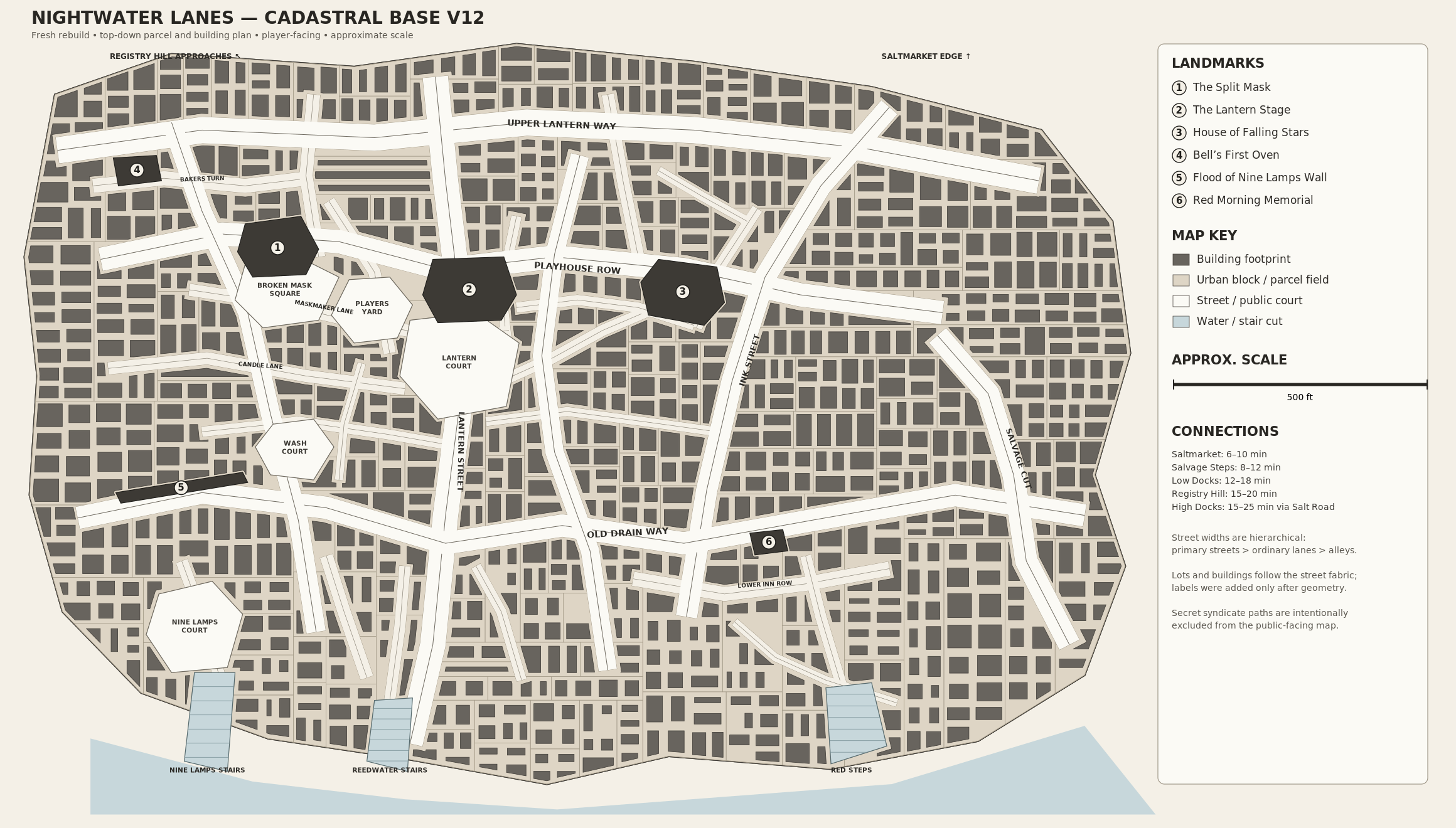
The map above represents Nightwater’s player-facing street and parcel structure. It shows the district’s public streets, building fabric, principal courts, major theatre sites, old drainage alignment, water-stair approaches, and connections toward neighboring parts of Windrider.
It deliberately does not show concealed cellar links, private roof crossings, backstage-only connections, syndicate passage routes, hidden storage chains, secure interiors, or other routes that require residence, employment, investigation, invitation, or underworld contacts to discover.
Nightwater occupies an irregular lower-city footprint roughly 2,400 feet across at its broadest and about 1,750 feet through its deepest built extent. Approximately fifty-five feet of relief separate the Saltmarket-facing upper edge from the lowest surviving water stairs.
The ground does not descend as one uniform slope. Nightwater occupies several old urban shelves interrupted by retaining walls, stair streets, filled watercourses, and abrupt changes in foundation height.
Its public circulation is consequently crooked rather than gridded.
Upper Lantern Way forms the strongest Saltmarket-facing edge.
Playhouse Row bends through the artistic core rather than forming a straight ceremonial avenue.
Ink Street carries printers, copyists, teachers, letter writers, and document services through the denser upper and central fabric.
Lantern Street provides one of the clearest public approaches to Lantern Court.
Old Drain Way follows the surviving alignment of an older drainage channel through the lower district.
Salvage Cut descends toward the Salvage Steps approaches and carries much of Nightwater’s heavier service movement.
Dozens of smaller streets, cuts, courts, stairways, and alleys divide the resulting blocks.
The Salt Road lies in the broader lower-city movement corridor connecting High Docks inland toward Saltmarket. It provides an important harborward approach to Nightwater, but High Docks and Nightwater do not share a simple direct boundary.
From central Nightwater, Saltmarket is usually six to ten minutes away on foot; Salvage Steps eight to twelve; Low Docks twelve to eighteen; Registry Hill roughly fifteen to twenty; and High Docks approximately fifteen to twenty-five minutes depending on route, congestion, freight movement, and the traveler’s familiarity with the lower city.
Courts, Squares, and Shared Ground
Nightwater’s density makes open ground valuable.
Most streets are too narrow to hold a large crowd without stopping traffic. Most residential courts belong primarily to the people living around them. Theatre loading spaces need to remain accessible. Food sellers, performers, printers, porters, children, couriers, Watch patrols, and people simply trying to cross the district compete constantly for the same limited ground.
The result is a hierarchy of shared spaces that are neither formal civic plazas in the Registry Hill sense nor private courtyards belonging to one household.
Five matter especially to the public life of Nightwater.
They are Lantern Court, Broken Mask Square, Nine Lamps Court, Players’ Yard, and Wash Court.
Each serves a different part of the district.
Together they prevent Nightwater’s public life from being forced entirely into streets.
Lantern Court
Lantern Court is the largest and most important public court in Nightwater’s central performance district.
At its broadest it measures roughly 180 by 230 feet, although surrounding buildings make its outline irregular enough that those measurements are more useful for understanding scale than describing a perfect rectangle.
It exists because several kinds of movement have always needed open ground here.
The large theatres require places for crowds to gather before doors open and disperse afterward. Scenery, instruments, food, costumes, printed bills, and maintenance supplies have to reach buildings whose rear service passages cannot handle every delivery. Lantern Street brings ordinary pedestrian movement directly through the area. Smaller lanes feed into it from nearby residential and workshop blocks. Over time, repeated rebuilding preserved the open space because closing it would have made several surrounding properties less useful at once.
The court is therefore not ornamental open ground.
It is working space that became public space.
The Lantern Stage occupies one of its defining frontages. Its doors, poster frames, awnings, ticket windows, and upper balconies make the theatre visually dominant whenever a performance is approaching. Other sides of the court are divided among food rooms, coffee houses, printers, costume and clothing repairers, small lodging houses, private meeting rooms, music businesses, upper-floor residences, and businesses that earn much of their income from theatre crowds without belonging to the theatres themselves.
Ground-floor frontages change rapidly.
A printer may become a supper counter after dark.
A coffee room may push benches outside in good weather.
A costume repair shop may display ordinary clothing during the day and elaborate masks during the Second Lighting.
Upper floors remain more stable. Families live above several of the most crowded evening businesses and have learned to treat noise below as a fact of geography.
The paving is a patchwork of repaired stone rather than one unified civic design.
The center is slightly more open than the edges, allowing pedestrian circulation and occasional cart access before performance hours. Drainage channels follow older paving seams and carry rainwater toward lower systems. Around the perimeter, steps, stoops, projecting windows, signs, balconies, and awnings make the edges feel much narrower than the court appears on a map.
By morning, Lantern Court belongs to workers.
Delivery carts arrive early enough to avoid performance crowds. Sweepers clear food scraps and paper. Theatre crews move scenery. Printers deliver bills. Coffee sellers serve workers finishing night shifts and others beginning morning ones.
By midday, the court becomes mixed ground.
Children cross it on errands. Tutors meet students outside crowded rooms. Street musicians test new pieces. Job notices appear. Visitors purchase matinee tickets. Couriers use the open center to orient themselves before entering denser lanes.
Before major performances, the space changes again.
Crowds accumulate in loose lines around theatre doors. Food sellers circulate between them. Printers and booksellers offer scripts, satirical pamphlets, song sheets, and cheap portraits of performers. Actors entering through public doors are sometimes stopped by admirers while less-famous company members try to reach service entrances unnoticed.
The Second Lighting transforms Lantern Court more visibly than most residential parts of Nightwater.
Colored shades replace clear lantern glass around the busiest frontages. Theatre signs brighten. Mirrors fixed above some doorways throw colored light farther into the court. Street musicians move toward the edges where they do not obstruct theatre queues. Food businesses extend service. Private rooms above surrounding establishments begin receiving evening clients.
The central paving remains comparatively open.
This is partly custom and partly necessity.
A completely filled Lantern Court becomes dangerous when several theatres empty at once.
Nearby businesses therefore have strong incentives to stop vendors, musicians, parked carts, and temporary stages from occupying every available route.
No single institution governs the court.
The Lantern Stage maintains the pavement, fixtures, and frontage immediately associated with its property. Other owners do the same. Theatre companies and surrounding businesses contribute to shared lantern replacement, small paving repairs, public decoration, and cleaning when heavy crowds make ordinary frontage maintenance insufficient. Benefit performances occasionally fund larger work.
Lantern Watch officers pass through regularly but do not normally occupy the court permanently.
Visible presence increases during controversial premieres, major public performances, large festival crowds, or periods of tension elsewhere in the district. Officers are particularly concerned with blocked exits, fights spreading into dense crowds, predatory theft, and anything that could produce a panic.
Nightwater residents judge the court partly by whether people who do not belong to a theatre can still use it.
A company that treats Lantern Court as its private forecourt earns resentment quickly.
A food seller who blocks a residential entrance does the same.
A wealthy patron whose carriage stops pedestrian movement will discover that Nightwater has many ways of expressing disapproval without violating any law.
In heavy rain, the court becomes a different sort of public space.
People crowd beneath awnings and theatre overhangs. Water follows old paving seams. Musicians retreat into coffee houses. Children jump drainage channels until someone stops them. Businesses nearest the lower edge place boards over the wettest approaches.
For player characters, Lantern Court is one of the easiest places in Nightwater to find public information without immediately entering its underworld.
They can hear theatre gossip, see new job notices, purchase tickets, find food, meet couriers, observe public arguments, hire ordinary services, watch street performance, notice who attends a politically controversial play, or discover that someone is deliberately watching one of the theatre doors.
It is also one of the district’s best places to understand the difference between Nightwater by day and Nightwater after the Second Lighting.
The buildings remain the same.
The people using the ground change.
Broken Mask Square
Broken Mask Square is smaller than Lantern Court and far less neutral.
Its irregular, roughly triangular shape is the result of old parcels and street alignments rather than deliberate civic planning. Buildings approach it at different angles. One edge widens gradually from a street; another terminates more abruptly against old frontage. The result feels less like a planned square than a piece of city that generations of argument prevented anyone from building over.
The Split Mask is the square’s most important theatre.
Its relationship to the space is inseparable from the Broken Mask Riots and the long tradition of satire that followed them.
Broken-mask imagery appears in several forms.
A cracked-mask relief occupies one wall.
Fragments of mask patterns appear in paving repairs.
Painted versions come and go depending on which artists have been active recently.
One public sculpture depicts a polished theatrical mask opened along a deliberate fracture rather than smashed apart. Residents have argued repeatedly about whether the work represents truth revealed, power divided, hypocrisy exposed, or merely Nightwater’s inability to leave an old joke alone.
The square is one of the district’s most common places for public speech and unscheduled performance.
A theatre company announcing a controversial production may perform a scene outside.
Printers sell pamphlets and broadsheets.
Musicians gather audiences.
Political speakers occasionally attempt to use the symbolism of the place.
Some discover that a square famous for resisting powerful merchants is equally willing to heckle anyone else who assumes history automatically belongs to them.
Daytime use is comparatively ordinary.
People cross between nearby shops. Cheap food sellers work the busiest corners. Printers and booksellers benefit from traffic associated with the Split Mask. Theatre workers move props and scenery. Tourists sometimes arrive expecting a solemn memorial and find children sitting on the famous paving while eating lunch.
At night the square becomes louder.
The Split Mask draws audiences willing to tolerate provocative work. Nearby drinking rooms and supper houses remain open late. Satirical songs can spread from one performer to another quickly enough that nobody is certain who wrote the first version.
The Lantern Watch treats large gatherings here more cautiously than it does similar crowds elsewhere.
The history of the Broken Mask Riots makes aggressive intervention politically visible. That does not prevent arrests or dispersal when violence begins, but officers generally distinguish between offensive speech, loud performance, obstruction, and actual public danger more carefully here.
Protest and theatre also blur together.
A gathering may begin as a performance and end as a demonstration.
A demonstration may deliberately adopt theatrical form.
A production may spill into the square as part of its staging.
Residents usually recognize the difference between expressive chaos and a crowd becoming dangerous before outsiders do.
Businesses surrounding the square depend on that judgment.
Broken Mask Square gives player characters a place to find printers, controversial performers, political gossip, satirical publications, public arguments, theatre patrons, labor complaints, and people deliberately trying to turn attention toward or away from a subject.
It can be festive, confrontational, absurd, or threatening without changing location.
That instability is the point.
Nine Lamps Court
Nine Lamps Court lies where the lower built district begins giving way to the broad descent of Nine Lamps Stairs.
It functions as both neighborhood court and transition space.
People descending toward the water stairs pass through it. People climbing from the landing often stop there before continuing farther into Nightwater. Residents of nearby buildings use it as ordinary shared ground when water traffic is light.
The court is physically less regular than Lantern Court.
Its paving changes level in shallow steps and ramps before reaching the more obvious descent of the water stairs. Old retaining masonry remains exposed along portions of its edge. Several buildings incorporate foundation stones older than the current street surface.
The Flood of Nine Lamps dominates the court’s public memory.
One of the district’s rebuilt memorial lamps stands here, and another can be seen farther down the approach under ordinary conditions.
The court does not contain all nine memorials.
Their distribution across the district is part of the point: the rescue did not happen in one square.
The lamp here is nevertheless the one most visitors encounter.
It is maintained carefully but without elaborate enclosure. People sit near it. Children touch the base. Sailors leave small offerings. During flood commemorations, the court becomes one of the principal gathering points before residents move between other memorial sites.
The Flood of Nine Lamps mural lies close enough to the court and lower route that commemorative gatherings frequently connect the two.
The imagery is not treated as untouchable sacred property.
People argue about restoration choices.
Artists debate whether older damaged sections should remain visible.
Families descended from flood survivors sometimes object when a painter changes details they remember differently.
Ordinary commerce continues around that history.
Small food sellers work the court.
Porters wait for water-stair traffic.
Boat passengers meet guides.
Couriers exchange packages.
Residents carry laundry or shopping through the same space visitors photograph and performers occasionally use for flood reenactments.
The court must remain comparatively open because it is part of the emergency and service approach to the stairs.
Large temporary structures are therefore uncommon.
During severe weather, the character of Nine Lamps Court changes immediately.
Loose goods are removed.
Boat traffic decreases.
Residents watch drainage points.
People with lower rooms move vulnerable property upward before formal warnings necessarily reach every household.
The court becomes a place for information: how high the water is, which landing remains usable, whether a drain is backing up, whether anyone has failed to return from the waterfront.
Lantern Watch officers and other responders use the open area when lower streets become difficult to move through.
For player characters, Nine Lamps Court is a natural place to encounter small-craft crews, porters, flood memorial practices, water-stair traffic, residents who understand the lower district’s drainage better than any visitor, and immediate evidence that Nightwater’s history still shapes how people respond to storms.
Players’ Yard
Players’ Yard is not a formal square.
It is a large, irregular working yard embedded among theatre buildings, workshops, rehearsal rooms, storage structures, and residential upper floors.
It survives because theatres need ugly space.
Finished performances are elegant.
Preparing them is not.
Scenery must be painted somewhere large enough to lay panels flat. Timber frames need assembly. Costumes must be carried between workshops. Musicians need places to rehearse without paying for a full theatre. Actors need somewhere to run movement drills. Apprentices need work that can be supervised without blocking a public street.
Players’ Yard became that place.
Ownership around the yard is fragmented.
No single theatre owns the entire open ground.
Instead, adjoining properties maintain customary rights of access and use that have accumulated through long practice, leases, agreements, and the simple reality that closing one passage would make several neighboring workshops nearly unusable.
This produces arguments.
Companies dispute rehearsal times.
Carpenters complain about dancers occupying work areas.
Actors complain about sawdust.
Painters complain about everyone.
Residents above the yard complain about noise and then lean from windows to watch rehearsals.
During the day, Players’ Yard is visibly unfinished.
Scenery leans against walls.
Costume racks cross between doors.
Musicians practice fragments rather than songs.
Stage fighters repeat the same exchange until it stops looking accidental.
Printers deliver revised pages while actors are already rehearsing the previous version.
Small auditions happen against blank walls.
Young performers wait for someone important to notice them.
Craft apprentices carry more than they perform.
The yard is also one of Nightwater’s most accessible points of entry into theatre work.
A person without wealthy patrons may find short-term labor carrying scenery, repairing benches, sewing simple costumes, painting flats, copying scripts, playing an instrument, cleaning after performances, or standing in a crowd scene.
Some remain laborers.
Some become performers.
Some discover they preferred carpentry.
Benefit performances occasionally take place here when the purpose matters more than comfort.
Temporary platforms can be erected, but the yard is not allowed to become permanently occupied because its everyday value comes from remaining flexible.
After the Second Lighting, much of the heavy work stops.
Rehearsal continues in enclosed rooms. Some doors close. Others open toward smaller private performances or company gatherings.
People who know the theatres well can cross through service spaces surrounding Players’ Yard more efficiently than visitors, but the public map does not reveal backstage-only passages or secure connections.
Players’ Yard gives player characters a direct way to find theatre employment, observe production before it reaches a stage, meet craftspeople and performers outside formal performances, commission scenery or costume work, hear rumors before they become public, or notice that a supposedly ordinary production is preparing something unusual.
Wash Court
Wash Court is important precisely because almost nothing about it is prestigious.
It is a residential court shaped around shared water access, wash surfaces, drainage, and the needs of people who live in dense buildings without enough private space to perform every household task indoors.
Laundry gives the court its name.
Lines stretch between upper galleries where property arrangements allow them. Ground-level washing areas include stone surfaces, troughs, basins, drainage channels, and spaces where residents can scrub clothing, household cloth, work aprons, theatre linens, or bedding too large for small rooms.
Professional laundresses work beside households doing their own washing.
Some take contracts from boarding houses, small theatres, clinics, or food businesses.
Others refuse commercial work and use the court only because their buildings share access.
Water use produces rules even without a formal authority.
Dirty work is separated from clean rinsing.
Dyes are not poured where they will ruin another household’s linen.
Clinic cloth receives different handling.
People who block a drain are expected to clear it.
Someone monopolizing a shared basin during the busiest morning hours will hear about it immediately.
Those expectations are enforced primarily by residents because they are the people who suffer first when somebody ignores them.
Wash Court is busiest during daylight.
Children are watched collectively while adults work.
Meals are exchanged between windows.
Clothing repairs occur beside washing.
News travels rapidly because people remain in one place long enough to talk.
A visitor asking three residents the same question should assume a large part of the court will know by afternoon.
This does not make Wash Court a surveillance system.
It makes it a neighborhood.
The court also demonstrates how Nightwater’s mixed population changes ordinary infrastructure.
Some washing and bathing arrangements can accommodate different body sizes and physical needs. Tailors working nearby understand that clothing is not made to one standard form. Residents who require different kinds of water access adapt schedules and spaces by agreement more often than by formal rule.
A small household shrine occupies one sheltered recess where the surrounding residents maintain it collectively.
Offerings change with the concerns of the people using the court: safe travel, family protection, healing, mourning, employment, a child’s illness, a sailor expected home, or gratitude that someone returned.
It is exactly the sort of hidden shrine common in Nightwater—public enough to its immediate neighbors, almost invisible to people who do not know to look.
The Second Lighting changes Wash Court far less dramatically than Lantern Court.
Most residents still need sleep.
Colored light from more commercial streets reaches the upper walls, but the court itself becomes quieter. Laundry comes down. Children are called inside. People returning from night work pass through.
The distinction matters.
Nightwater’s transformation after dark does not mean every residential court becomes entertainment space.
For player characters, Wash Court offers ordinary neighborhood information, laundry and repair services, household contacts, local rumor, community mediation, hidden devotional practice, and a strong reminder that most Nightwater residents are living ordinary lives beside the district’s more famous nightlife.
Old Waterlines and the Shape of Nightwater
Nightwater grew over former tidal margins, old drainage cuts, embankments, reclaimed ground, and service paths laid down before the surrounding lower city reached its present density.
The oldest buildings frequently fail to align with later streets.
Some properties face one lane while their rear walls preserve the angle of a watercourse buried generations ago. Certain ground floors sit half below current street level. Exterior stairs connect buildings occupying different shelves. Shared galleries cross narrow courts. Retaining walls disappear into structures built directly against them.
Three surviving water-stair cuts remain particularly important.
Nine Lamps Stairs is the broadest and most publicly maintained. A stepped approach descends between retaining walls from the lower district toward a landing used by small passenger craft and legitimate deliveries.
Reedwater Stairs passes through denser residential fabric and is used heavily by residents, couriers, deliveries, and smaller private craft.
Red Steps is the most irregular. Several flights descend at changing angles through older foundations toward a small public landing. Nightwater rumor attaches many more routes to the Red Steps than any public map confirms.
The lower district feels noticeably different from Upper Lantern Way. Blocks become smaller. Foundations become less uniform. Streets narrow and bend more sharply. Storage, repair, inexpensive lodging, clinics, porter traffic, and late freight become more common.
A Neighborhood Before Anything Else
Thousands of people live in Nightwater without belonging to a theatre, syndicate, clinic, gambling house, or smuggling network.
Some families have occupied the same building for generations.
Others arrived last month.
Most buildings combine uses. A grocer may occupy the ground floor while two families live above. A courtyard might contain a laundry, a communal kitchen, rented rooms, a playwright’s attic, and an elderly resident who has lived there longer than the current landlord.
Nightwater housing is usually smaller and cheaper than comparable space in higher parts of Windrider.
Privacy within a household can be limited.
Privacy from the wider city can be unusually strong.
That combination attracts artists, dockworkers, translators, couriers, sailors between berths, widows, apprentices, itinerant teachers, displaced families, injured workers, performers, and people rebuilding their lives after debt or scandal.
Courtyards provide much of Nightwater’s neighborhood life.
People cook together. Children run errands beneath drying laundry. Older residents sit near doorways and notice movements that escape official attention. A death can close half a court. A wedding can fill one.
Nightwater’s mixed population has also shaped the physical neighborhood without dividing it into ancestry quarters.
Boarding houses routinely keep rooms that can be rearranged for different body sizes and needs. Tailors and costumers are accustomed to wings, tails, unusual proportions, and clothing that requires different fastening or weight distribution. Clinics regularly treat patients with different physiologies. Some upper galleries and roof-access doors are useful to residents capable of flight without being reserved for them. Bathing houses and lower lodgings sometimes maintain water-access accommodations. Theatre seating, backstage movement, costuming, and scenery design assume mixed audiences and casts as an ordinary condition of Windrider life.
Mixed households are not remarkable enough to require explanation.
The district adapts because its residents do.
Food, Coffee, and the Working Day
Nightwater eats almost continuously.
Its relationship with food is shaped by the fact that someone in Windrider is always beginning or ending a shift.
Bakeries fire ovens before midnight so bread is ready for harbor crews before dawn. Breakfast kitchens open while theatres and clubs are still closing. Stew houses maintain large pots through much of the day. Noodle counters, fish grills, soup rooms, pastry shops, tea houses, grocers, preserved-food sellers, confectioners, and fried-food stalls occupy nearly every busy street.
Some establishments are famous enough that people cross Windrider specifically to eat there.
Bell’s First Oven
Near the upper harborward approaches stands Bell’s First Oven, a broad-fronted bakery and coffee house run by Margaret Bell and her family.
Its name comes from the claim that its first oven is lit before most of Nightwater has finished the previous night.
The bakery produces inexpensive loaves, filled rolls, sweet buns, heavy breakfast breads, portable meat and vegetable pastries, and other foods designed to survive a walk toward the docks without becoming difficult to eat.
Before dawn, Edwin Bell organizes outgoing deliveries toward High Docks and Repair Yards.
Large sealed kettles of strong coffee-like drink leave beside baskets of bread. Some customers purchase concentrated brew to dilute later with hot water aboard ship or in dockside workrooms.
Bell’s First Oven is not glamorous.
It is dependable.
Dockworkers know it. Couriers know it. Repair crews know it. Actors leaving late rehearsals know it. Sailors who have slept badly before an early departure know it.
Margaret also maintains a chalkboard near the entrance where harbor crews occasionally leave short-term work notices. This is tolerated because anyone reading the board is likely to buy breakfast while doing so.
Nightwater Coffee
Nightwater is one of Windrider’s major suppliers of strong coffee-like beverages and ordinary stimulant infusions.
These drinks are not alchemical performance enhancers.
They are breakfast.
Dockworkers drink them. Pilots drink them. Sailors drink them. Repair Yard crews drink them. Couriers drink them. Actors drink too much of them during rehearsals.
Some houses roast imported beans or comparable stimulant plants. Others specialize in dark regional infusions flavored with spices, sweeteners, or preserved citrus.
The trade is large enough that disruption to imported supply can be noticed across the harbor workforce within days.
Ordinary Nightwater coffee has no special PF2e mechanical effect. It is food and drink, not a consumable granting a numerical bonus.
Practical Trades and Everyday Services
A person can solve an astonishing number of mundane problems in Nightwater without waiting for morning.
Cobblers resole boots.
Tailors mend coats and alter clothing for travelers whose equipment was never made for their body shape.
Luggage repairers replace broken straps.
Lantern repairers fit new glass.
Locksmiths open trunks whose keys disappeared during a voyage.
Small metalworkers repair hinges, clasps, buckles, tools, instrument fittings, and household hardware.
Instrument repairers work beside musicians’ shops.
Printers share buildings with bookbinders.
Stationers sell cheap paper.
Letter writers compose messages for people uncomfortable writing themselves.
Translators handle languages common across maritime Windrider.
Contract readers explain agreements without pretending to be courts or advocates.
Couriers work hours that ordinary offices do not.
Small storage businesses hold trunks, crates, scenery, tools, instruments, or household belongings for travelers with nowhere permanent to keep them.
Nightwater’s practical economy survives because time itself is valuable.
A sailor departing at dawn cannot wait for another district to open tomorrow.
Nightwater sells the answer tonight.
The District of Temporary Lives
Nightwater specializes in beginnings that may last only a few days.
A person arriving in Windrider with one bag can find lodging, wash clothing, sell an old coat, buy used boots, hire a translator, obtain work, store a trunk, eat cheaply, receive mail, and learn about departing ships without leaving the district.
Boarding houses range from respectable establishments with private rooms to crowded halls where tenants rent beds around work shifts.
Furnished rooms can be hired by the week.
Mail drops accept letters for sailors and travelers without permanent addresses.
Employment brokers connect workers with theatres, kitchens, shipping crews, courier houses, workshops, households, Repair Yard contracts, and temporary construction.
Crew recruiters work nearby.
Passage agents help travelers understand what ships are leaving and what documentation they require.
Consignment houses buy groups of belongings from people leaving Windrider permanently.
Used furniture, clothing, instruments, trunks, tools, and household wares circulate continuously.
Pawn and secondhand stalls are a normal part of this economy. Some older residents still use the loose term salvage stall for businesses selling recovered, repaired, pawned, abandoned, or deeply discounted goods, but Nightwater does not own the lawful first disposition of newly recovered wreck property. That remains the responsibility of Salvage Steps and the appropriate salvage processes there. Nightwater’s dealers handle ordinary used goods, desperate sales, goods already lawfully released into commerce, and—less lawfully—property whose owner may not have intended to part with it.
Nightwater is therefore one of the easiest places in Windrider to arrive poor.
It is also one of the easiest places to disappear into debt while trying to stop being poor.
Learning, Making, and Reinvention
Nightwater has more teachers than its reputation suggests.
Language instruction is everywhere because the port constantly produces demand.
Literacy tutors teach adults privately.
Navigation instructors work with sailors preparing for advancement.
Bookkeeping teachers serve small merchants and clerks.
Fencing schools offer exercise, practical self-defense, theatrical combat, or some combination of the three.
Music, dance, acting, painting, printing, costume work, lighting craft, stage construction, and performance all support formal and informal instruction.
Many lessons take place in rented rooms rather than dedicated schools.
Some apprenticeships last years.
Others last three weeks because that is all the student can afford.
Nightwater attracts people who want to become something they are not yet.
Sometimes that means actor.
Sometimes translator.
Sometimes navigator.
Sometimes something they do not intend to advertise.
Theatres, Playwrights, and the Creative Quarter
Nightwater is Windrider’s most concentrated district of theatrical and artistic production.
Its largest playhouses can seat hundreds.
Its smallest stages may fit thirty people into a converted storeroom.
Daytime programming ranges from children’s puppet performances and popular comedies to touring music, historical dramas, public lectures, demonstrations, and matinees intended for sailors whose watches prevent evening attendance.
At night, programs change.
Serious drama, political satire, experimental theatre, adult performance, masked work, improvisational shows, unusual music, and productions considered too scandalous for more conservative districts become common.
Three major houses anchor the public theatre geography.
The Lantern Stage, near Lantern Court, is one of Nightwater’s largest mainstream venues and operates throughout the day.
The Split Mask, near Broken Mask Square, maintains a reputation for satire, political work, and productions willing to offend important people.
The House of Falling Stars is associated with experimental light, illusion, scent, music, and immersive staging.
Playwrights live here because actors are here.
Actors live here because theatres are here.
Printers live here because playwrights need scripts.
Costume makers, scene painters, prop builders, wigmakers, mask makers, lighting specialists, instrument makers, dancers, musicians, stage carpenters, poets, puppeteers, illusionists, and storytellers gather because the infrastructure already exists.
Artistic reputation moves quickly through Nightwater.
A brilliant performance can make someone famous in a week.
A disastrous performance can sometimes do it faster.
The Broken Mask Riots
Nightwater’s artistic independence is inseparable from the Broken Mask Riots.
Generations ago, merchant Edmund Valehurst controlled one of Windrider’s most powerful shipping and finance houses.
Valehurst House financed cargo, extended credit to captains, purchased debt, and exercised enough influence that smaller merchants avoided crossing the family directly.
A Nightwater playwright wrote a satire centered on a smiling merchant who sold safety while quietly tightening debts around everyone who trusted him.
The character wore a polished mask.
At the end of the play, the mask split down the middle.
Nobody in Windrider had difficulty understanding who was being mocked.
Valehurst pressured the theatre to close the production.
When that failed, he pressured printers and civic contacts.
Several performers were detained after refusing to abandon the work.
Nightwater answered badly.
Actors performed scenes in public streets.
Printers reproduced passages faster than they could be suppressed.
Painters placed broken masks across walls.
Dockworkers joined demonstrations after Valehurst-backed creditors threatened crews associated with the production.
For several days, Nightwater became less a district than a public stage.
The compromise that ended the unrest did not destroy Valehurst House.
It did something more lasting.
The family retained its wealth and business, but its informal political reach was curtailed. Practices associated with its credit operations came under greater scrutiny, and the family never recovered Edmund’s near-unquestioned ability to turn commercial power directly into civic pressure.
His descendants still control Valehurst House.
It remains wealthy.
It remains important.
It has never again been unquestioned.
Broken-mask imagery survives throughout Nightwater.
Some examples are historical.
Others are simply painted because people like the symbol.
Valehurst descendants have learned not to complain about either.
Public Art and Civic Memory
Nightwater’s artistic community does more than perform.
It maintains pieces of the district.
There is no central arts authority.
Instead, theatre companies, print houses, workshop collectives, neighborhood subscription groups, patrons, and benefit performances finance specific public works.
One theatre may maintain a fountain.
A printers’ collective may pay for a public notice wall.
A season of benefit performances may replace communal kitchen equipment after a fire.
Musicians may raise money for lantern repairs.
Painters may donate work to a boarding-house courtyard.
Stage carpenters often contribute labor because they already possess the necessary tools.
The result is permanent civic art throughout Nightwater.
Murals occupy walls too large for ordinary signs.
Statues stand in small courts.
Mosaic paving marks memorial sites.
Carved panels commemorate fires and rescues.
Public fountains incorporate sculpture.
Lantern posts have been painted, carved, welded, rebuilt, or decorated by generations of local workshops.
Nightwater records itself in material that can be argued with.
Registry Hill records Windrider formally.
Nightwater remembers it publicly.
The Flood of Nine Lamps
One of the oldest events still visible throughout Nightwater is the Flood of Nine Lamps.
Before lower-city drainage was adequately reinforced, a severe Gulf storm forced water back through old channels and into the district after dark.
Streets became waterways.
Ground floors flooded.
Residents climbed to upper stories.
Nine tall lantern posts remained visible above the water and became improvised rescue points.
Boat crews, theatre workers, sailors, residents, porters, and strangers moved between them carrying children, injured people, food, rope, and whatever would float.
The disaster killed dozens.
It also changed Nightwater permanently.
Drainage channels were widened.
Retaining walls were reinforced.
Access to several old watercourses was preserved for maintenance rather than built over.
Blocked drains became a neighborhood obsession.
Nine memorial lantern structures now stand near the approximate remembered rescue sites.
None is original.
Each has been rebuilt repeatedly.
Several are elaborate works of public art.
One remains intentionally plain because the surrounding residents maintain that the rescue matters more than the monument.
A long mural near Old Drain Way shows boats moving through streets now occupied by ordinary businesses.
The names of known dead are incorporated along the lower edge.
The Ash-Sail
Children throughout Windrider know the story of the Ash-Sail.
The details change depending on who tells it.
In the most common Nightwater version, a ship struggling toward Windrider during a catastrophic Gulf storm sighted another vessel breaking apart offshore.
The safer decision was to continue toward harbor.
The Ash-Sail turned back.
Its crew rigged lines through heavy seas and pulled survivors aboard while both vessels drifted toward danger.
By the time the rescuing ship reached Windrider, its sails were torn dark by soot, pitch, seawater, and debris.
Whether every detail is historically accurate matters less than what the story became.
The rescue tale is associated in popular memory with the broader period later remembered as the Ash-Sail Arrivals, but the Arrivals were not a single ship, fleet, rescue, or day. They were years of repeated displacement and migration into Windrider, particularly amid the upheavals surrounding the Caerlon invasion and the early Crownless Age. People arrived through many routes and under many circumstances, often without intact manifests, witnesses, personal papers, property records, or reliable proof of the identities under which they had previously lived.
Those repeated arrivals created problems that Registry Hill and the Blue Lantern Courts could not solve by treating every missing document as fraud.
Over time, Windrider had to decide how identity could be established after catastrophe; what testimony carried weight when records had been destroyed; how rescued, displaced, undocumented, and falsely documented people could be distinguished; and how much proof a person could reasonably be expected to produce when the institutions that had once recorded their life no longer existed.
Registry Hill remembers the records problem.
Blue Lantern remembers the legal consequences.
Nightwater remembers stories of people being brought safely ashore—and among those stories, none is more famous than the Ash-Sail turning back.
Sailors tell children the Ash-Sail means no crew should abandon another crew to the sea.
Parents tell it as a story of courage tempered by responsibility.
Devotees of Thalara may tell it as an example of the obligations sailors owe each other under an uncaring storm.
Performers turn it into adventure.
Nightwater artists disagree enthusiastically about what the vessel looked like.
Murals show different hulls.
Children’s plays contradict one another.
One sculpture depicts only two hands gripping the same rope.
The childhood tale and the larger historical name overlap in Windrider memory without reducing the Ash-Sail Arrivals to a single voyage.
No definitive artistic image of the Ash-Sail exists.
Nightwater prefers it that way.
Privacy for Hire
Nightwater sells privacy almost as readily as it sells food.
Private dining rooms can be rented by the hour.
Some meeting houses offer neutral chambers with separate entrances.
Translators provide confidential service.
Lodging houses maintain rooms entered from interior courts rather than public streets.
Storage businesses accept trunks without displaying owners’ names publicly.
Medical consultation can occur behind screens or in rented rooms.
Actors rehearse unreleased work in private lofts.
Merchants negotiate deals they do not want competitors observing.
Lovers meet.
Clergy counsel people who do not wish to be seen entering formal religious offices.
Witnesses wait before proceedings.
Travelers avoid unwanted acquaintances.
Privacy is not illegal.
Nightwater simply understands that people will pay for it.
That legitimate demand creates excellent cover for people whose reasons for secrecy are less lawful.
The Second Lighting
The transformation begins before sunset.
Lantern keepers move through the district carrying colored shades and replacement panes.
Businesses alter signs.
Some shutters close.
Others open.
Clear lamps become red, violet, blue, green, or amber.
Mirrors mounted above doors redirect light onto painted walls and wet paving.
Alchemical illumination appears in selected venues, particularly theatres and altered-state establishments, but ordinary colored glass produces most of Nightwater’s visual character.
Theatre boards change from daytime programming to evening bills.
Street performers relocate.
Food counters shift toward supper.
Private rooms begin taking reservations.
Bathhouses change staff.
Gaming houses open additional floors.
Couriers collect different kinds of work.
Some lawful apothecaries close.
Gray-market brokers become easier to find.
By full dark, Nightwater looks transformed even though most of its buildings have not changed at all.
Residents call this the Second Lighting.
It is neither festival nor curfew.
It happens every day.
Nightwater After the Lights Change
Evening brings more people into Nightwater.
Some come for theatre.
Some for food.
Some to gamble.
Some for sex.
Some for substances.
Some to dance.
Some to listen to music.
Some to disappear into a private room.
Some to work.
Some to steal from all of the above.
Legal red-light commerce exists alongside ordinary evening trade. Businesses operating openly depend heavily on reputation, worker relationships, neighboring establishments, and the fact that visible violence brings attention that few Nightwater proprietors want.
That does not eliminate exploitation.
It does make open predation costly.
The streets become more psychedelic after dark.
Colored light catches bathhouse steam.
Perfume, smoke, incense, cooking odors, and alchemical scents overlap.
Music from different rooms produces accidental harmonies and terrible collisions.
Costumes that looked theatrical in daylight begin looking ordinary.
Ordinary clothing begins looking theatrical.
Nightwater encourages uncertainty about which is which.
Altered States
Psychoactive substances are common enough in Nightwater that altered consciousness is part of the district’s culture rather than a hidden exception.
That does not mean every substance is illegal.
Ordinary alcohol exists beside mild hallucinogenic teas, calming preparations, sleep aids, pain suppressants, stimulants, sensory intensifiers, dream preparations, and stronger substances intended for controlled recreational or therapeutic use.
Some are traditional preparations imported through Marithel.
Some are locally compounded.
Some originated as medicines.
Some began in artistic communities seeking particular sensory or emotional states.
Some venues build performances around them.
Others prohibit them entirely.
A theatre might offer an altered-state production only on specific evenings and require patrons to remain afterward until the strongest effects diminish.
A bathhouse may forbid anything stronger than ordinary drink.
A musician may use a mild preparation before an improvisational performance.
A clinic may administer something chemically similar at a medically appropriate dose.
Legal status depends on the substance, strength, intended use, source, and applicable regulation.
Nightwater residents generally understand those distinctions better than outsiders.
How the Substance Market Works
The market operates in layers.
Lawful sellers provide ordinary intoxicants, stimulants, sleep aids, pain relief, mild psychoactive preparations, and legal recreational products.
Licensed or restricted compounders handle stronger substances requiring trained preparation or controlled sale.
Gray-market brokers move restricted stock outside normal channels, obtain diverted medicine, arrange unofficial imports, or sell preparations without the records lawful counterparts maintain.
Illicit distributors handle prohibited substances, experimental compounds, counterfeit product, and material whose origin itself creates legal problems.
The layers overlap.
They are not identical.
A respected legal apothecary may despise the Ninth Room.
A gray-market compounder might secretly buy one ingredient from a source associated with them.
A clinic may treat someone injured by counterfeit medicine designed to resemble a legitimate preparation.
When reliable supply fails, prices rise first.
Regular customers receive preference.
Compounders substitute ingredients.
Then quality deteriorates.
Diverted medical stock appears.
Counterfeit batches spread.
Suppliers stretch product.
Thieves target lawful inventories.
Rumors of bad stock travel through performers, clinics, lodging houses, dealers, bartenders, and Lantern Room contacts.
Hidden clinics usually see the consequences before formal authorities do.
The Ninth Room
The name Ninth Room is well known in Nightwater.
Whether there was ever an actual ninth room depends on whom one asks.
People familiar with Nightwater’s illicit substance trade commonly use the term Kitchens for circles of compounders and collaborators associated with the organization.
How formally those Kitchens relate to one another is considerably less clear.
The Ninth Room is associated with experimental substances, unusual hallucinogens, illicit clinics, altered-state performances, and products legitimate compounders will not touch.
Its reputation is strongly tied to craft.
Nightwater dealers generally distinguish between genuinely Ninth Room-associated work and cheap product merely borrowing the name.
People selling dangerous counterfeit material under Ninth Room provenance have historically acquired enemies quickly.
Perfume houses, incense shops, galleries, apothecaries, bathhouses, costume workshops, food venues, clinics, and performance spaces are all rumored at one time or another to have Ninth Room connections.
Some rumors are probably true.
Others are what happens when a strange theatre production opens in Nightwater.
What remains clear to ordinary residents is that the Ninth Room does not control every substance sold in the district and that treating it as though it does is a good way to misunderstand both Nightwater and the organization.
The Beacon Compact
The Beacon Compact is the most publicly legible of Nightwater’s major criminal networks.
Its visible businesses can look like ordinary prosperity: restaurants, private dining rooms, gaming houses, theatres, lodging properties, import businesses, bathhouses, clubs, and music venues.
Its influence rests heavily on patronage.
Businesses associated with Compact protection may receive mediation, warnings about trouble, introductions, emergency credit, access to particular suppliers, assistance collecting obligations, or help dealing with violent customers.
Those benefits create obligations in return.
Payments, favors, loyalty, introductions, and information all matter.
The Compact describes this as maintaining stability.
People paying them may describe it differently.
The organization grew through several established families, marriages, patronage arrangements, sponsorships, and sworn associations rather than a single bloodline.
Its longstanding social and commercial connections to people in Lighthouse-linked maritime circles contribute to its prestige, although this does not make the Lighthouse itself a criminal institution.
Nightwater residents understand one contradiction clearly:
The Compact profits from instability.
It also profits from preventing instability from becoming too destructive.
A Compact mediator may stop a killing because peace is profitable.
The person who survives usually does not care why.
Tichá Ruka
Tichá Ruka, commonly rendered approximately as TEE-khah ROO-kah, has a reputation for making people, cargo, and documents appear to possess histories they did not originally have.
Freight offices, storage businesses, commercial copyists, courier services, private security companies, warehouses, import businesses, and locksmiths are frequently suspected of connections.
Most suspicions cannot be proven.
The organization is associated with forged identities, altered manifests, stolen cargo, weapons movement, false commercial histories, and records designed to survive more than a casual inspection.
Nightwater residents familiar with underworld business commonly describe Tichá Ruka as compartmentalized.
Few people claim to understand its internal structure in detail.
That uncertainty is part of its reputation.
What is publicly apparent is that sophisticated forgery requires sophisticated knowledge of legitimate bureaucracy.
Registry Hill is therefore not merely Tichá Ruka’s opponent.
Its procedures are something the organization must understand.
A false document that looks convincing but produces no supporting record is not a good false document.
The best work appears ordinary.
That is the quality for which Tichá Ruka is feared.
Red 27 — Hung Jaa Cat
Most Windrider residents call the organization Red 27.
People closer to the network also use Hung Jaa Cat.
Red 27 is associated less with controlling streets than with controlling access to movement.
It has a strong reputation among sailors, smugglers, fugitives, couriers, and people seeking unofficial passage.
Water stairs, small-craft captains, lodging houses, couriers, storage businesses, travel services, laundries, food houses, importers, and performance venues are all rumored to participate in portions of its network.
The organization is widely believed to rely on introductions, sponsorship, and layered trust rather than allowing strangers to purchase its most sensitive services directly.
Its strongest public reputation concerns protected passage.
Nightwater stories hold that once Red 27 genuinely accepts responsibility for moving someone, betraying that person casually is considered a serious internal offense.
The exact limits of that promise are not public.
Nor are the signals, boats, rooms, routes, or individuals involved.
That uncertainty has not prevented Red 27 from becoming associated with moving criminals and contraband.
It has also been associated with abused spouses, threatened witnesses, debtors, refugees, undocumented travelers, and people who cannot safely use ordinary systems.
That ambiguity is central to how Nightwater understands the organization.
Independent Thieves and the Stolen-Goods Economy
The four major networks do not own Nightwater crime.
Independent thieves remain common.
Pickpocket crews work theatre crowds.
Burglars target temporary lodgings.
Rooftop thieves specialize in upper-story access.
Dishonest porters redirect baggage.
Some performers steal from patrons.
Some patrons steal from performers.
A stolen object does not become money automatically.
It must move.
The normal pattern is concealment, alteration, appraisal, fencing, and then resale, export, or dismantling.
A distinctive ring may be broken apart.
A stolen instrument may be sent to another port.
A tool may lose identifying marks.
A valuable coat may simply wait until enough time has passed.
Fences make money because they understand risk.
The best know when not to buy.
Debt, Favors, and Leverage
Nightwater debt is rarely simple.
A person may owe money.
They may owe passage.
They may owe a favor.
They may owe for medicine.
They may owe a landlord.
They may owe a gambling house.
They may owe someone who prevented a worse debt.
Obligations can be transferred, sold, renegotiated, bundled into another agreement, forgiven, or called in.
That does not make all such obligations legally enforceable.
Their power comes from what the debtor risks losing.
Employment.
Lodging.
Suppliers.
Protection.
Passage.
Introductions.
Information.
Reputation.
Some debt brokers genuinely help people escape impossible obligations.
Others make money ensuring those obligations never quite disappear.
The Beacon Compact is deeply involved in this economy.
It does not own it.
Clinics, Recovery, and the Lantern Rooms
Nightwater contains legitimate clinics, private healers, hidden treatment rooms, and medical practitioners willing to work with patients who do not want official attention.
Some patients are criminals.
Many are not.
Travelers may fear creating records.
Performers may seek discreet treatment.
Abused workers may not want employers informed.
Substance users may fear arrest or stigma.
People injured in private violence may fear retaliation.
Some clinics exploit those fears.
Others exist because somebody has to treat people who do not safely reach formal systems.
The Lantern Rooms
The Lantern Rooms are Nightwater’s informal recovery network.
They are not one building.
They are not a registered institution.
They are a web of healers, former users, religious workers, families, performers, lodging keepers, and sympathetic proprietors who maintain places where someone can endure withdrawal, recover after adulterated substances, receive food and water, sleep under observation, or be connected to more formal care.
Some Lantern Rooms are openly known.
Others operate quietly.
No central leader maintains a complete list.
That decentralization makes coordination difficult.
It also makes the network difficult for any single landlord, criminal organization, or hostile official to eliminate.
Devotees and clergy associated with Veyra frequently contribute healing, mercy, or referral work.
Those associated with Halven often emphasize food, warmth, shelter, and keeping a person safely housed through a difficult night.
The network belongs to neither faith.
Nightwater rarely allows one institution to own something that survives precisely because many people participate.
The Red Morning
The modern Nightwater criminal equilibrium was shaped by the Red Morning.
Before the current balance among major criminal networks stabilized, several crews competed more openly over protection, smuggling, debt collection, and passage routes.
Representatives from multiple groups agreed to meet before dawn in a private commercial house under the pretense of negotiating boundaries.
One faction had planned something else.
The attack was methodical.
Doors were blocked.
Several rival leaders were killed in a concentrated assault.
Prepared escape arrangements allowed the attackers to disappear before an effective response could form.
At sunrise, residents opened shutters to find the meeting house and adjoining lane filled with dead and wounded.
The street had to be washed.
Nightwater remembered the water running red.
The aftermath damaged nearly everyone.
Lantern Watch patrols concentrated in the district.
Businesses closed.
Routes became unusable.
Customers stayed away.
Suppliers withdrew.
Arrests expanded beyond the immediate perpetrators.
Rivals seized weakened operations.
Residents became openly hostile toward visible syndicate warfare.
The lesson survived longer than the crews responsible.
Open criminal war destroys the economy criminals depend upon.
Modern Nightwater networks still use violence.
They generally prefer intimidation, economic pressure, targeted assault, sabotage, disappearance, reputation destruction, and carefully contained killing to a public conflict capable of closing streets.
A mural near the remembered site depicts neither the killers nor the dead leaders.
It shows residents carrying buckets, opening shutters, sweeping glass, and reopening shops.
Its inscription reads:
THE STREET REMAINED.
Lantern Watch and the Nightwater Equilibrium
The Lantern Watch does not control every Nightwater room.
It also does not surrender the district.
Enforcement depends heavily on consequence.
A private gambling room may receive little attention.
A public knife fight receives considerably more.
A gray-market substance seller may operate quietly.
A contaminated batch killing uninvolved residents brings raids.
Unofficial passage may be inconsistently enforced.
A syndicate conflict that shuts Old Drain Way is not.
The Watch responds most aggressively when Nightwater’s criminal economy becomes a broader civic hazard: sustained public violence, serious fires, widespread poisoning, politically significant disappearances, obstruction of major streets, threats to harbor operations, large-scale civic forgery, or open defiance of Windrider authority.
Below that threshold, enforcement becomes less predictable.
Some officers are honest.
Some are corrupt.
Some cultivate informants.
Some tolerate minor offenses in pursuit of larger operations.
Some know that an unofficial broker can locate a missing person faster than formal procedure.
Some are simply exhausted.
Nightwater knows all of them.
Faith in Nightwater
Religion in Nightwater is woven into work, family, risk, art, travel, healing, desire, and death rather than confined to formal temples.
Major religious institutions remain elsewhere in Windrider, particularly around Shrine Row and the established temples of the city.
Nightwater uses them differently.
Hidden shrines are common enough to be part of the district’s ordinary fabric. Some occupy the back of workshops or boarding-house kitchens. Others are tucked beneath stairs, inside rehearsal rooms, beside old water accesses, behind privacy screens in clinics, or in corners of courtyards where several households maintain them together. Their discretion does not necessarily imply illegality. In Nightwater, a shrine may simply be hidden because the people using it value privacy, work irregular hours, cannot easily reach a formal temple, or prefer a place embedded in the life of their own street.
Backstage dressing rooms and rehearsal spaces often contain small offerings associated with Nymora, whose associations with art, beauty, joy, love, and desire make her an obvious presence among performers and artists.
Istravell appears differently. Masks, changing identities, concealed selves, lies, transformation, and performance give the god an uneasy familiarity in theatres, private rooms, disguise work, and parts of Nightwater that thrive on ambiguity. Not every performer honoring Istravell is dishonest, and not every liar claims the god.
Sailors, pilots, water-stair workers, and people departing by small craft often invoke Thalara, especially before uncertain weather or difficult water.
Travelers, couriers, brokers, gamblers, and people entering uncertain bargains commonly make smaller observances to Selari.
Clinics and Lantern Rooms frequently encounter practitioners or devotees associated with Veyra, especially where healing and mercy overlap.
Halven is present in quieter ways: food set aside for someone without money, beds kept available, family shrines, communal kitchens, and the conviction that shelter carries obligations.
Where someone dies without family present, disappears at sea, or requires proper mourning after an anonymous life, practices associated with Morvane become important.
Nightwater residents commonly honor more than one god.
A sailor might ask Thalara for safe water, Selari for a fortunate bargain, Halven for a safe return home, and Morvane to receive a dead companion without considering those devotions contradictory.
The district’s faith is practical because its life is practical.
People of Nightwater
Margaret Bell
Human woman, fifties — baker and coffee-house proprietor
Margaret runs Bell’s First Oven, one of the district’s best-known pre-dawn bakeries.
Her crews deliver bread and strong coffee toward High Docks and Repair Yards before sunrise.
She knows which harbor shifts are running late because those crews often order breakfast twice.
Edwin Bell
Human man, twenties — delivery manager
Margaret’s son organizes Bell’s First Oven’s harbor deliveries and wants to open another location.
Margaret believes one oven is enough trouble for any family.
Rosa Medina
Halfling woman, forties — lodging-house keeper
Rosa manages a respectable furnished-room house near the Saltmarket-facing side of Nightwater.
She rents to performers, sailors, translators, teachers, and occasionally people very interested in not being found.
Her rule is simple: privacy is included; violence is not.
Arthur Wynn
Human man, sixties — cobbler and neighborhood elder
Arthur has repaired boots in Nightwater for forty years.
He holds no official civic position.
People nevertheless bring him small disputes because he remembers everybody’s parents.
Elena Foster
Tengu woman, thirties — courier-house proprietor
Elena runs a legitimate courier service specializing in irregular hours.
She knows public and service routes exceptionally well and refuses jobs that obviously involve violence.
Information reaches her regardless.
Daniel Sloane
Human man, forties — translator and letter writer
Daniel works from a narrow Ink Street office and handles several common maritime languages.
He writes letters, translates contracts, reads notices aloud, and quietly helps newcomers avoid signing documents they do not understand.
Marie Holloway
Gnome woman, fifties — employment broker
Marie connects temporary workers with theatres, kitchens, shipping crews, couriers, workshops, and Repair Yard contracts.
She has an excellent reputation because she remembers which employers fail to pay.
Lewis Grant
Orc man, thirties — locksmith and luggage repairer
Lewis repairs trunks, locks, travel boxes, stage cases, household hardware, and whatever else people manage to break while moving through a port.
Underworld recruiters have approached him repeatedly.
He remains independent.
Evelyn Hart
Human woman, forties — language and literacy teacher
Evelyn teaches adults in rented rooms above a tea shop.
Her students include sailors preparing for promotion, newcomers improving trade language, actors learning roles, and workers who never received formal schooling.
Miriam Vale
Human woman, thirties — playwright
Miriam is one of Nightwater’s better-known contemporary playwrights.
Her work is politically sharp enough that Valehurst House dislikes her surname despite there being no known relation.
She considers this extremely funny.
Celia North
Strix woman, forties — actor and theatre director
Celia runs a medium-sized experimental company performing both daytime public work and late-night productions.
She is deeply involved in benefit performances funding neighborhood projects.
Jacob Reed
Poppet man, adult — scene painter and muralist
Jacob paints theatre scenery and public murals.
He participated in the most recent restoration of the Flood of Nine Lamps mural.
His scenery is designed to disappear after a production.
His civic work is designed not to.
Thomas Avery
Goblin man, thirties — printer
Thomas prints plays, broadsheets, posters, advertisements, memorial notices, and satire.
He insists he does not print illegal material.
His definition depends heavily on whether anyone has successfully prohibited it yet.
Helena Moreau
Vishkanya woman, forties — lawful apothecary
Helena operates one of Nightwater’s most trusted legitimate apothecaries.
She sells medicine, lawful sleep preparations, pain relief, and permitted psychoactive products.
She despises counterfeiters because patients frequently blame legitimate medicine for injuries caused by false versions.
Simon Ward
Human man, fifties — discreet clinic healer
Simon treats patients who avoid ordinary medical systems.
He does not ask why someone was stabbed before stopping the bleeding.
He asks afterward if the answer changes what danger may follow them through his door.
Lucy Bennett
Shoony woman, forties — Lantern Rooms contact
Lucy does not command the Lantern Rooms because nobody does.
She simply knows more participating houses than most and spends much of her time connecting patients, families, healers, religious workers, and safe lodging.
Adrian Moss
Human man, thirties — compounder associated with Ninth Room circles
Adrian is known for sensory preparations used in experimental theatre.
Whether he belongs to any formal Ninth Room hierarchy depends entirely on whom one believes.
He is charming, talented, and considerably more careful with dosage than his reputation suggests.
Beatrice Corwin
Human woman, fifties — Beacon Compact patron
Beatrice operates two restaurants and a private gaming room.
She is one of the Compact’s most effective neighborhood mediators because she understands that a profitable compromise usually outlasts an impressive threat.
Pavel Novak
Human man, forties — storage and logistics operator
Pavel publicly manages storage contracts.
Nightwater rumor connects him strongly to Tichá Ruka.
What precisely he coordinates is much harder to establish.
Mei Lau
Human woman, forties — passage broker
Mei operates a legitimate travel and lodging service near Reedwater Stairs.
People arriving through trusted introductions sometimes discover that her understanding of unofficial passage is considerably broader than her public advertisements suggest.
Harold Pike
Ratfolk man, thirties — independent fence
Harold buys small stolen property and refuses anything likely to bring a major syndicate to his door.
His greatest professional talent is recognizing when profit is not worth the trouble.
Alice Penrose
Human woman, twenties — rooftop thief
Alice works independently and specializes in upper-story entry.
She refuses long-term syndicate sponsorship because she considers recurring obligations more dangerous than occasional Lantern Watch attention.
Victor Calder
Human man, fifties — debt broker
Victor negotiates informal obligations between people who would prefer not to involve formal institutions.
Sometimes he genuinely rescues debtors.
Sometimes he merely changes who owns the problem.
Nora Ellery
Azarketi woman, thirties — private-room proprietor
Nora operates discreet meeting rooms and short-term storage near Lantern Court.
Her business depends on clients believing she does not listen.
She listens constantly and repeats almost nothing.
Lieutenant Sarah Kell
Human woman, forties — Lantern Watch officer
Sarah has worked Nightwater long enough to distinguish ordinary vice from an emerging public threat.
Syndicates consider her inconvenient because she cannot easily be bought and dangerous because she understands when not to waste resources on trivial offenses.
Matthew Valehurst
Human man, forties — head of the modern Valehurst House
Matthew inherited a business far more powerful than most Nightwater companies and far less politically dominant than it was under Edmund Valehurst.
He has spent much of his career attempting to modernize the family reputation.
Broken-mask murals remain outside his control.
Nightwater in Play
Characters can use Nightwater entirely lawfully.
They can find inexpensive food, lodging, coffee, translation, temporary work, lessons, storage, couriers, repairs, theatre, clinics, private meeting rooms, used goods, printers, employment brokers, artists, performers, and passage information.
They can eat breakfast at Bell’s First Oven before a harbor departure.
Commission a mural.
Attend a play.
Hire a musician.
Learn a language.
Find a night-shift job.
Recover damaged luggage.
Send a message before dawn.
Rent a room where nobody asks why they need a second entrance.
They can also enter Nightwater’s unofficial systems.
A character might seek forged documents, unofficial passage, prohibited substances, debt mediation, stolen property, discreet healthcare, criminal information, or access to people who know the district’s less public routes.
None of those services should be treated as automatically available simply because the party entered Nightwater.
Contacts, reputation, investigation, payment, appropriate rarity, and circumstances still matter.
PF2e Remaster Use
Routine Nightwater life requires no check.
Buying bread, drinking coffee, attending an ordinary performance, hiring a normal courier, renting a publicly available room, or purchasing ordinary legal goods are simply normal transactions when the service is available.
Society can help identify neighborhood conventions, artistic movements, public reputations, or the significance of particular venues.
Appropriate Lore skills can address underworld practices, Windrider law, mercantile systems, theatre, sailing, particular trades, or other specialized knowledge.
Medicine can assess overdose, withdrawal, adulteration, injury, disease, or treatment.
Crafting covers appropriate checks involving repairs, manufactured goods, substances, props, equipment, and identification of relevant crafted materials. Actually creating alchemical items still requires the feats, formulas, proficiency, access, and other requirements imposed by the applicable PF2e Remaster rules; Nightwater does not bypass them.
Performance is especially valuable in theatres, music venues, public squares, artistic communities, and appropriate Earn Income activity.
Diplomacy, Deception, and Intimidation matter where negotiation, privacy, debt, information, protection, criminal services, or access are genuinely uncertain.
Perception can reveal surveillance, concealed exchanges, tampered locks, suspicious goods, forged details, or environmental clues.
Thievery applies normally to locks, theft, tampering, and clandestine access.
Stealth and Acrobatics become particularly relevant among dense streets, balconies, roofs, backstage passages, stairs, and lower service routes.
Characters can Earn Income legitimately as performers, musicians, printers, translators, couriers, repairers, teachers, cooks, artists, healers, clerks, and other suitable professions.
Uncommon and rare items, substances, magical services, formulas, and equipment require actual Thesalon sources and appropriate access.
A black market is not universal access.
The Character of Nightwater
Nightwater is easiest to misunderstand after dark.
Visitors see colored lanterns, performers, smoke, gambling houses, couriers disappearing through side doors, bathhouse steam, painted faces, strange preparations, red-light businesses, private rooms, thieves, syndicate brokers, and Watch patrols deciding what matters enough to pursue.
They think that is the district.
Residents know better.
Nightwater is also bread leaving Bell’s First Oven before dawn.
A child carrying laundry across a courtyard.
An actor rehearsing the same line twenty times.
A dockworker drinking coffee before an early shift.
A translator helping a traveler write home.
A painter repairing a flood mural.
A teacher explaining letters to an adult student.
A theatre company paying to repair a fountain.
A Veyran healer sitting through someone’s withdrawal.
A Halvenite neighbor making sure there is soup afterward.
A family that has lived above the same shop for four generations.
Then evening comes.
The lanterns change.
Nightwater does not become false.
It becomes less guarded.
Its art grows stranger.
Its pleasures become more explicit.
Its risks move closer.
Its criminal networks become easier to reach without becoming easier to understand.
The same streets that helped someone find work at noon may help someone disappear at midnight.
The district has survived floods, riots, criminal massacres, political pressure, addiction, poverty, fashion, scandal, and generations of people elsewhere in Windrider insisting they know exactly what Nightwater is.
Nightwater keeps answering in murals, plays, bread, coffee, gossip, music, prayers, lantern light, and crowded streets.
It has never offered only one answer.