Appearance
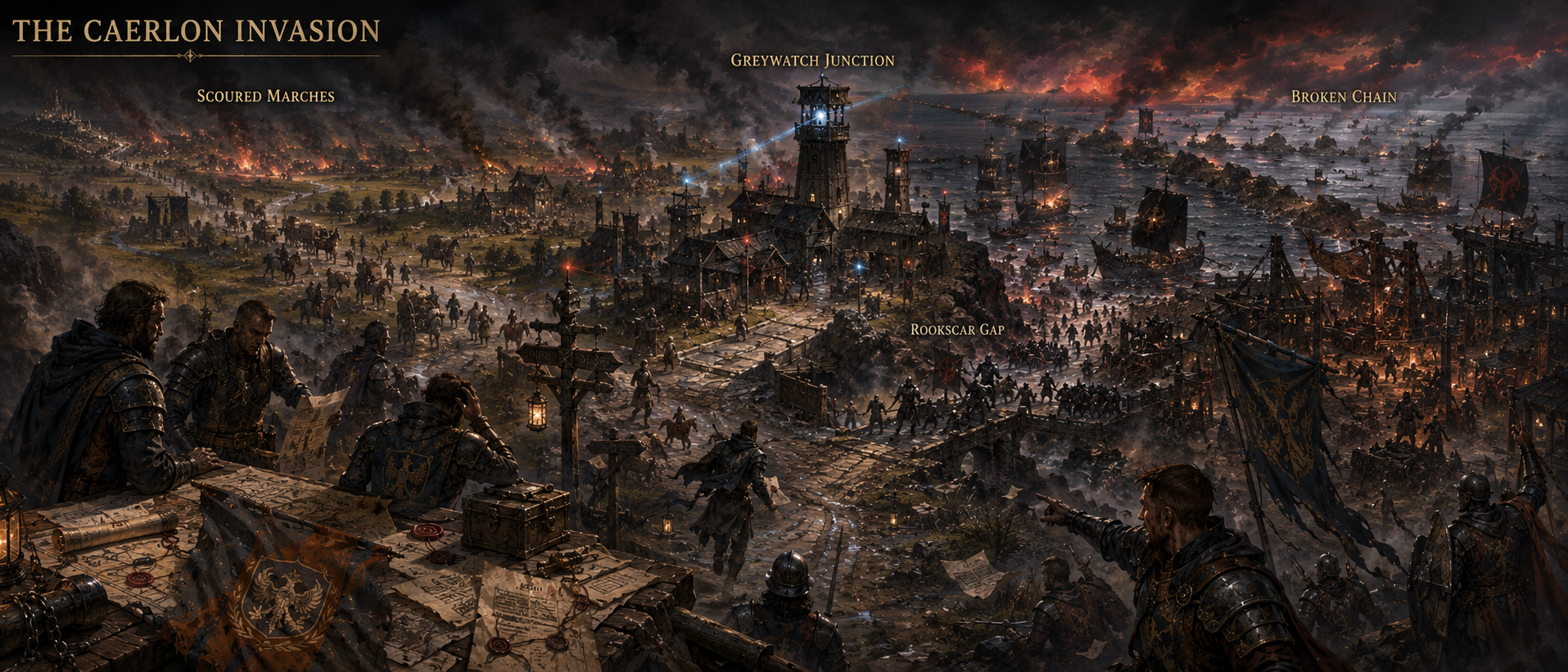
The Caerlon Invasion
The Caerlon invasion was the war that ended the Age of Crowns.
Vorrak did not conquer Caerlon, but conquest was not required to transform the world. The invasion destroyed cities, emptied districts, broke roads, scattered archives, created generations of displaced people, and proved that the major institutions of Thesalon could fail together. Caerlon survived through a resistance that drew upon local militias, crowns, assemblies, freeholds, foreign ships, temple relief, monster defectors, and communities that continued fighting after their recognized commanders were dead or missing.
The invasion succeeded at first because Caerlon’s defenses were deliberately opened from within.
A Crownward brigade assigned to the eastern approaches passed military surveys, signal procedures, reserve locations, patrol rotations, and mobilization delays to Vorrakian scouts. Its senior conspirators then falsified reports during the opening landings, allowing the invading forces to bypass Estenmark’s strongest positions and reach the interior road network before Crownward Seat understood that a continental invasion had begun.
This betrayal is remembered as the Opening of the Eastern Gate, although no single gate was opened. The name refers to the surrender of Caerlon’s military geography: its roads, timings, signals, bridges, depots, and assumptions.
The invasion did not remain successful. Vorrak’s Great Seats entered the war for different purposes and turned on one another when those purposes became incompatible. Caerlonian resistance hardened as local authorities stopped waiting for unified command. Foreign intervention increased. Vorrakian subject peoples sabotaged supply routes. Blackwood covenant-speakers withheld critical support. Red Waste route powers restricted reinforcement. A major Synod faction abandoned the final Crownward campaign to secure its own prisoners and spoils.
The invaders withdrew without achieving permanent continental rule, but the old order did not return. Caerlon’s crowns had survived without preserving the confidence that once sustained them. The political age that followed would be called the Crownless Age.
On This Page
- The War at a Glance
- Causes of the Invasion
- The Dread Synod War Agreement
- The Ashen Banner Betrayal
- The Opening of the Eastern Gate
- The First Landings
- The Fall of the Eastern Warning Line
- The War of Roads
- The Scouring of the Eastern Marches
- The Battle for the Heart Plains
- The Torinbridge Campaign
- The Crownward Encirclement
- Highharbor and the Western Lifeline
- The Silveredge and Verdant Campaigns
- Foreign Intervention
- Resistance Inside Vorrak’s War
- The Fracture of the Invasion Host
- The Retreat Across the Broken Chain
- The Cost of the War
- Surviving Battlefields and Ruins
- Prisoners, Missing Persons, and the Unreturned
- The Betrayal Investigations
- How the War Is Remembered
- What Most People Know
- Related Pages
The War at a Glance
The invasion was not one uninterrupted march from the Dread Sea to Crownward Seat. It developed through distinct phases in which different Vorrakian powers pursued different objectives.
| Phase | General character | Principal locations |
|---|---|---|
| The Hidden Crossing | Scouts, supplies, agents, forged records, and route surveys crossed the Broken Chain before open war | Broken Chain, Dread Sea Coast, eastern Estenmark |
| The Opening of the Eastern Gate | The Ashen Banner Brigade concealed the scale of the landings and redirected loyal forces | Greywatch Junction, Rookscar Heights, the Esten eastern roads |
| The First Landings | Dreadshore and Gaping Coast forces seized landing sites while Iron Tribute units opened supply roads | Dread Sea Coast, coastward Marches, lower Esten approaches |
| The War of Roads | Vorrakian forces attacked signals, bridges, depots, archive houses, and road junctions rather than every settlement | Estenmark, Scoured Marches, central road network |
| The Scouring | Maw Court war-hosts, Ashen engines, Grimspine troops, and Varkul corpse detachments devastated eastern Caerlon | eastern and middle Marches |
| The Continental Resistance | Heartplain grain, Torin crossings, Highharbor shipping, local militias, and foreign aid prevented a rapid collapse | Heart Plains, Torin Freeholds, Highharbor Coast |
| The Crownward Campaign | Several invasion hosts attempted to isolate Crownward Seat while pursuing incompatible war aims | Crownward roads, Elderidge approaches, central Caerlon |
| The Synod Fracture | Vorrakian courts abandoned joint strategy, fought over prisoners and spoils, and withheld reinforcement | central and eastern fronts |
| The Broken Chain Retreat | Surviving invasion forces withdrew eastward while Caerlonian and foreign forces pursued unevenly | Dread Sea Coast and Broken Chain |
The exact length of the war remains unsettled because regions use different definitions of its beginning and end. Estenmark dates the invasion from the first confirmed enemy landing. Crownward records begin with the declaration of continental emergency. The Torin Freeholds date their war from the first military demand placed upon the bridge. Highharbor dates the conflict from the first convoy loss. Some Marcher communities insist the war did not end when the main host withdrew because raids, missing-person seizures, and battlefield predation continued for years.
Causes of the Invasion
No single motive united the Vorrakian powers. The Dread Synod created cooperation among courts that expected different rewards and intended different endings.
The Maw Court of Kharzug-Maul sought food, captives, hunting prestige, and new tribute communities. The Hollow Crown of Varkul Neth-Kharn sought bodies, names, royal tokens, burial records, and legal possession of the dead. Drakkar-Grim sought military glory, strategic heights, fortresses, and proof that its war-hosts could defeat the western crowns. The Ashen Throneholds of Varkhûl-Ashak sought ore, tools, workshops, engineers, sealed knowledge, and opportunities to test Warglass and siege systems. The Iron Tribute Host of Urgath-Korr sought roads, depots, bridge rights, mobile tribute, and a permanent western route.
The outer powers had their own interests. The Dreadshore Eyries sought control of the Broken Chain and access to Caerlonian signal knowledge. The Gaping Coast Broods sought feeding territories, biological material, coastal lairs, and concessions from the Synod. Several lesser courts joined because refusal would have marked them as prey. Subject communities were compelled to provide labor, food, transport, scouts, or hostages.
Vorrak also faced internal pressure. Forge quotas had expanded beyond safe access to material. Tribute roads were producing rebellion. Some hunting domains could not support the claims made upon them. Varkul’s death-law authorities sought new fields of bodies and records. Synod leaders feared that, without an external campaign, the Great Seats would turn their full strength against one another.
Caerlon offered wealth, land, workshops, grain, archives, captives, and symbolic victory. It also appeared vulnerable. Its regional powers cooperated but resisted permanent centralized command. Its roads and records were extensive. Its eastern defenders had warned of invasion so often that new warnings could be interpreted as another demand for funding. Its foreign trade brought Vorrakian agents into contact with maps, cargo records, harbor procedures, and military suppliers.
These weaknesses alone would not have guaranteed success. Caerlon’s eastern defenses had been built for an attack from across the Dread Sea.
The betrayal told Vorrak how to pass through them.
The Dread Synod War Agreement
The formal agreement that enabled the invasion is usually called the Westward Synod Compact, although no complete authenticated copy is publicly available. It was likely negotiated through several meetings rather than signed in one ceremony.
The agreement did not create one commander over all Vorrakian forces. Each Great Seat retained authority over its own host, law, prisoners, and spoils. Joint action was managed through route schedules, target assignments, signal codes, hostage exchanges, and negotiated rights of first claim.
Vrassa Black-Tongue, the Synod diplomat associated with the earlier Synod of Closed Mouths, is generally credited with designing the coordination structure. She divided the invasion into obligations that could appeal to rival courts without requiring trust.
The Dreadshore Eyries would secure observation and staging sites along the Broken Chain. Gaping Coast pilots and brood-guides would identify landing waters and coastal approaches. Urgath-Korr would build and protect the supply road. Varkhûl-Ashak would provide siege engines, bridge equipment, Warglass devices, armor, and technical detachments. Drakkar-Grim would supply heavy assault forces. Kharzug-Maul would provide the largest mobile war-hosts. Varkul would manage the dead, prisoners designated by corpse or inheritance claim, and the recovery of royal and archival objects.
The compact’s central weakness was built into its design. Each court received its own claim, but no final authority existed to resolve what would happen when several courts claimed the same city, road, prisoner, archive, or battlefield.
That conflict would eventually break the invasion.
The Ashen Banner Betrayal
The Ashen Banner Brigade was a Crownward formation assigned to reinforce the eastern approaches between Estenmark and the central road system. Its name came from the grey-orange field of its banner, adopted decades earlier after the brigade helped contain a series of grain-store fires. The name had no original connection to the Ashen Throneholds of Vorrak, although the coincidence became infamous after the betrayal.
The brigade was not an obscure or disposable unit. It contained road engineers, signal officers, scouts, quartermasters, mounted messengers, bridge specialists, and infantry trained to support Estenmark during an eastern emergency. Its headquarters stood at Greywatch Junction, where the eastern military road divided toward Estenwatch, the coastward Marches, and the central Crownward route.
Its commander was Brigadier Cassian Veyr, a career officer from a lesser Crownward military family. Cassian had served in Estenmark, Crownward Seat, and the Hall of Seven Delegations. He understood the delays built into Caerlonian mobilization because he had helped write several of the procedures.
Cassian believed that Crownward intended to sacrifice eastern forces long enough to protect the royal heartland. Surviving letters show that this fear was genuine, but they do not prove it was accurate. He had become convinced that Estenmark and the eastern brigades would be ordered to hold until destroyed, after which Crownward would negotiate from a position of preserved strength.
Vorrakian agents reinforced that belief. They supplied Cassian with altered copies of Crownward contingency plans, forged correspondence suggesting that eastern evacuation routes would be closed, and testimony from officials who claimed the crown had already chosen which regions would be abandoned. Some of these documents were sophisticated forgeries. Others may have been genuine planning drafts stripped of their context.
Cassian’s motives were therefore mixed. He feared betrayal by Crownward, resented the Vaelor court, believed regional military officers deserved greater authority, and expected the Synod to recognize an autonomous eastern command after the invasion. Several conspirators were promised land, titles, protected families, or positions within a client government. At least two appear to have been paid through Maritheli financial intermediaries.
The senior conspiracy included:
- Colonel Maresa Dain, commander of the brigade’s road engineers;
- Signal-Major Oren Pell, custodian of emergency codes and tower rotations;
- Quartermaster Halvek Sorn, responsible for reserve depots and transport schedules;
- Captain Seral Venn, commander of the mounted reconnaissance companies;
- Archivist-Lieutenant Tessa Marr, who copied route surveys and mobilization tables;
- Chaplain Arel Vaelor, a distant royal relation who provided seals used to authenticate false orders.
The conspirators passed information through a chain of smugglers, foreign cargo agents, and Dreadshore scouts operating among the Broken Chain islands. Meetings took place at abandoned fisheries, private warehouses, and one Caerlonian signal station officially listed as storm-damaged.
The information delivered to Vorrak included the location of eastern depots, the capacity of bridges, signal schedules, reserve assembly points, patrol gaps, messenger relays, fallback roads, and the expected delay between an Estenmark warning and Crownward authorization of a general mobilization. Most importantly, the brigade revealed Rookscar Gap, an old quarry route considered unsuitable for a large army because its western bridge could not carry heavy engines.
Colonel Maresa Dain’s engineers supplied the exact reinforcement requirements needed to make the bridge usable. Ashen Thronehold components were prefabricated in Vorrak and transported through the Broken Chain before the invasion.
Not every officer or soldier in the Ashen Banner Brigade was part of the betrayal. Most believed they were preparing to defend Caerlon. Loyal officers were reassigned, isolated, sent on false patrols, arrested under fabricated charges, or killed during the opening hours. Entire companies fought without knowing that their senior command had compromised them.
This distinction remains important. Descendants of the brigade still face suspicion, even when their ancestors died resisting the conspirators.
The Opening of the Eastern Gate
The betrayal became operational during the three days preceding the first landings.
Signal-Major Oren Pell altered the eastern tower schedule and reported that several coastal stations were undergoing maintenance. Captain Seral Venn sent loyal scouts toward false landing sites. Quartermaster Halvek Sorn moved reserve animals and bridge wagons away from Greywatch Junction under the pretext of a flood-readiness exercise. Cassian Veyr ordered two Estenmark liaison teams detained after accusing them of carrying forged instructions.
On the night before the invasion, Ashen Banner engineers removed the locking bars from the western bridge at Rookscar Gap and replaced them with fittings compatible with the Vorrakian reinforcement frame. A Dreadshore team crossed ahead of the main force, killed the remaining loyal sentries, and raised a Caerlonian safe-road signal.
The first true warning reached Greywatch Junction before dawn. Brigadier Veyr classified it as an unconfirmed raid and transmitted a false report stating that the eastern line remained intact. He then ordered the brigade’s loyal reserve battalion south, away from Rookscar Gap, claiming that Gaping Coast raiders had landed near the lower Esten.
The false signal delayed Crownward’s general mobilization and prevented neighboring forces from understanding that they faced a coordinated continental operation. Estenmark responded locally, expecting reinforcements that had already been redirected.
By the time the deception was exposed, Dreadshore scouts held the signal heights, Iron Tribute units had crossed the strengthened bridge, and Ashen engineers were extending a supply road toward the interior.
The phrase Opening of the Eastern Gate was first used by Estenmark officer Captain Ysara Reedwatch, who escaped Greywatch Junction after discovering loyal signal personnel murdered beneath the tower. Her written accusation reached Estenwatch hours before she did.
She described no opened fortress gate. She wrote that the enemy had been given “every gate made from distance, schedule, trust, and road.”
The First Landings
The initial invasion came ashore at several points along the Dread Sea Coast and the coastward Marches. The landings were designed to appear disconnected.
Dreadshore assault groups seized signal towers and cliff paths. Gaping Coast forces entered estuaries, caves, and damaged harbor works. Iron Tribute troops secured roads and marked protected supply zones. Ashen engineers unloaded prefabricated bridge parts, siege equipment, Warglass assemblies, and furnace-treated road plates. Grimspine heavy troops landed later, once the routes could support them. Maw Court war-hosts followed in the greatest numbers.
The principal landing commander was Skarth Veyrak, a Dreadshore war-leader appointed to coordinate the coastal phase. His authority ended once the forces moved inland, but his signal system allowed separate landings to respond to one another without gathering in one vulnerable harbor.
Caerlonian coastal defenders fought several effective local actions. At Harrowlight Station, keeper Elis Venn destroyed the signal lens rather than allow it to be captured. At Merewatch Cove, a fishing militia under Toran Bellweather burned its own boats after evacuating civilians, denying the invaders immediate coastal transport. At Sablebank Landing, Estenmark marines held a stone customs house for two days and destroyed three Ashen unloading platforms.
These victories did not stop the invasion because they were not connected. False signals and damaged relays prevented commanders from knowing which positions remained friendly.
The invasion’s first major objective was not a city. It was the eastern communication network.
The Fall of the Eastern Warning Line
Estenmark’s warning system consisted of towers, river stations, mounted routes, road bells, and military archives. It had been built to identify an invasion early enough for Caerlon’s regional powers to mobilize.
The Ashen Banner betrayal allowed the invaders to attack the system from behind and with accurate knowledge of its procedures.
Dreadshore troops captured Rookscar Heights, the ridge from which several eastern signals could be seen. Instead of extinguishing the towers, they transmitted recognized Caerlonian patterns. False messages reported isolated raids, controlled withdrawals, and successful local defenses.
At Esten Ford Station, Varkul agents seized casualty rolls and personnel records before the building was burned. At Three-Bell Ridge, Ashen devices reproduced the sound pattern of an all-clear signal after the defenders had been killed. At Greywatch Junction, the brigade command continued transmitting false reports until Captain Ysara Reedwatch’s accusation reached Estenwatch.
Marshal Elian Esten ordered every eastern signal treated as compromised. This decision prevented further deception but also blinded the defense. Messengers had to travel physically between commands while invasion forces already occupied portions of the road.
The defensive battle at Greywatch Junction began when loyal Ashen Banner companies turned upon their own headquarters. Colonel Dessa Corven, who had been excluded from the conspiracy, led infantry into the signal compound and captured Signal-Major Oren Pell. Cassian Veyr escaped eastward with several conspirators under escort from an Iron Tribute detachment.
Greywatch was retaken, but the junction could not be held. Vorrakian forces approached along three roads, including Rookscar Gap. Colonel Corven ordered the archive vaults emptied and the bridge records burned before withdrawing west.
Greywatch Junction became the first major Caerlonian position abandoned during the invasion. Its ruins lie within the dangerous coastward Marches.
The War of Roads
The invasion advanced by controlling movement rather than occupying every settlement. Urgath-Korr’s commanders marked roads, wells, bridges, and depots with Iron Tribute protection signs. Communities that accepted a mark received temporary protection in exchange for food, labor, hostages, information, or passage rights. Communities that refused could be classified as unclaimed.
The principal Iron Tribute commander was Road-Lord Ghar Urgath, known in Caerlonian sources as the Chain Marshal. Ghar carried a mobile court that judged road disputes, assigned tribute, and recorded which Vorrakian host possessed the right to use each route.
The Ashen Throneholds supported the advance with road plates, portable bridges, siege ramps, heat-cutting tools, and Warglass instruments used to survey walls and foundations. Their chief engineer was Furnace-General Varkessa Sar, a niece or ritual descendant of the Cinder Regent. Varkessa’s teams avoided towns where possible and concentrated on the infrastructure that allowed Caerlonian forces to unite.
The first months of the war therefore became known as the War of Roads. Fighting centered on junctions, bridges, granaries, signal ridges, river landings, and archive houses.
At the Battle of Five Milestones, Estenmark troops held a junction long enough to evacuate three villages and remove the roadstones that identified the western route. The invaders responded by using copied Crownward surveys.
At Bellweather Ford, defenders rang the continuous evacuation signal until the bell tower collapsed. The settlement was destroyed, but most civilians escaped west. Survivors later founded or expanded New Bellweather, carrying the cracked warning bell with them.
At the Battle of Redbank Crossing, a local coalition destroyed the eastern span after the last refugee convoy passed. The action delayed an Iron Tribute column for four days and forced Ashen engineers to expose their bridging equipment to river archers.
At Pell Archive House, scribes scattered military records among ordinary land, inheritance, and grain documents before fleeing. The invaders seized thousands of pages but could not immediately distinguish current route information from records centuries out of date.
The war demonstrated both the strength and weakness of Caerlon’s archival culture. Detailed records helped defenders coordinate where archives remained secure. Captured records gave the invaders exact knowledge where they did not.
The Scouring of the Eastern Marches
The eastern territories suffered the greatest devastation. These lands later became the Scoured Marches, although the region is not uniformly ruined. Western portions have been rebuilt, the middle Marches remain politically contested, and the coastward Marches contain abandoned roads, monster-haunted sites, hidden settlements, invasion depots, and places never fully recovered.
The Scouring began when the Maw Court’s hosts entered the war in force. Their commander, Feast-Lord Kharzug Vorr, treated resistance as a challenge that increased the value of the prey. His forces attacked livestock, grain stores, fortified estates, refugee roads, and militia gatherings.
Drakkar-Grim troops under Drekar Stone-Wing seized ridges, towers, and walled heights. Ashen engines broke fortified crossings. Varkul detachments followed the battles, tagging bodies, copying names, removing royal insignia, and claiming remains under foreign death law.
The most notorious early destruction occurred at Hearthvale, a market settlement built around a road refuge. Its council attempted to negotiate protected status through Iron Tribute law. Ghar Urgath accepted the tribute, but Kharzug Vorr refused to recognize the road court’s right to deny a Maw Court hunt. The resulting dispute was resolved by allowing the Maw host to take people not listed under the tribute mark.
The road clerk responsible for the list, Mara Keslin, added hundreds of names during the night, including strangers and refugees. She was executed when the deception was discovered, but most of those named escaped. Hearthvale was burned.
The act became known as Keslin’s False Census and remains a symbol of how Vorrakian law could be manipulated to save lives without becoming just.
The Siege of Estenwatch
Estenwatch did not fall during the first campaign, but it was partially encircled. Marshal Elian Esten refused to abandon the fortress because its river position blocked direct access to the lower Esten and protected western evacuation.
The siege was led jointly by Drekar Stone-Wing and Furnace-General Varkessa Sar. Their alliance was unstable from the beginning. Drekar wanted a visible assault and the prestige of taking the fortress. Varkessa wanted to isolate it, test its walls, and preserve the workshops and archives.
Estenwatch’s defenders included regular troops, river crews, militia, Ashen Banner loyalists, and civilians trained to maintain the signal and water systems. Captain Ysara Reedwatch organized false tower lights to conceal the number of functioning defenses.
The siege lasted long enough for Heartplain and Torin forces to reinforce the western bank. It ended without the fortress being taken when the Vorrakian command redirected major forces toward the central roads.
Estenwatch survived, but the eastern districts outside its walls were destroyed. Its present authority and militarized culture derive directly from this siege.
The Long Withdrawal
Not every eastern settlement could be held. Estenmark commanders organized a phased retreat through prepared road stations. At each position, defenders evacuated civilians, removed food, destroyed bridge fittings, and left false route marks.
The retreat was led by General Maera Esten, sister of the marshal, and became known as the Long Withdrawal. Maera refused orders to preserve several noble estates when doing so would have trapped civilian columns. Her choices saved thousands but made her enemies among displaced landholders.
The Long Withdrawal preserved enough of the eastern army to continue fighting. It also created the first mass refugee movement toward the Heart Plains, Torin Freeholds, Crownward territory, and Highharbor Coast.
The Battle for the Heart Plains
The Heart Plains were essential to both sides. If the invaders seized the granaries, they could feed the invasion and deny food to the resistance. If the defenders preserved them, Caerlon could continue the war.
Speaker Mara Tallseed placed the Heartplain Assembly under emergency procedure but refused to surrender full control of the granaries to Crownward command. She argued that no army could be allowed to consume the seed reserves needed for the next planting.
The principal invasion force approaching the plains included Maw Court war-hosts and Iron Tribute units commanded by Feast-Lord Kharzug Vorr and Road-Lord Ghar Urgath. Their cooperation collapsed over whether captured grain belonged to the hunt or the road claim.
The first major engagement, the Battle of Six Keys, took place around the old granary district near the Heartplain Assembly Halls. The assembly divided its defenders into six commands, each responsible for one of the emergency keys required to open the central reserve.
Kharzug Vorr expected the defenders to concentrate around the granaries. Mara Tallseed instead ordered grain moved through farm roads in thousands of small carts. The central stores contained less than the invaders expected, while local militias flooded field channels and destroyed heavy-road access.
During the battle, Granary Warden Tessa Redsheaf refused a Crownward order to open the protected seed vault for military distribution. She was nearly arrested by royal officers before General Maera Esten intervened. The reserve remained closed until the assembly formally declared a continental famine emergency.
The Battle of Six Keys ended without a decisive military victory, but it denied the invaders the rapid capture of Heartplain food. The resistance continued receiving grain through dispersed local networks.
The Burned Furrow Campaign
Unable to seize the principal stores, Maw Court forces attacked fields, mills, livestock, and farming villages. The campaign became known as the Burned Furrow.
Heartplain defenders responded by moving animals west, hiding seed grain in burial fields and temple cellars, and organizing night attacks against foraging units. Local guides removed or reversed field markers. Children and elders carried messages through irrigation channels too narrow for mounted patrols.
The campaign devastated the eastern Heart Plains but failed to produce the famine the Synod expected. It also transformed the Heartplain Assembly from a regional agricultural authority into one of the most respected political institutions of the resistance.
The Torinbridge Campaign
Torinbridge controlled one of the principal crossings needed to move armies and refugees between eastern and western Caerlon. The Torin Freeholds had resisted permanent Crownward garrisons before the war, but the invasion made neutrality impossible.
Bridgewarden Jessa Vale declared the Emergency of the Open Span, allowing military transit while preserving Freehold authority over the bridge. Crownward officers could move troops, but they could not seize the towers, toll houses, ferries, or central platform without Freehold agreement.
The first invasion attempt came from an Iron Tribute force seeking the bridge intact. Road-Lord Ghar Urgath offered recognition of Freehold autonomy in exchange for passage. Jessa Vale refused, stating that an agreement made with an invading army could not preserve a public crossing.
The First Battle of Torinbridge took place on the eastern approach. Freehold defenders raised two sections of the bridge while Estenmark troops held the road. Ashen engineers attempted to anchor crossing cables from the riverbank. Torin boat crews cut the lines under fire.
The second attempt came from Varkul agents who entered among refugee columns carrying authentic Caerlonian death papers taken from the eastern archives. They sought the central platform’s registry rooms, which contained names, inheritance records, and transit lists. Clerk Orris Vale recognized inconsistencies in the burial seals and ordered the registry doors barred.
The Night of Closed Ledgers became a close battle within the bridge towers and record rooms. The agents were defeated, but portions of the refugee registry disappeared. Families still search for names removed that night.
The largest assault, the Battle of the Three Spans, occurred when Grimspine troops attacked the bridge while Gaping Coast swimmers and brood-creatures entered the river below. Jessa Vale ordered the eastern span destroyed, preserving the central and western sections for evacuation.
The destruction stopped the assault but severed one of Caerlon’s most important roads. Temporary ferries and military pontoons operated for the remainder of the war.
The Torin Freeholds emerged from the campaign with greater political legitimacy. They had defended the crossing without surrendering it to a crown.
The Crownward Encirclement
After failing to seize the Heartplain granaries and Torinbridge quickly, the invasion command attempted to isolate Crownward Seat. The objective was not shared equally. Drekar Stone-Wing wanted the prestige of taking the royal capital. Varkessa Sar wanted its archives and workshops. Varkul sought royal bodies, seals, succession records, and the Vaelor crown. Kharzug Vorr wanted a public submission feast. Urgath-Korr wanted the central roads.
King Alaric Vaelor declared the Continental Emergency and called every recognized Caerlonian power to provide troops, grain, transport, or defensive support. Several complied under their own command rather than accepting Crownward officers.
The capital’s outer defenses relied on the same roads that had made it powerful. As the invaders approached, Crownward officials closed selected routes, demolished bridges, and moved archives into dispersed vaults.
The Battle of the Seven Roads
The first major struggle for Crownward occurred where seven recognized approaches converged outside the central territory. The battle was not one engagement but a week of connected fighting.
Estenmark troops held the eastern road. Heartplain militias protected the grain route. Elderidge oath-companies defended the wooded northern approach. Verdant cavalry and household forces guarded the southwestern estates. Silveredge engineers fortified the stone road. Highharbor marines arrived along the western route. Crownward troops held the central approach to the Seat.
The resistance had no single field commander. King Alaric appointed General Seressa Vaelor, his cousin, to coordinate the roads, but regional commanders retained the right to withdraw if their own people were endangered.
Vorrakian commanders expected this divided structure to collapse. Instead, the defenders used it to continue fighting after individual roads were cut. Commands acted independently according to local knowledge while sharing messengers through the Hall of Seven Delegations.
The invasion won ground but failed to destroy the coalition.
The Assault on the Continental Archive
Varkul and Ashen detachments launched a targeted attack on the Crownward archive district. Their objective included the Continental Seal, resurrection records, dynastic genealogies, military surveys, and documents identifying hidden royal storage sites.
Archivist Merra Pell V ordered the oldest records moved into the foundations beneath the former Open Hall. Decoy chests were left in the upper vaults.
The attackers reached the Archive Court and removed thousands of records before being driven out. Some were genuine. Others were deliberate mixtures of outdated maps, false lineage claims, unresolved court cases, and copies altered to produce future legal disputes.
The archive attack remains one reason Caerlonian law is fragmented in the Crownless Age. Some original documents survive only in foreign or enemy collections.
The Death of King Alaric
King Alaric Vaelor died during the Crownward campaign, but the circumstances remain contested.
The official Crownward account states that he was killed when a Warglass projectile struck the western command gallery. Estenmark testimony claims he had already been wounded during an attempted evacuation of the Hall of Seven Delegations. A Varkul ledger lists him as “received alive, crown absent,” implying capture rather than battlefield death. No universally accepted body was recovered.
The Vaelor crown also disappeared.
The absence of a confirmed body, intact crown, and uncontested final order created the succession crisis that transformed the old Crownward state into the Crownward Remnant.
Several people have since claimed to possess Alaric’s remains, spirit testimony, final seal, or surviving heir. None has settled the question.
The Holding of Crownward Seat
The invaders entered outer districts but did not take the full administrative center. Crownward defenders, refugee militias, foreign volunteers, and surviving regional units held the archive foundations, central cisterns, and western road.
The most famous defense occurred at the Open Hall Steps, where General Seressa Vaelor, Heartplain officer Dessa Tallseed, and Elderidge oathkeeper Maren Renn organized a mixed force after their formal commands had broken apart.
The defenders swore no new royal oath. They pledged only to hold the steps until the civilians and archives below had been removed.
This oath became one of the earliest symbols of the Crownless Age: loyalty to a task and community rather than unquestioned loyalty to a crown.
Highharbor and the Western Lifeline
Highharbor became the principal maritime lifeline of the resistance. Ships carried grain, medicine, soldiers, refugees, foreign volunteers, tools, and messages between Caerlon and Marithel. The harbor also became the largest departure point for those fleeing the continent.
League Speaker Celara Varrow and Harbormaster Dessa Saltwatch placed the harbor under emergency convoy law. Merchant vessels could be requisitioned only through witnessed contracts. Refuge ships received priority over profitable cargo, but owners were promised compensation from future Crownward and League funds.
Many of those promises remain unpaid.
The Highharbor League organized the Western Lifeline Convoys, which sailed between Highharbor, Grainwake Harbor, Windrider Freeport, Selvarin, and other Maritheli ports. The convoys carried Suthrani grain and medicine, Veyrskoldic metal, Ilyrian remedies, and returning military volunteers.
The route was attacked by Dreadshore raiders, privateers operating under uncertain authority, and ships whose ownership changed repeatedly through debt and capture.
The Battle of Saltwatch Roads
A Vorrakian coastal force attempted to seize the approaches to Highharbor and cut the western road. Highharbor marines, League private ships, and local militia fought from the elevated warehouse district and the old refuge walls.
Captain Lena Varrow III ordered harbor cranes used to drop stone ballast into assault vessels entering the inner basin. The original Inner Refuge Wall sheltered civilian boats while fighting continued outside it.
The attackers were repelled, but several outer shipyards burned. Highharbor remained open throughout the war, although parts of the port operated under bombardment and quarantine.
Windrider and the Refugee Question
Windrider Freeport accepted large numbers of Caerlonian refugees under Blue Lantern guest law. Some arrived without papers. Others used temporary names because their families, creditors, political enemies, or Vorrakian captors were searching for them.
Freeport Speaker Galira Netmender refused demands that all refugees be transferred to Crownward representatives. She argued that the Crownward government could not guarantee their safety and no longer possessed uncontested authority over every Caerlonian abroad.
This decision preserved lives but created long-term identity disputes. Some refugees later returned under different names. Others remained in Marithel. Children separated from families were adopted, placed in temple care, or entered ship households.
The war permanently expanded the Caerlonian diaspora in Marithel.
The Silveredge and Verdant Campaigns
The Silveredge Holds and Verdant Principalities were not the first targets of the invasion, but both became strategically important as the war widened.
The Silveredge Refuge Roads
The holds provided metal, engineers, mountain refuge, and defensible routes. Hold-Marshal Dessa Kes opened the Law of the Warm Gate to war refugees while restricting Crownward attempts to take direct control of mines and fortifications.
Ashen Thronehold agents sought sealed chambers, rare ores, and ancient mountain works. Their principal operation targeted Kesward Deep, a mining and refuge complex above the western road.
Silveredge engineers collapsed the lower approach after evacuating civilians. The Ashen force entered through an older tunnel exposed by prewar excavation and reached a sealed chamber before being stopped.
The battle released another wave of shared dreams similar to those reported before the war. Soldiers from both sides described a road beneath the mountain and something striking a gate from below.
The chamber was resealed. Its current condition is classified by the Silveredge Holds.
The Verdant Estates
The Verdant Principalities provided cavalry, food, estate fortifications, and refuge. Their divided noble claims made unified command difficult, but local household forces knew the roads and terrain.
Princess Aelia Ellisar organized the Verdant Muster, requiring each principal house to contribute according to the population and stores it actually controlled rather than titles claimed through ancestry.
The most important fighting occurred at the Court of Returning Heirs, where a Vorrakian force attempted to seize resurrection judgments and noble genealogies. Varkul agents appeared especially interested in records concerning people who had died and returned.
The court building was defended by resurrected claimants and living successors who had spent years opposing one another. Their temporary alliance became known as the Second Return Company.
The documents survived, but portions were later stolen during evacuation.
Foreign Intervention
Caerlon did not resist alone. Foreign aid came from governments, temples, leagues, private fleets, healers, mercenaries, pilgrims, defectors, and volunteers. The intervention prevented total conquest but did not restore the old order.
Marithel
Marithel provided the fastest large-scale foreign response because Highharbor could be reached through established western routes. The League of Nine Harbors financed convoys, while Windrider Freeport received refugees and protected witnesses. Stormgate prioritized military and relief traffic. Farwake navigators used routes omitted from public charts to move people around raider patrols.
Maritheli involvement was divided. Some private fleets fought for Caerlon. Others attacked war shipping under contracts issued by competing authorities. Some merchants sold supplies to both sides. Debtwater lenders financed rescue voyages, military escorts, and opportunistic seizures through the same networks.
The most celebrated Maritheli commander was Admiral Elya Farwake III, who led the Nine-Light Convoy through a Dreadshore interception attempt. The convoy delivered grain, healers, and bridge fittings to Highharbor and evacuated civilians on its return.
The most controversial was Captain Vara Blackwake II, whose Tidebound fleet fought Vorrakian ships but also seized Caerlonian vessels carrying disputed debt. Vara claimed that war did not erase lawful contracts. Highharbor courts later classified several seizures as piracy.
Suthrane
Suthrane’s contribution centered on grain, healing, burial law, transport, and diplomatic coordination. The Anointed River Compact and Ivory Floodplain authorities released emergency grain despite concerns about their own reserves. The Grand Temple Concordance sent healers, funerary officials, resurrection reviewers, and sanctuary clerks.
High Custodian Mera Selen authorized the Procession Beyond the River, a temporary foreign mission empowered to perform burial, identify the dead, register missing people, and protect refugee sanctuaries.
Suthrani death officials clashed repeatedly with Varkul’s corpse claims. At the Field of White Cords, Morvane’s attendants marked Caerlonian dead for lawful burial before a Varkul recovery detachment could claim them. Fighting began when the Varkul commander declared the marks invalid outside Suthrani territory.
The Suthrani attendants refused to withdraw. Caerlonian militia and foreign volunteers defended the field until the bodies could be removed.
Veyrskold
Veyrskold’s intervention arrived slowly because of distance, season, and political disagreement. Its forces included escort ships, hold engineers, oathkeepers, seal specialists, and mercenary companies already serving abroad.
Sea-King Arven Hrafn sent the Northfire Escort, which protected later Western Lifeline convoys. Stonewake wardens examined Warglass and Ashen devices for connections to sealed northern dangers. Silveredge defenders valued Veyrskoldic engineers because they understood construction around ancient and unstable works.
Veyrskoldic oathkeeper Halla Var II witnessed emergency agreements among Crownward, Heartplain, Torin, Highharbor, and foreign authorities. Her records are now among the most trusted sources for the final campaigns.
Ilyr
Ilyr provided medicines, healers, ecological specialists, guides, and controlled material support. The Namarra Healing Network sent antidotes, infection treatments, pain relief, and recovery agents. The Thornward Marches increased border security to prevent the war from expanding southeast.
Ilyrian authorities refused requests for unrestricted access to medicinal species and complete maps of protected routes. Some Caerlonian officials accused them of withholding aid. Ilyrian stewards argued that destroying the source of medicine would not save Caerlon.
Healer Veyra Namar II organized the Green Relief Houses in Highharbor and Selvarin. These houses treated refugees and soldiers while recording the ecological and magical effects of Vorrakian weapons.
Ilyrian observers were among the first to identify that Warglass residue altered nearby plant behavior and could persist after a battle.
Resistance Inside Vorrak’s War
The invasion host included people who opposed the war, served under coercion, sought escape, or intended to sabotage particular courts.
Blackwood covenant-speakers withheld living timber and medicine from several Synod hosts. The Red Waste Kharruk restricted access to reinforcement routes. Subject laborers damaged supply wagons, spoiled food, falsified route marks, and passed information to Caerlonian patrols.
The Hidden Lantern Cells operated across the invasion route. Their members included subject-town clerks, prisoners, court interpreters, convoy workers, foreign smugglers, and monstrous individuals opposed to the Synod.
One important figure was Sera Nail-Eye, an Iron Table clerk who carried copies of supply schedules to Estenmark. She had participated in the invasion’s early logistics and was therefore both witness and collaborator. Her testimony exposed the location of three coastal depots, but many Caerlonians demanded her execution.
Marshal Elian Esten protected her under military witness status. She disappeared before the postwar tribunal.
Another was Ghoran Tide-Minder, a Gaping Coast brood mediator who refused orders to guide an assault into a civilian evacuation harbor. Ghoran redirected the attacking force into a tidal channel that grounded its vessels. Caerlonian sailors rescued him after his own brood marked him for death.
Blackwood speaker Yara Grathmora authorized covert medicine and route aid to subject deserters while continuing to refuse formal alliance with Caerlon. She argued that opposition to the Synod did not erase the Blackwood’s own grievances against foreign extraction.
These acts did not make the invasion less brutal. They prevented the war from being reduced to a simple division between everyone born in Vorrak and everyone born in Caerlon.
The Fracture of the Invasion Host
The invasion began to fail when its courts could no longer postpone their disputes over claims, supplies, prisoners, and final objectives.
The first major rupture concerned the Heartplain grain. Kharzug-Maul claimed food taken in battle under hunt and feast law. Urgath-Korr claimed the same grain because it had moved along roads protected by Iron Tribute marks. Ashen commanders demanded priority for siege forces. The dispute delayed distribution and led to fighting between allied units.
The second rupture concerned the Crownward archives. Varkul claimed genealogies, death records, royal tokens, and bodies. Varkhûl-Ashak claimed engineering records, magical research, and workshops. Drakkar-Grim demanded the Vaelor crown as proof of conquest. No court accepted another’s priority.
The third and decisive rupture occurred during the final Crownward campaign.
The Withdrawal of Varkul
Varkul’s forces abandoned a coordinated assault after securing a convoy of bodies, prisoners, royal objects, and archive chests. Their commander, Auditor Nethra Voss, declared that the Hollow Crown’s contracted objective had been fulfilled.
Drekar Stone-Wing accused Varkul of betraying the Synod. Varkul replied that Drakkar-Grim had failed to take the capital within the agreed campaign period.
The withdrawal opened a gap in the eastern encirclement and removed many of the specialists managing captured records and prisoners.
Vorrakian tradition remains divided over whether this was lawful withdrawal, cowardice, secret sabotage, or the decisive betrayal that prevented victory.
The Death of Feast-Lord Kharzug Vorr
Kharzug Vorr died during fighting west of Crownward Seat. Caerlonian accounts state that Heartplain archer Tessa Redsheaf II killed him from a granary roof. Maw Court traditions claim he was struck from behind by an Iron Tribute weapon during a dispute over captured food.
His death divided the Maw host into several claim groups. Some continued fighting. Others began carrying spoils and captives east.
The Breaking of the Ash Road
Caerlonian scouts, Hidden Lantern saboteurs, and Maritheli raiders attacked the principal invasion supply road leading back toward the Dread Sea. At Chainfall Ravine, Silveredge engineers destroyed an Ashen bridge while a convoy was crossing.
The loss trapped siege equipment west of the ravine and reduced the flow of furnace-treated replacement parts. Varkessa Sar ordered several engines destroyed rather than abandoned.
The Refusal at Rookscar
The Red Waste Kharruk closed one of the eastward reinforcement routes after the Synod attempted to place permanent Iron Tables on it. The Blackwood Covenants simultaneously blocked alternative forest supply paths.
The invasion hosts in Caerlon could still withdraw, but they could no longer expect unlimited reinforcement.
The Counteroffensive
General Seressa Vaelor, Marshal Elian Esten, Speaker Mara Tallseed, Bridgewarden Jessa Vale, and Highharbor Captain Lena Varrow III coordinated a broad counteroffensive without creating one permanent command.
Their agreement, witnessed by Halla Var II, assigned objectives rather than ranks. Estenmark would pressure the eastern roads. Heartplain forces would deny food and secure refugee routes. Torin units would restore crossings behind the advance. Highharbor and Maritheli ships would attack coastal supply. Crownward troops would hold the central districts and prevent renewed encirclement.
The arrangement reflected the political reality of the resistance. The powers could agree on what needed to be done without agreeing on who should rule afterward.
The Retreat Across the Broken Chain
The Vorrakian withdrawal was not one orderly retreat. Some forces left under negotiated passage. Some fought toward the coast. Some remained as isolated warbands. Some were abandoned by their courts. Some disappeared into the Scoured Marches.
Urgath-Korr attempted to preserve the road network and extract tribute from retreating allies. Drakkar-Grim forces held ridges to protect the movement of heavy troops. Dreadshore Eyries controlled embarkation signals. Gaping Coast forces evacuated through tidal caves and estuaries. Ashen units destroyed workshops and equipment they could not carry. Varkul convoys prioritized bodies, prisoners, names, and royal objects.
The principal Caerlonian pursuit reached the Dread Sea Coast after much of the main host had already crossed to Broken Chain staging islands. The resistance lacked the unified fleet required to destroy the retreat completely.
Maritheli and Highharbor vessels attacked several crossings, but Stormgate, League, freeport, and private-fleet authorities disagreed over command and lawful targets. Foreign governments also feared that pursuing the war into Vorrak would convert a successful defense into an open-ended invasion.
The Battle of Broken Chain Sound
The largest naval engagement of the withdrawal occurred in a channel among the western Broken Chain islands. Admiral Elya Farwake III led a mixed force of Highharbor, League, Veyrskoldic, and private vessels against a Dreadshore evacuation convoy.
The allied fleet destroyed several transports and recovered prisoners, but it failed to close the eastern exit. False lighthouse signals and unfamiliar brood-guided channels allowed many Vorrakian ships to escape.
Captain Vara Blackwake II broke formation to pursue a vessel believed to carry valuable prisoners or royal cargo. Her action opened a gap in the allied line. She later claimed that League signals had directed the pursuit.
No surviving authenticated signal record supports her claim.
The Last Eastern Road
Marshal Elian Esten stopped the pursuit at Rookscar Gap. Some commanders demanded an immediate crossing into the Broken Chain. Elian argued that Caerlon’s forces were exhausted, its supply system damaged, and its civilians still in danger.
His order became known as the Last Eastern Road Decision.
Critics accuse him of allowing Vorrak to escape and preserving the possibility of another invasion. Supporters argue that an advance into the Broken Chain would have stranded the resistance and extended the war into enemy-prepared waters.
The war ended without a formal peace treaty.
The Cost of the War
No complete casualty figure exists. Records were destroyed, populations moved, bodies were removed by Varkul, and some settlements disappeared without reliable counts.
The eastern and middle Marches suffered the greatest population loss. Estenmark survived but lost much of its outer settlement network. The Heart Plains preserved enough agriculture to prevent total famine, though eastern fields and villages were burned. Torinbridge was partially destroyed. Crownward Seat lost districts, archives, officials, and its uncontested royal succession. Highharbor lost ships, outer yards, and enormous sums in unpaid wartime obligations.
The invasion also changed who counted as missing. Some people were killed without identified remains. Some were taken to Vorrak. Some escaped under false names. Some joined foreign crews. Some were resurrected far from home. Some returned altered by captivity, magic, or time. Some refused to return because the communities they remembered no longer existed.
The war left large numbers of refugees and displaced households, unreturned prisoners, orphaned or separated children, disputed heirs, unpaid soldiers and shipowners, invalidated land claims, missing archive records, captured names and seals, monster-born people facing collective suspicion, foreign volunteers unable to prove service, collaborators whose level of coercion remains disputed, and loyal Ashen Banner families marked by the brigade’s crime.
The old political order could not address these problems through restoration alone.
Surviving Battlefields and Ruins
The invasion remains physically present across Caerlon. Many sites are active settlements, roads, courts, and military positions rather than abandoned memorials.
Greywatch Junction
Greywatch lies in the coastward Scoured Marches at the meeting of the former Esten military road, Rookscar route, and western Crownward road. The signal compound and brigade headquarters are ruined. Estenmark patrols maintain a watch post on the western edge but do not occupy the entire site.
The underground message vault has never been fully cleared. Searchers have found false orders, loyalist records, Vorrakian court marks, and bodies that cannot all be identified.
Rookscar Gap
The quarry route used to bypass the eastern defense remains physically passable but heavily controlled. The reinforced bridge was destroyed during the retreat, and later replacements follow a different alignment.
Ashen metal fittings remain embedded in the stone. Some react to Warglass or heat.
Three-Bell Ridge
The signal station where invaders transmitted a false all-clear is now an Estenmark memorial and active warning post. The three bells are never rung together except on the invasion anniversary.
Local accounts claim a fourth bell can sometimes be heard below the ridge.
Hearthvale
Hearthvale was rebuilt west of its original market. The burned refuge and tribute hall remain as ruins east of the modern road.
Visitors leave copied names in honor of Mara Keslin’s False Census. Estenmark authorities periodically remove false identities added by people seeking to use the memorial as legal evidence.
Bellweather Ford
The destroyed settlement’s old bridge foundations and collapsed bell tower remain beside the ford. New Bellweather lies farther west.
The cracked original bell is housed in New Bellweather’s public hall.
The Scoured Road
The principal invasion road through the eastern Marches remains a mixture of active road, abandoned sections, Iron Tribute plates, Ashen repairs, collapsed bridges, and unmarked military spurs.
The Marcher Concord controls some western stretches. Estenmark patrols others. Several coastward sections pass through territory with no reliable authority.
The Six-Key Granary Vault
The Heartplain central vault remains beneath the Assembly Halls. Its protected seed reserve is still governed by emergency key procedure.
Damage from the Battle of Six Keys is visible on the eastern walls.
Torinbridge
The modern bridge incorporates repaired prewar spans, temporary wartime structures, and later reconstruction. The central platform contains the memorial registry for those lost during the Night of Closed Ledgers.
The missing names remain a current legal and political issue.
The Open Hall Steps
The steps and lower archive foundations survived the Crownward fighting. They are used for public memorials, petitions, and political assemblies.
No royal banner is permanently displayed there.
The Empty Command Gallery
The western Crownward gallery where King Alaric was reportedly killed remains partially ruined. The Crownward Remnant has preserved the impact damage but restricts excavation.
Varkulian fragments found nearby suggest that a body was removed after the strike.
Chainfall Ravine
The destroyed Ashen bridge and convoy debris remain in the ravine. Salvagers search for Warglass, forge tools, military records, and sealed cargo.
Silveredge authorities classify the site as dangerous because some wrecked devices remain active.
Broken Chain Depots
Several invasion depots survive on islands between Caerlon and Vorrak. Their control changes among Dreadshore powers, smugglers, Caerlonian raiders, hidden communities, and forces that deny occupying them.
They contain route records, collapsed docks, prisoner chambers, supply marks, and evidence relevant to whether another invasion is being prepared.
Prisoners, Missing Persons, and the Unreturned
The prisoner crisis remains one of the clearest signs that the war never received a true settlement.
Vorrakian courts claimed prisoners under different laws. Maw Court captives might be tribute, prey, hostages, servants, or members of absorbed warbands. Varkul recorded some prisoners as legally dead while their bodies remained alive. Iron Tribute authorities assigned captives to road labor or protection debts. Ashen Throneholds took engineers, smiths, miners, mages, and laborers. Drakkar-Grim valued soldiers, scouts, and people familiar with fortifications.
Some captives escaped. Some were ransomed. Some entered subject communities. Some gained status within courts. Some had children. Some no longer possess documents proving their original identities. Others may not wish to return to Caerlonian communities that consider them compromised.
Caerlon’s official missing-person registries conflict with Varkul ledgers, Maritheli refugee manifests, Suthrani burial records, and Hidden Lantern testimony.
The Unreturned Offices in Crownward Seat, Estenwatch, Highharbor, Torinbridge, and Selvarin receive claims concerning missing soldiers, civilians, prisoners, heirs, and children. They also investigate people who return under disputed names.
The Hollow Crown continues to possess bodies, names, royal tokens, and legal records taken during the invasion. Its purpose remains unclear. Some believe Varkul intends to create claims over Caerlonian inheritance and rulership. Others believe the dead are being prepared as soldiers, witnesses, hostages, or components of a larger death-law project.
The Betrayal Investigations
The Ashen Banner betrayal was confirmed during the war, but the full conspiracy has never been established.
Signal-Major Oren Pell was captured alive at Greywatch Junction. He died before the first public tribunal after suffering what guards described as a seizure accompanied by black fluid in the mouth. His written confession named several conspirators but omitted Cassian Veyr.
Colonel Maresa Dain escaped with the retreating invasion force. Vorrakian sources disagree over her fate. One Ashen record lists a Caerlonian bridge engineer entering protected service. A Varkul ledger lists a Maresa Dain as legally dead but physically retained. A Hidden Lantern witness claims she was executed after refusing to design a second crossing.
Quartermaster Halvek Sorn was captured in the middle Marches. He admitted moving supplies and receiving foreign payment but claimed he believed the conspiracy intended only to force Crownward reform. He was executed after the war.
Captain Seral Venn disappeared during the first Greywatch fighting. Several later reports place him in the Dreadshore Eyries under a court-marked name.
Archivist-Lieutenant Tessa Marr surrendered to the Heartplain Assembly and provided copies of route exchanges, financial transfers, and false orders. She received protected witness status. Her testimony is sealed because it implicates Crownward officials, Maritheli lenders, and foreign intermediaries who remain politically powerful.
Chaplain Arel Vaelor died defending a refugee column after the betrayal. Whether this represented repentance, an attempt to silence witnesses, or proof that he never understood the full plan remains disputed.
Cassian Veyr was last reliably seen crossing Rookscar Gap under Iron Tribute protection. No confirmed body has been recovered.
Who Paid the Brigade?
Financial evidence points toward several channels rather than one patron. Payments passed through foreign cargo houses, distressed military contracts, Maritheli debt instruments, and Vorrakian tribute metal sold through intermediaries.
Debtwater Harbor records may contain the clearest account, but relevant ledgers are missing or privately held.
What Was Cassian Promised?
The most widely accepted interpretation is that Cassian expected to command an autonomous eastern client state after Crownward’s defeat. He may have believed the Synod would recognize Estenmark and the Marches as a protected military territory under his authority.
No Vorrakian court has admitted making such a promise.
Iron Tribute law contains forms of protected client command that resemble the arrangement described in Cassian’s private notes. It is equally possible that the promise was never intended to be honored.
Did Crownward Plan to Abandon the East?
No surviving approved plan orders the deliberate sacrifice of Estenmark or the eastern brigades. Several contingency drafts prioritize the defense of Crownward Seat, the Heartplain granaries, and the Torin crossings after loss of the coast.
The distinction matters. Military plans did consider the possibility that the eastern line could fail. Cassian treated that possibility as proof of deliberate betrayal.
The forgeries given to him transformed contingency into conspiracy.
Were More Brigades Involved?
No other complete brigade has been proven to have joined the betrayal. Individual officers, merchants, signal keepers, and officials outside the Ashen Banner did assist the invasion.
The continued search for collaborators has sometimes become a political weapon used to discredit rivals, refugees, monster-born communities, and regional authorities.
How the War Is Remembered
Caerlon does not possess one memory of the invasion.
The Crownward Remnant describes a continental defense led by the old institutions at terrible cost. Estenmark emphasizes ignored warnings, the Long Withdrawal, and eastern sacrifice. The Heartplain Assembly remembers the defense of food, seed, and local authority. The Torin Freeholds remember that an independent bridge defended the continent without surrendering itself to a crown. Highharbor remembers ships, refugees, unpaid contracts, and the western lifeline. The Verdant Principalities remember lost estates, resurrected claims, and the defense of inheritance records. The Silveredge Holds remember refuge, extraction pressure, and sealed dangers disturbed by both sides. The Marcher Concord remembers communities that survived after every distant authority had withdrawn.
Vorrak’s courts remember the war differently. Kharzug-Maul may describe a hunt denied its final feast. Varkul remembers a field of names, bodies, and unresolved death claims. Drakkar-Grim remembers lost victory and allied betrayal. Varkhûl-Ashak remembers weapons tested, workshops lost, and systems requiring improvement. Urgath-Korr remembers a road that nearly became permanent. Blackwood speakers remember broken covenants and a war that exported Vorrak’s internal sickness. Red Waste traditions remember an attempt to make temporary routes into chains.
Marithel remembers the war through convoy ledgers, refugee manifests, unpaid debt, false names, lost ships, and accusations that maritime profit enabled both invasion and resistance. Suthrane remembers grain releases, burial disputes, foreign sanctuary, and the Book of Unarrived Dead. Veyrskold remembers warnings that arrived before intervention. Ilyr remembers medicine sent, maps withheld, and evidence that wartime extraction could damage living systems far from the battlefield.
The invasion has become a source of political legitimacy. Nearly every modern Caerlonian power claims that its own conduct preserved the continent. Many of those claims are true.
None is complete.
What Most People Know
Most people know that Vorrak invaded Caerlon through the Broken Chain and that the Dread Synod coordinated powers that normally hated one another. They know that the invasion devastated eastern Caerlon, reached the central heartland, threatened Crownward Seat, and ended without a peace treaty.
They know that the Ashen Banner Brigade betrayed Caerlon by passing military information to Vorrakian scouts and falsifying reports during the opening attacks. They know that this betrayal allowed the invaders to bypass Estenmark’s strongest defenses and seize the eastern roads before Caerlon could mobilize.
They know that the resistance depended on more than crowns. Estenmark soldiers, Heartplain farmers, Torin bridge crews, Highharbor sailors, Silveredge engineers, Verdant households, Elderidge oath-companies, Marcher communities, foreign fleets, temple healers, and Vorrakian defectors all contributed.
They know that Vorrak withdrew because Caerlon resisted, foreign aid arrived, supply roads broke, and the invading courts turned against one another.
They also know that the war never truly settled its prisoners, missing people, stolen archives, royal succession, collaborator networks, or Broken Chain routes.
The invasion ended the Age of Crowns because Caerlon survived without proving that its crowns had been sufficient.