Appearance
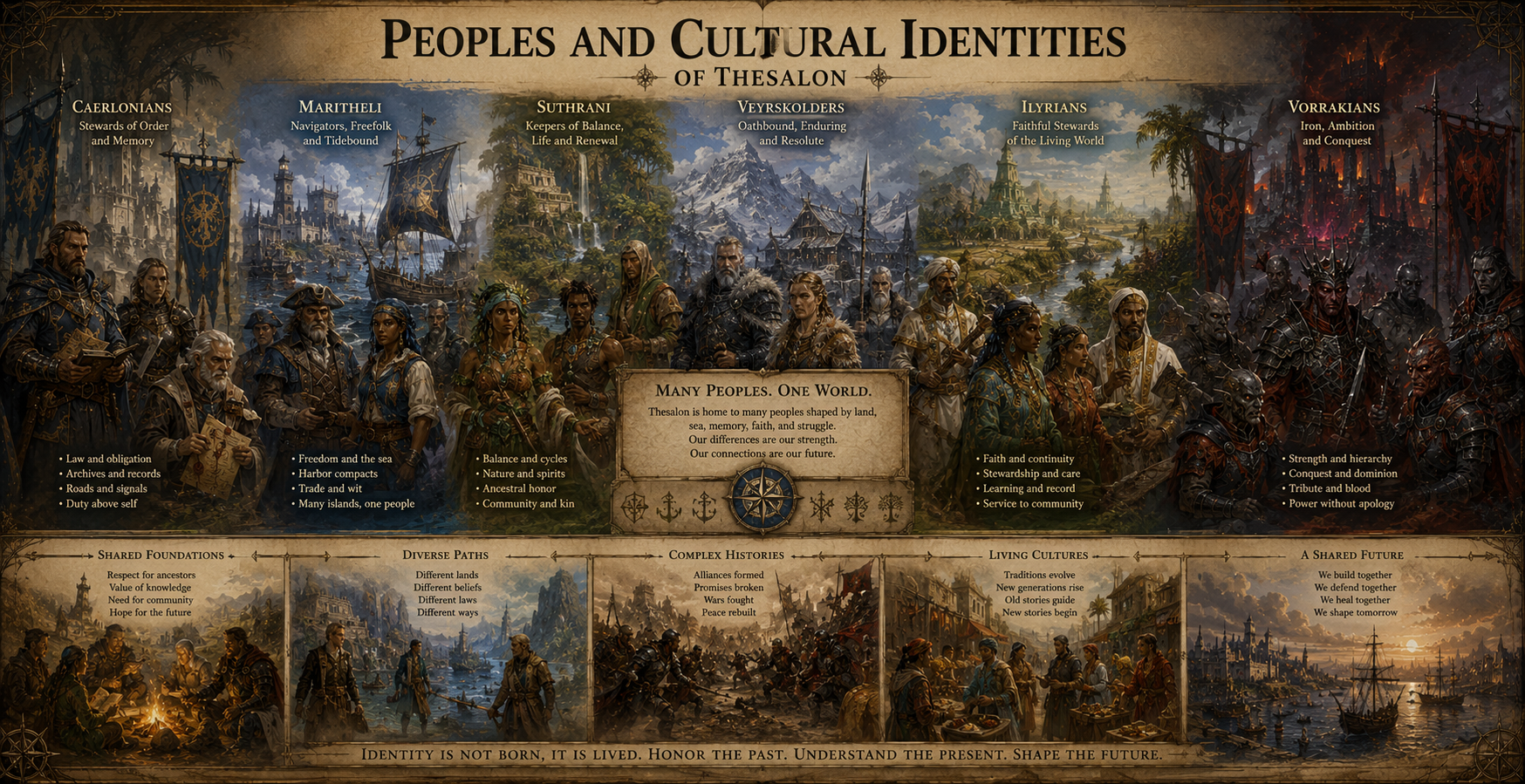
Peoples and Cultural Identity
The peoples of Thesalon are not defined by ancestry alone.
A people may form around a city, harbor, river, road, court, temple, ship, island group, mountain hold, military history, profession, stewardship obligation, migration, or shared experience. Some peoples possess recognized governments. Others exist across political borders or within several larger polities. Some are ancient. Others formed during the Caerlon invasion or the reconstruction that followed.
A person may belong to several cultural communities at once.
A sailor from Highharbor may also belong to a Maritheli ship household, a Caerlonian refugee family, a temple community, and a dwarven-founded dock quarter. An orc from West Hearthvale may identify as Marcher, Caerlonian, and a descendant of Vorrak-born defectors. A human raised on an Aeloran Guest Platform may consider an Ilyrian canopy community their primary home.
Culture is learned through participation. It includes language, food, family, work, public behavior, hospitality, law, faith, memory, celebration, mourning, seasonal labor, and expectations of mutual responsibility.
It is never perfectly uniform. Every culture contains internal disagreement, generational change, personal variation, political factions, and people who reject some customs while remaining part of the community.
Festivals and cultural inflection points make these identities visible. They include harvest celebrations, civic inspections, household reunions, mourning nights, road openings, oath renewals, signal tests, pilgrimages, market weeks, and seasonal duties. These observances are not decorative. They change travel, commerce, public authority, family expectations, and the availability of services.
On This Page
- Using This Directory
- Culture, People, and Political Authority
- Belonging to More Than One People
- Festivals and Cultural Inflection Points
- Caerlonian Peoples
- Vorrakian Peoples
- Suthrani Peoples
- Veyrskoldic Peoples
- Maritheli Peoples
- Ilyrian Peoples
- Selvarin and International Peoples
- Cross-Continental Cultural Communities
- Choosing a Cultural Origin
- Cultural Identity and Pathfinder 2e
- What Most People Know
- Related Pages
Using This Directory
Each cultural entry provides:
- Primary locations: where the culture is most established;
- Community basis: what holds the people together;
- Common ancestries: ancestries frequently represented without implying exclusivity;
- Languages: the kinds of languages or registers commonly learned;
- Everyday life: recurring work, responsibilities, and institutions;
- Values and obligations: what community membership tends to require;
- Internal divisions: important disagreements within the culture;
- Festivals and inflection points: recurring events that reveal how the culture operates;
- Character origins: player-facing ways to belong;
- Common misconceptions: inaccurate outsider assumptions.
These entries establish broad cultural foundations. Individual cities, villages, courts, islands, families, and households may differ.
Culture, People, and Political Authority
A cultural people and a polity can overlap without being identical.
The Torin Freeholds are a polity. Torin bridge households are a culture shaped by the crossing, public passage, evacuation, and civic independence. Not every person living under Freehold law belongs to an old bridge household, and Torin cultural communities exist outside the immediate bridge district.
The League of Nine Harbors is a political compact. Maritheli harbor peoples include League citizens, foreign residents, ship households, reef communities, workers, refugees, and people who reject League control.
The Blackwood Covenants possess political authority, but Blackwood peoples also include communities bound by local stewardship, medicine, refuge, spirit relationships, and resistance traditions.
A person may belong culturally without holding citizenship. A person may hold legal citizenship without adopting every local custom.
Belonging to More Than One People
Cultural membership may come through:
- birth;
- adoption;
- marriage;
- household membership;
- ship or caravan service;
- apprenticeship;
- military service;
- residence;
- pilgrimage;
- temple initiation;
- stewardship obligation;
- refuge;
- exile;
- shared reconstruction;
- deliberate personal choice;
- recognition by the community.
A character can claim several cultural origins. The useful question is not whether one identity is the “real” one. The useful questions are:
- Which community raised the character?
- Which community recognizes them?
- Which obligations do they still honor?
- Which customs do they practice?
- Which language feels most natural?
- Where do they expect hospitality?
- Where do others consider them an outsider?
- Which parts of their upbringing do they reject or seek to change?
- Which annual observances still draw them home?
Festivals and Cultural Inflection Points
A cultural inflection point is a recurring event during which ordinary expectations change.
It may be:
- a harvest or planting festival;
- a family gathering;
- a public mourning;
- a civic inspection;
- an oath renewal;
- a road, river, or harbor opening;
- a seasonal market;
- a religious observance;
- a remembrance of war, exile, rescue, or reconstruction;
- a community vote;
- a period of sanctuary;
- a public test of infrastructure.
During these events:
- courts may suspend ordinary cases;
- roads or harbors may close;
- family attendance may be expected;
- debts may be delayed or called in;
- strangers may receive temporary hospitality;
- public officials may be tested or replaced;
- names of the dead or missing may be read;
- communities may renew claims, alliances, and obligations.
The observances below are cultural rather than universally religious. Many invoke gods of the Thesalon pantheon, local saints, ancestors, civic institutions, or natural forces, but participation does not always imply worship.
Caerlonian Peoples
Caerlonian cultures were reshaped by invasion, regional defense, reconstruction, refugee return, and the failure to restore one uncontested crown.
Continent-Wide Caerlonian Observances
The Empty Seat Vigil
When: The last night before the Crownless Reckoning anniversary.
Across Caerlon, an empty chair, bench, saddle, work station, or place at table is left unused for the dead, missing, imprisoned, unreturned, and politically absent.
Crownward uses a carved ceremonial chair. Marcher communities often use an unfinished stool. Highharbor leaves an open berth or mooring. Heartplain villages leave one bowl unfilled.
No universal agreement exists over whether the empty place also represents the lost crown.
Seven Roads Remembrance
When: Early reconstruction season.
Communities inspect and walk major evacuation and supply routes. Roadside memorials are repaired, missing names are added, and blocked passages are reported.
The observance began as a practical inspection after the invasion and remains both memorial and civic duty.
First Key Turning
When: Before the first major seasonal release of protected seed.
Heartplain key-bearers publicly inspect locks, seals, grain quality, and witness rolls. Six symbolic keys are turned in sequence, even where modern reserve systems no longer use six literal keys.
Crownward Civic Households
Primary locations: Crownward Seat and Crownward-administered districts.
Community basis: public administration, archives, courts, civic service, diplomacy, and maintenance of the old capital.
Common ancestries: human, dwarf, elf, gnome, halfling, ratfolk, minotaur, fetchling, wayang, poppet, automaton, and mixed families.
Crownward civic households often define belonging through service to the city rather than support for restoration of the monarchy. Families may maintain archives, cisterns, courts, streets, public kitchens, hospitals, or diplomatic offices.
Hospitality is formal. A guest is introduced through household, office, or sponsor. Written requests carry weight, but public testimony remains important after the destruction of the archives.
Internal divisions include royalists, remnant constitutionalists, regional federalists, archivist reformers, and residents who believe Crownward should stop claiming continental primacy.
Festivals and Cultural Inflection Points
The Empty Seat Vigil
Crownward’s version is centered on the unoccupied royal seat and thousands of smaller empty places throughout the city. Royalists treat the ceremony as mourning for legitimate monarchy. Republicans and regionalists treat it as remembrance of everyone lost to failed authority.
Civic Lamps Night
Every public office places a lamp at its entrance and posts the names of the officials responsible for that service. Citizens may bring complaints without appointment. Offices that fail to open are publicly marked the following morning.
Character origins: archive clerk family, public-cistern household, diplomatic servant, court translator, reconstruction worker, mixed urban ward resident.
Common misconception: Every Crownward resident supports a restored Vaelor monarchy.
Crownward Archive Families
Primary locations: Continental Archive districts, Foreign Archive Rooms, Pell Archive House, and associated quarters.
Community basis: preservation, copying, authentication, recovery, translation, and protection of contradictory records.
Children often learn catalog marks, script comparison, document handling, and the distinction among originals, copies, extracts, translations, and later summaries.
Internal divisions concern public access, state secrecy, Tessa Marr’s testimony, the Vorrak Room, refugee privacy, and whether records should be returned to their communities of origin.
Festivals and Cultural Inflection Points
Night of Open Shelves
Once each year, selected nonrestricted collections remain open from sunset to dawn. Families donate copied letters, account books, recipes, maps, and household histories.
Public readers volunteer to assist those who cannot read. Political factions compete over which collections should be displayed.
Ash and Ink Morning
Archive workers clean soot, dust, mold, and insects from storage areas. The observance commemorates records saved during the invasion. No copying is performed until all hands have participated in preservation work.
Character origins: junior archivist, record recoverer, descendant of a family that hid documents, translator, expelled clerk.
Crownward Reconstruction Wards
Primary locations: damaged outer districts, worker housing, restored corridors, and foreign-funded neighborhoods.
Community basis: rebuilding, labor associations, mixed migrant settlement, and contested ownership.
Community life centers on shared tools, food halls, repair funds, neighborhood courts, and arguments over creditor ownership.
Festivals and Cultural Inflection Points
Wall-Raising Week
Neighborhoods select one unfinished public structure and complete as much of it as possible through shared labor. Musicians, cooks, childcare crews, and healers support the workers.
Foreign creditors sometimes attempt to claim completed buildings, turning the observance into a political confrontation.
First Roof Supper
When a rebuilt block becomes safely habitable, residents eat on the newest roof. The oldest surviving resident and youngest child divide the first loaf.
Character origins: mason’s child, foreign engineer’s descendant, ward organizer, reconstruction-debt heir, labor-company medic.
Estenmark Border Households
Primary locations: Estenwatch, eastern forts, restored roads, signal settlements, and Marcher approaches.
Community basis: frontier defense, evacuation planning, patrol service, and memory of ignored warnings.
Households maintain evacuation stores and know the nearest signal route. Preparedness is treated as a civic responsibility.
Festivals and Cultural Inflection Points
Signal Test Muster
Every tower, bell, fire basket, flag station, runner post, and road marker is tested in sequence. Families carry written confirmation from one station to the next.
False signals during the Muster are treated as serious crimes.
The Night of Unanswered Warnings
Names of scouts, villagers, clerks, and officers whose warnings were ignored before the invasion are read publicly. Reports dismissed by current authorities may be submitted anonymously during the observance.
Character origins: signal-tower family, patrol household, eastern refugee, military clerk, defector raised under protection.
Common misconception: Every Estenmarker is a soldier or supports expanded military rule.
Estenwatch Fortress Culture
Primary location: Estenwatch.
Community basis: siege memory, defense, supply discipline, engineering, and civilian–military interdependence.
Respect often follows competence rather than birth.
Festivals and Cultural Inflection Points
The Full Storehouse Inspection
Citizens inspect food, water, medicine, fire equipment, and evacuation routes. Children are taught where to report during an attack.
Broken Lance Day
Military rank is suspended for one communal meal. Veterans and civilians publicly name failures of command that should not be repeated.
Character origins: fortress artisan, officer cadet, siege-history guide, civilian quartermaster, Lantern House East resident.
Heartplain Granary Peoples
Primary locations: Heart Plains, protected seed districts, farming villages, and Assembly centers.
Community basis: food production, protected seed, irrigation, shared storage, seasonal labor, and famine responsibility.
The central principle is that harvest is personal labor but survival is a public obligation. Seed grain is treated differently from ordinary property.
Festivals and Cultural Inflection Points
First Key Turning
Reserve seals and protected seed are inspected before planting. Representatives of farmers, millers, villages, transport workers, and the Assembly witness the process.
The Long Table Harvest
After the principal harvest, villages place tables end to end through the main road. Each household contributes food according to means. Strangers may eat before local political speeches begin.
Empty Granary Day
Storehouses are deliberately cleared, cleaned, measured, and repaired. Hidden spoilage or false accounting discovered that day can remove an official from office.
Character origins: seed-vault family, irrigation worker, grain assessor, village defender, harvest crew, resettled refugee family.
Common misconception: Heartplain culture lacks political sophistication.
Six-Key Households
Primary locations: settlements linked to protected reserves.
Community basis: custody of emergency grain, public accountability, and resistance to unilateral seizure.
Festivals and Cultural Inflection Points
The Passing of the Keys
When a key-bearer dies, resigns, or is removed, the key passes through six witnesses before reaching the successor. Each witness publicly states one failure that would justify taking it back.
Character origins: former key-bearer’s child, reserve guard, audit clerk, exile after a disputed opening.
Valenic River and Freight Peoples
Primary locations: river towns, barge settlements, towpaths, and freight warehouses.
Community basis: river movement, cargo coordination, bridge schedules, and emergency transport.
Festivals and Cultural Inflection Points
First Barge Down
The first major freight barge of the season carries no private luxury cargo. It transports seed, tools, medicine, mail, and public records.
Rope-Cutting Evening
Old tow ropes are cut into lengths and distributed to households as reminders that every journey depends on many hands. Damaged rope is burned; sound rope is reused.
Character origins: barge household, towpath rider, warehouse clerk, river pilot, freight negotiator.
Torin Bridge Households
Primary locations: Torinbridge, ferry settlements, and bridge-maintenance villages.
Community basis: public passage, maintenance, toll law, refuge, evacuation, and civic independence.
Children learn traffic priority, flood warnings, emergency rope use, and crowd direction.
Festivals and Cultural Inflection Points
Open Span Day
Tolls are suspended for one day. Every section of the bridge is inspected, repaired, swept, and marked. Travelers cross carrying flowers, trade tokens, or names of people who never completed the journey.
The Closing Bell
A ceremonial closing is performed after dark to teach the lawful process for shutting the bridge during fire, flood, invasion, or structural danger. Unauthorized closure during the rest of the year is compared against this public standard.
Character origins: maintenance family, ferry household, Registry clerk, toll advocate, refugee descendant.
Common misconception: Torin independence means hostility toward outsiders.
Torin Freehold Civic Culture
Primary locations: Freehold council districts and associated towns.
Community basis: local authority, witnessed agreements, resistance to outside garrisons, and practical self-government.
Festivals and Cultural Inflection Points
Witness Market
Public agreements are renewed in an open market. Contracts, marriages, apprenticeships, militia obligations, and civic appointments can be witnessed without private court fees.
Chair-Turning Day
Council chairs are physically turned to face the public before officials answer questions. A chair left facing inward signifies refusal and may trigger a removal petition.
Character origins: council messenger, local advocate, bridge guard, public works organizer, anti-garrison activist.
Highharbor Dock Peoples
Primary locations: dock wards, repair yards, outer quays, warehouses, and marine districts.
Community basis: shipping, repair, cargo, convoy service, rescue, and waterfront labor.
Festivals and Cultural Inflection Points
The Hammered Hull
Repair crews strike the hulls of seaworthy vessels in sequence. Differences in sound reveal rot, loose fittings, and concealed damage. The night ends with communal food in the yards.
Convoy Names Day
Names of ships lost during the invasion and reconstruction are painted temporarily along the quays. No ship may obscure a name with cargo or advertising.
Dockhands’ Rest
One rotating day each year shuts most commercial loading. Emergency and relief cargo continues, but owners who force ordinary labor face public boycott.
Character origins: dockworker family, ship repair apprentice, harbor pilot, marine household, convoy survivor, cargo investigator.
Highharbor League Families
Primary locations: civic and merchant districts.
Community basis: convoy organization, harbor law, maritime finance, diplomacy, and western political identity.
Festivals and Cultural Inflection Points
Fleet Ledger Opening
Shipping houses publicly display selected accounts, losses, relief contributions, and outstanding claims. Critics argue that the records are curated to conceal predatory contracts.
Western Compact Supper
League families host representatives from docks, refugee wards, foreign houses, and inland roads. Seating order becomes a visible measure of political influence.
Character origins: minor merchant house, harbor official’s child, convoy planner, debt-court clerk, political dissident.
Harbor of Names Communities
Primary location: Highharbor refugee and identity-hearing districts.
Community basis: uncertain identity, temporary papers, legal advocacy, and mutual aid.
Festivals and Cultural Inflection Points
Many Names Night
Residents write every name they have used on separate strips of paper, cloth, shell, or wood. They keep, burn, bury, or publicly read each one according to personal choice.
Witness Table Week
Identity witnesses offer free public testimony for neighbors, former shipmates, adoptees, and returnees. False testimony discovered during the week carries severe social consequences.
Character origins: returnee, refugee descendant, identity witness, sanctuary advocate, person with a disputed original name.
Marcher Concord Peoples
Primary locations: West Hearthvale, New Bellweather, restored Marches, and militia-road communities.
Community basis: rebuilding, occupancy, local defense, refugee integration, and resistance to distant claims.
Marcher identity is earned through present participation. Rebuilding, maintaining roads, defending settlements, and recording the missing can carry more legitimacy than inherited title.
Festivals and Cultural Inflection Points
Bellweather Calling
Every settlement rings, strikes, lights, or otherwise activates its warning system. Each community then reports whether neighboring signals were heard.
Occupancy Fires
Households light fires in inhabited structures at dusk. Empty, disputed, unsafe, or claimed buildings remain dark and are recorded publicly.
The False Census Reading
Names omitted, falsified, or reassigned during wartime censuses are read beside current resident rolls. Property disputes often surface immediately afterward.
Character origins: rebuilt-town resident, militia family, refugee occupier, defector household, salvage worker, road judge.
Common misconception: Marchers reject all law or property.
West Hearthvale Civic Culture
Primary location: West Hearthvale.
Community basis: Concord politics, reconstruction law, public memory, and road-based governance.
Festivals and Cultural Inflection Points
Road Dust Assembly
Delegates enter the assembly without cleaning travel dust from boots, cloaks, wheels, or hooves. The practice signifies that authority comes from traveled roads rather than isolated halls.
The Unfinished Wall
One civic wall is deliberately left incomplete. Each year the community debates whether the Concord’s work remains unfinished and adds, removes, or leaves one stone.
Character origins: Concord clerk, memorial keeper, occupancy advocate, militia representative, road-court assistant.
New Bellweather Road Culture
Primary location: New Bellweather.
Community basis: evacuation, warning, road repair, public wells, and open exits.
Festivals and Cultural Inflection Points
Open Gate Morning
Every lawful exit is opened and inspected. Children walk the evacuation routes with elders.
The Bell Without a Rope
A damaged invasion-era bell is displayed without its rope. Residents strike it by hand while naming warnings that must never depend on one official.
Character origins: signal repairer, public-well keeper, road patrol, memorial family, registry clerk.
Coastward Hidden Communities
Primary locations: unmapped estates, caves, abandoned forts, forests, depots, and ruins.
Community basis: concealment, self-defense, distrust of registries, and hidden trade.
Festivals and Cultural Inflection Points
No-Lantern Night
No exterior light is shown. Residents test hidden paths, covered fires, watch rotations, and silent evacuation.
The Stranger’s Bowl
Once each year a meal is placed outside the settlement boundary for travelers who know the local sign. Some communities use it to identify allies; others use it as a trap.
Character origins: hidden scout, child sent outward, exile, mediator.
Silveredge Hold Peoples
Primary locations: Silveredge Mountains, mining settlements, pass communities, archive holds, and sealed works.
Community basis: controlled extraction, structural maintenance, refuge, pass safety, and containment.
Festivals and Cultural Inflection Points
Seal and Support Inspection
Mines, bridges, tunnels, archives, and sealed doors are inspected. Work stops until faults are repaired or formally accepted.
First Echo
Children and new residents strike designated walls and listen to the returning sound. Elders teach how stable, hollow, flooded, or dangerous stone differs.
The Closed Door Supper
Food is shared outside one sealed location. The community recounts why the site remains closed and records any argument for reopening it.
Character origins: pass warden, mine family, Quilldeep archivist, seal engineer, adopted foreign worker, closed-worksite survivor.
Common misconception: Silveredge secrecy exists only to control wealth.
Verdant Principalities
Primary locations: forest courts, garden estates, restored communities, and living succession jurisdictions.
Community basis: cultivation, continuity, resurrection law, stewardship, and negotiated succession.
Festivals and Cultural Inflection Points
The Living Claim
Heirs, officeholders, returned persons, and community representatives walk the estate or jurisdiction they claim to serve. Neglected land, households, or duties may be cited against them.
Grafting Week
Families exchange cuttings, recipes, apprentices, fosterlings, and sworn assistance. The symbolism emphasizes that continuity can come through deliberate joining rather than unbroken blood.
Returning Bloom
People restored from death, exile, transformation, or prolonged absence are publicly welcomed, but not automatically returned to previous office or property.
Character origins: court household, garden steward, returned-heir family, estate worker, succession assistant, fosterling.
Elderidge Oath Peoples
Primary locations: Elderidge Oathlands, roads, shrines, maintenance communities, and dispersed oath households.
Community basis: continuing promises, witness, inherited responsibility, and active maintenance.
Festivals and Cultural Inflection Points
Oath Renewal Walk
Participants travel the physical route, building, boundary, or community connected to an oath. Spoken renewal without inspection is considered incomplete.
Release Day
Impossible, unjust, or fulfilled oaths may be brought before witnesses for release. Families sometimes divide over whether release is mercy or dishonor.
Character origins: oathkeeper, shrine maintainer, witness family, person seeking release, traveling verifier.
Ashen Banner Descendant Communities
Primary locations: Crownward, Estenmark, Highharbor, Marches, and hidden family networks.
Community basis: shared stigma, disputed service records, mutual aid, and separation of loyal service from conspiracy.
Festivals and Cultural Inflection Points
The Unbroken Standard
Families display fragments, copies, or symbolic versions of banners associated with units proven loyal. Others refuse all military symbols.
Names Under Ash
Names of both traitors and loyal dead are written beneath ash. Participants wash away only those they believe should be remembered without condemnation, making the observance politically volatile.
Character origins: loyal veteran’s descendant, family using another surname, petition organizer, conspiracy investigator, denied officer.
Vorrak-Born Defector Communities in Caerlon
Primary locations: Lantern House East, Highharbor, West Hearthvale, Estenwatch, and protected settlements.
Community basis: asylum, translation, witness protection, court-law knowledge, and difficult integration.
Festivals and Cultural Inflection Points
Unmarked Table
No court symbols, rank marks, tribute signs, or military titles are allowed at the communal meal. Participants sit by arrival order.
Lantern East Night
Windows are lit facing east for people still trapped in Vorrak. Some families leave no light, fearing the signal exposes relatives.
Character origins: Hidden Lantern family, former court clerk, Gaping Coast defector, Lantern House resident, patrol interpreter.
Vorrakian Peoples
Vorrak contains many peoples divided among courts, subject communities, mobile societies, hidden settlements, and resistance networks. There is no single Vorrakian culture.
Maw Court Peoples
Primary locations: Kharzug-Maul and territories influenced by the Maw Court.
Community basis: feast hierarchy, hunting right, protection, challenge, tribute, and public provision.
Festivals and Cultural Inflection Points
Feast of Measured Hunger
Households, warbands, hunters, herders, and subject communities present food according to declared ability. A leader who demands more than the community can provide may be publicly challenged.
The Empty Platter Challenge
A claimant to leadership must feed a group chosen by rivals using only resources gathered or negotiated within a fixed period.
Character origins: hunt household, feast provisioner, protected subject family, challenger’s descendant, exile.
Common misconception: Maw Court people value uncontrolled violence.
Maw Court Subject Communities
Primary locations: farms, herding territories, quarries, and supply villages.
Community basis: negotiated survival, tribute, local production, and protection.
Festivals and Cultural Inflection Points
Tribute Counting
Communities count what was given, what was taken, and what protection was actually received. Secret copies of the records are often kept.
The Hidden Portion
Families reserve one portion of the harvest for local need before tribute collectors arrive. The practice may be lawful custom, covert resistance, or both.
Character origins: tribute village, herding family, mediator, escaped subject, seeker of protection.
Hollow Crown Court Culture
Primary locations: Varkul Neth-Kharn, sepulcher cities, registry houses, and death-law districts.
Community basis: names, death status, inheritance, body custody, testimony, and continuing obligations.
Festivals and Cultural Inflection Points
Counting of Unfinished Names
Names of people whose death, survival, captivity, resurrection, or inheritance remains unresolved are read aloud. Each name is followed by the current legal status and custodian.
The Quiet Procession
Living and undead residents walk separate routes that cross at designated points. The crossings represent obligations that death did not settle.
Black Seal Morning
Old death declarations are reviewed. A black seal may be broken if new evidence exists, but doing so can reopen marriages, debts, offices, and inheritances.
Character origins: registry family, mortuary worker, living subject, skeleton household, escaped claimant, forbidden archivist.
Common misconception: Everyone in Varkul is undead or worships death.
Varkul Registry Peoples
Primary locations: provincial registry towns and traveling record offices.
Community basis: legal classification, witness chains, inheritance, and body tracking.
Festivals and Cultural Inflection Points
Ledger Turning
The year’s closed death ledgers are turned face down. Unresolved volumes remain upright and visible.
Witness Fast
Registry workers abstain from speaking outside formal testimony for one day, emphasizing the danger of careless declarations.
Character origins: corpse auditor, courier, witness family, registry forger, haunted clerk.
Grimspine Fortress Peoples
Primary locations: Drakkar-Grim, high passes, cliff settlements, and fortress roads.
Community basis: defense, altitude, pass law, martial household, engineering, and dragon agreements.
Festivals and Cultural Inflection Points
First Gate Under Snow
The first gate sealed by winter is ceremonially closed, inspected, and assigned a relief crew.
Wing and Stone Muster
Cliff flyers, ground patrols, engineers, and dragon-linked representatives test coordinated defense. Rival houses compete openly.
Pass-Breath Feast
Travelers who survived the previous winter are invited to eat inside the fortress. Those who denied shelter may be publicly accused.
Character origins: fortress household, cliff scout, dragonet family, pass engineer, military exile, subject resident.
Grimspine Pass Communities
Primary locations: minor passes and remote high settlements.
Community basis: shelter, maintenance, avalanche knowledge, toll negotiation, and local independence.
Festivals and Cultural Inflection Points
Cairn Opening
Snow-covered route cairns are uncovered, repaired, and counted. Missing cairns may indicate avalanche, sabotage, or territorial movement.
Ashen Forge Peoples
Primary locations: Varkhûl-Ashak, Furnace-Crown settlements, forge roads, mining camps, and industrial towns.
Community basis: production, technical rank, furnace access, labor obligation, and dangerous innovation.
Festivals and Cultural Inflection Points
First Hammer of the Furnace Cycle
All furnaces are briefly extinguished except one central flame. The first new strike begins the production cycle.
Cooling Day
Production stops so channels, vents, slag pits, and worker injuries can be inspected. Furnace authorities frequently attempt to shorten the observance.
The Unnamed Tool
Workers place one unmarked tool at the furnace edge for laborers whose names were removed from records.
Character origins: forge worker, apprentice, Skill House escapee, Warglass laborer, saboteur, fugitive artisan.
Common misconception: Every Ashen worker supports military production.
Ashen Subject and Worker Communities
Primary locations: outer forge towns, mining routes, waste settlements, and barracks.
Community basis: labor crews, mutual protection, hidden repair, ration exchange, and resistance.
Festivals and Cultural Inflection Points
Cold Supper
Meals are eaten without using official furnace heat, demonstrating dependence on community rather than the forge authority.
Broken Measure Night
False quotas, altered weights, and impossible demands are recited and mocked through songs, masks, and improvised tools.
Iron Tribute Road Peoples
Primary locations: Urgath-Korr, road courts, fortified wells, depots, and caravan territories.
Community basis: movement, protection contracts, tribute, roads, portable authority, and witnessed exchange.
Festivals and Cultural Inflection Points
Walking of the Tables
Recognized Iron Tables are carried along their routes. Agreements are renewed at wells and junctions. Communities may refuse to host a table whose protections failed.
Wheel Mark Day
Road households repaint vehicle, animal, unit, and family marks. Forged marks are publicly burned.
Open Well Truce
Violence and debt seizure are suspended at designated wells. Breaking the truce can make a household unwelcome across several routes.
Character origins: road household, convoy guard, tribute clerk, well keeper, camp descendant, merchant.
Common misconception: Iron Tribute contracts are always voluntary.
Iron Table Families
Primary locations: administrative encampments and road junctions.
Community basis: record custody, route judgment, contract witness, and passage marks.
Festivals and Cultural Inflection Points
Iron Polishing
Tables are stripped of old wax, blood, paint, and seals. Every surviving inscription is copied before the surface is renewed.
Blackwood Covenant Peoples
Primary locations: Blackwood forests, boundary settlements, groves, medicine communities, and refuge networks.
Community basis: stewardship, protected routes, medicine, refuge, spirit relationships, and resistance to extraction.
Festivals and Cultural Inflection Points
Root-Bound Renewal
Covenants are renewed at living boundary trees or root halls. Participants state what they took, restored, protected, or failed to protect.
The Closed Path
One commonly used route is closed and allowed to recover. Travelers must use a longer route, reinforcing that convenience does not override stewardship.
Medicine Exchange
Healers share treatments, observations, and prepared remedies while keeping protected seeds and locations concealed.
Character origins: medicine household, boundary guide, refuge family, covenant witness, foreign negotiator, burned-grove survivor.
Common misconception: Blackwood peoples reject all settlement or trade.
Red Waste Kharruk
Primary locations: Red Waste routes, wells, mobile camps, seasonal settlements, and trade points.
Community basis: movement, well protection, route memory, livestock, portable property, and resistance to imposed roads.
Festivals and Cultural Inflection Points
Moving Ground Assembly
Camps converge without creating permanent foundations. Agreements last until the next Assembly unless explicitly renewed.
Well-Skin Renewal
Water skins, cistern linings, ropes, and well covers are repaired. Families exchange route information but omit protected paths.
The Road Refusal
A symbolic line is drawn across a proposed permanent road. Participants state what the road would claim, divide, or expose.
Character origins: mobile family, well keeper, route scout, caravan negotiator, displaced camp member, anti-road organizer.
Common misconception: The Kharruk wander without territory or law.
Dreadshore Eyrie Peoples
Primary locations: western cliffs, signal houses, naval camps, storm settlements, and island approaches.
Community basis: aerial watch, cliff access, signals, sea raiding, fishing, and controlled landing.
Festivals and Cultural Inflection Points
Wind-Flag Renewal
Signal cloths are replaced and old patterns reviewed. Communities sometimes alter a flag to reject Synod control.
The Lowest Flight
Experienced flyers descend to sea level and guide younger participants through dangerous crosswinds.
Silent Eyrie Night
No official signal is shown. Residents test whether alternate local warning systems still function.
Character origins: signal house, cliff fisher, naval family, defector community, lighthouse keeper, storm scout.
Gaping Coast Brood Peoples
Primary locations: tidal caves, mudflats, submerged settlements, estuaries, and changing coastlines.
Community basis: brood bonds, tidal territory, fishing, pilotage, feeding rights, and coastal survival.
Festivals and Cultural Inflection Points
Returning Tide Feast
Food is placed at several water levels so surface, amphibious, and fully aquatic participants can eat together.
Brood Naming
New members, adoptees, allies, and children are formally placed within a brood relationship. Biological kinship is not required.
Mudline Reckoning
Communities mark how far tides, erosion, and settlement boundaries moved during the year.
Character origins: tidal pilot, brood mediator, defector family, fisher, mixed undersea household.
Hidden Lantern Communities
Primary locations: scattered Vorrakian towns, Broken Chain refuges, Caerlonian asylum houses, and covert routes.
Community basis: resistance, hidden communication, prisoner aid, sabotage, escape, and evidence preservation.
Festivals and Cultural Inflection Points
Night Without Marks
Participants remove or cover court marks, uniforms, brands, and official symbols. Safe houses exchange lists of the missing.
The Small Flame Passing
A concealed flame or light passes between cells. Each cell adds one verified name, location, or warning.
Character origins: courier, safe-house family, former prisoner, code keeper, child raised after flight.
Prisoner-Descendant Communities in Vorrak
Primary locations: old road camps, Skill Houses, forge towns, estates, and hidden settlements.
Community basis: descent from captives, mixed identity, survival, inherited skills, and contested return.
Festivals and Cultural Inflection Points
The Names We Kept
Families recite names, words, recipes, prayers, and place descriptions preserved from older homelands. Accuracy is less important than continuity.
No Rescue Feast
Some communities commemorate ancestors who chose not to return or were never asked what they wanted. The observance is controversial among foreign recovery groups.
Character origins: Skill House descendant, road-camp family, hidden Caerlonian-speaking settlement, relative seeker, anti-rescue community member.
Suthrani Peoples
Suthrani cultures are shaped by rivers, temples, floodplains, caravan routes, sacred law, adoption, burial, pilgrimage, and layered authority.
Continent-Wide Suthrani Observances
Alamushti
When: After the first harvest of the season.
Decorated reed boats are released into rivers, canals, wells, irrigation channels, and coastal waters with the hope that they eventually reach the Anointed River.
Boats may carry:
- first grain;
- flowers;
- colored cord;
- written names;
- small lamps;
- prayers;
- messages to absent relatives.
Floodplain farmers place first grain inside. River households add names of absent kin. Temple communities attach petitions. Caravan families release boats at wells. Coastal families release them on an outgoing tide.
A trapped boat is retrieved, repaired, and released again. Deliberately blocking another community’s boats is a serious insult.
During Alamushti, river traffic slows, public meals are served, family disputes are heard, and children compete to build boats that travel farthest.
Concord of Bells
Major temples ring in a negotiated sequence representing different gods and jurisdictions. The pattern is revised whenever new temples are formally recognized.
White Cord Procession
Families of the missing, unreturned, and unburied carry white cords between temple, river, and cemetery sites.
Anuth-Selai River Court Peoples
Primary locations: Anuth-Selai and associated river jurisdictions.
Community basis: water law, public landing, flood responsibility, barges, arbitration, and river records.
Festivals and Cultural Inflection Points
Alamushti
Anuth-Selai hosts one of the largest reed-boat releases. Court petitions involving water are heard publicly during the festival.
Landing Stones Washing
Public landing stones are scrubbed, inspected, and re-marked. Merchants and temples compete over responsibility for repairs.
Upstream Testimony Day
Downstream communities present evidence about harm caused by upstream actions.
Character origins: water-court clerk, barge household, flood engineer, landing guard, river advocate, temple-raised resident.
Anointed River Households
Primary locations: river villages, canals, ferries, and flood-control communities.
Community basis: irrigation, fishing, ferrying, levees, seasonal movement, and household cooperation.
Festivals and Cultural Inflection Points
Alamushti
Families release boats bearing first grain and names of those living far downstream.
First Ferry Crossing
The first seasonal ferry passage is free. The ferry carries children, elders, seeds, letters, and one representative from each bank.
Levee Hands Day
Every able household contributes labor, food, tools, childcare, transport, or healing to levee maintenance.
Character origins: ferry family, canal worker, fisher household, levee crew, river healer.
Grand Temple Precinct Peoples
Primary locations: temple districts, sacred courts, pilgrimage centers, and residential wards.
Community basis: the Thesalon pantheon, sacred law, ritual service, pilgrimage, education, healing, burial, and sanctuary.
Festivals and Cultural Inflection Points
Concord of Bells
Temples ring in an agreed order. Disputes over sequence can indicate changes in prestige or recognition.
Open Courtyard Week
Temple courtyards remain open for public meals, minor healing, teaching, and petition. Restricted sanctums remain closed.
The Shared Incense
Each recognized temple contributes one ingredient to a common incense. Refusal signals serious theological or political conflict.
Character origins: temple household, ritual assistant, pilgrim guide, sanctuary clerk, healer, multitemple student.
Common misconception: All precinct residents share one theology.
Temple Adoption House Communities
Primary locations: Grand Temple Precincts, Anuth-Selai, pilgrimage roads, and diaspora networks.
Community basis: adoption, foster care, preservation of names, ritual kinship, education, and mutual support.
Festivals and Cultural Inflection Points
Two Births Reunion
Adults raised in adoption houses return, send messages, or designate representatives. Birth families, adoptive families, temple siblings, and chosen kin may all attend.
Name Ribbon Day
Children add, remove, or reorder ribbons bearing names, households, places, and affiliations they claim.
Character origins: House of Two Births child, temple sibling, adoption-record investigator, adult seeking original family.
White Cord Peoples
Primary locations: funerary landings, cemetery districts, and communities of the missing.
Community basis: unresolved death, unreturned relatives, burial without bodies, legal mourning, and testimony.
Festivals and Cultural Inflection Points
White Cord Procession
Cords are carried from household doors to river, temple, cemetery, or memorial. A returned person may cut, untie, keep, or replace the cord.
The Unfilled Vessel
An empty water vessel is placed at the family table for someone missing. Filling it signifies a legal or emotional declaration that the person has returned, died, or been released from expectation.
Character origins: funerary clerk, missing-person family, recovery pilgrim, legal mourner, returnee.
Ivory Floodplain Estate Peoples
Primary locations: estates, raised roads, granaries, levee districts, and agricultural courts.
Community basis: flood agriculture, levee maintenance, seasonal labor, grain obligation, and livestock protection.
Festivals and Cultural Inflection Points
Alamushti
Estate boats often carry the first grain. Tenant communities sometimes release separate boats to protest estate control.
Raised Road Fair
Livestock, tools, seed, food, contracts, and marriage negotiations gather along the flood-safe roads.
Silt Measuring
Communities measure deposited silt and adjust planting claims. Fraudulent measurements can provoke violence.
Character origins: estate household, levee worker, tenant family, grain clerk, flood patrol, refugee descendant.
Floodplain Village Peoples
Primary locations: smaller floodplain communities and river margins.
Community basis: shared boats, raised housing, flood markers, storage, and seasonal rebuilding.
Festivals and Cultural Inflection Points
House-Lifting Day
Homes, walkways, storage platforms, and animal shelters are raised or repaired before flood season.
The First Dry Step
After flood recession, the first reliable patch of dry ground becomes a communal gathering place.
Character origins: boat household, flood rescuer, seed keeper, raised-road scout.
New Ivrath Ford Communities
Primary location: New Ivrath Ford and related Caerlonian resettlements.
Community basis: refugee settlement, flood agriculture, mixed councils, and generational land claims.
Festivals and Cultural Inflection Points
Two Harvest Table
Caerlonian dry-field food and Suthrani floodplain food are served together. Families debate which traditions belong to the settlement.
Ford Founding Walk
Residents retrace the first refugee arrival route and end at the current council house.
Mereth-Kai Inner Sea Peoples
Primary locations: Mereth-Kai, ports, islands, fisheries, and undersea districts.
Community basis: maritime assembly, fishing, shipping, harbor law, naval service, and Inner Sea identity.
Festivals and Cultural Inflection Points
Net Blessing
Nets are repaired, washed, decorated, and inspected. Damaged or illegal nets are publicly cut.
Deep and Dry Assembly
One assembly session is held partly underwater and partly on land, with paired representatives and interpreters.
Lantern Fish Night
Small lights are carried on boats and beneath the water to mark spawning routes and remember drowned sailors.
Character origins: harbor household, sailor, undersea diplomat, fisher family, admiralty clerk.
Osseran Caravan Peoples
Primary locations: Osseran, desert wells, caravanserais, Sunroad towns, and mobile camps.
Community basis: route knowledge, water law, protection, hospitality, trade brokerage, and seasonal movement.
Festivals and Cultural Inflection Points
Nine-Well Market
Caravans converge and each recognized well sends water, news, and one dispute for public hearing.
Open Shade Day
Private awnings and courtyards become public shelter during peak heat.
Bell of Departure
A bell sounds before the largest caravan season. Missing travelers’ names are read before the first convoy leaves.
Character origins: caravan family, well keeper, broker, animal handler, performer, desert guide.
Sunroad Settlement Peoples
Primary locations: permanent communities along caravan routes.
Community basis: inns, repair, exchange, water storage, translation, and hosting strangers.
Festivals and Cultural Inflection Points
Road Dust Feast
Travelers contribute one item, story, song, recipe, or piece of news from another settlement.
Wheelwright Week
Wheels, harnesses, saddles, litters, and wagons are repaired before the main travel season.
Kharad-Sur Gate Peoples
Primary locations: Kharad-Sur, pass towns, toll houses, and guarded roads.
Community basis: gate law, mountain passage, engineering, tolls, shelter, and strategic control.
Festivals and Cultural Inflection Points
First Gate Opening
The principal pass opens after inspection. The first travelers cross without toll but must carry public mail or supplies.
Stone Account
Every collapse, repair, death, and closure is carved or added to the gate record.
Alternate Path Day
Independent guides demonstrate lesser routes, challenging Kharad-Sur’s monopoly.
Character origins: gate household, pass engineer, mountain guard, toll clerk, smuggler.
Sundered Mountain Communities
Primary locations: independent valleys, mining villages, shrine settlements, and alternate passes.
Community basis: autonomy, avalanche response, hidden routes, mining, herding, and resistance to gate monopolies.
Festivals and Cultural Inflection Points
Avalanche Silence
No hammering, bells, blasting, or loud ritual is permitted for one day while slopes are inspected.
Valley Exchange
Communities swap salt, tools, livestock, ore, marriage proposals, and warnings without passing through Kharad-Sur.
Salt-Crown Coastal Peoples
Primary locations: southern coasts, salt estates, maritime emirates, and markets.
Community basis: salt production, trade, hereditary courts, water management, and naval protection.
Festivals and Cultural Inflection Points
First Salt Cutting
The first crystallized salt is divided among workers, court, temple, and public kitchens.
White Road Procession
Salt carts travel through coastal settlements, leaving small portions for household preservation and blessing.
Wellspring Protectorate Peoples
Primary locations: sacred springs, protected water sources, and temple-managed settlements.
Community basis: preservation of water, restricted access, healing, irrigation, and sacred custody.
Festivals and Cultural Inflection Points
Clear Cup Day
Every household presents water for inspection. Contamination, theft, and false healing claims are investigated.
The Closed Spring
One spring is rested and closed to use, even if demand is high.
Sunveil March Peoples
Primary locations: exposed borderlands, caravan defenses, desert margins, and contested routes.
Community basis: patrol, settlement defense, heat survival, and mixed military–civil communities.
Festivals and Cultural Inflection Points
Veil Raising
Shade cloths, warning banners, and defensive screens are raised before the hottest and most dangerous season.
Border Meal
Patrols and civilians eat together at marked boundary posts.
Pilgrimage-Road Peoples
Primary locations: routes connecting temples, courts, burial grounds, and sacred sites.
Community basis: hospitality, guidance, healing, shrines, translation, and seasonal movement.
Festivals and Cultural Inflection Points
First Sandal
The year’s first major pilgrimage begins when a designated traveler steps onto the road carrying petitions from those unable to travel.
Roadside Saints Week
Shrines, markers, wells, and shelters dedicated to saints and local protectors are repaired.
Veyrskoldic Peoples
Veyrskoldic cultures are shaped by winter, refuge, holds, giant roads, dragons, geothermal resources, sea rescue, sealed ruins, and exact oath traditions.
Continent-Wide Veyrskoldic Observances
First Hearth Night
At the first dangerous cold, public hearths are lit and tested. Shelter obligations begin.
The Oars Returned
Sea-rescue communities display oars from lost, recovered, and retired vessels.
Red Thaw Remembrance
Communities remember deaths caused by sudden thaw, industrial heat, flood, collapse, and failed warning.
Skeldheim Hearth Peoples
Primary locations: Skeldheim and southern hearth-league settlements.
Community basis: winter shelter, shared food, road clearing, local defense, and public hearth obligation.
Festivals and Cultural Inflection Points
First Hearth Night
Public hearths open and no lawful resident or traveler may be denied emergency shelter without cause.
Ash Counting
Households count remaining fuel, preserved food, medicine, and repair materials. Concealed hoarding during declared emergency is publicly condemned.
Last Door Closed
Communities confirm which buildings remain occupied through winter and who is responsible for checking abandoned structures.
Character origins: hearth keeper, road clearer, quartermaster, trader, adopted foreign family.
Iceflow Hold Peoples
Primary locations: glacier valleys, ice rivers, seasonal crossings, and northern holds.
Community basis: ice movement, seasonal roads, fishing, hunting, structural maintenance, and winter storage.
Festivals and Cultural Inflection Points
Blue Crack Listening
Residents inspect and listen to glacier fractures. Work and travel plans are changed according to what is heard.
Moving House Day
Seasonal structures, storage, shrines, and walkways are relocated before the ice shifts.
Boreal Moot Peoples
Primary locations: assembly sites linking northern communities.
Community basis: gathering, dispute settlement, marriage networks, shared defense, and warning exchange.
Festivals and Cultural Inflection Points
Long Table Moot
Delegates eat at a table assembled from planks carried by each community. A missing plank signifies boycott, disaster, or political rupture.
Child of the North Naming
Children born since the last Moot are introduced to allied communities and entered into shared rescue and kinship records.
Stonewake Warden Peoples
Primary locations: Stonewake, seal stations, forbidden ruins, and specialist camps.
Community basis: containment, precision, maintenance, warning, and refusal to exploit dangerous sites.
Festivals and Cultural Inflection Points
Black Bell Renewal
Warning bells are removed, inspected, retuned, and returned. Each bell has a specific danger pattern.
Sealed Door Vigil
Wardens remain outside major sealed sites through the night, checking vibration, sound, temperature, light, and magical change.
The Unasked Question
Scholars publicly name one question they have chosen not to pursue because the risk is too great.
Character origins: seal warden, inscription reader, warning courier, recovered automaton, expelled scholar.
Common misconception: Stonewake withholds knowledge only for power.
Dromgard Giant-Road Peoples
Primary locations: Dromgard, giant roads, mixed settlements, bridge halls, and highland works.
Community basis: mortal–giant agreement, road maintenance, scale accommodation, burial, and defense.
Festivals and Cultural Inflection Points
Giant Step Gathering
Travelers follow a section of giant road together, with separate lanes and facilities for different body scales.
High Table Oath
Large and small representatives address one another from matched platforms. Neither side speaks from physically dominant height.
Stone Meal
Food is prepared in portions suited to several body sizes and served from one common hearth.
Character origins: mixed giant–mortal household, road engineer, interpreter, oath witness, large-body worker.
Shattered Spine Jarldom Peoples
Primary locations: mountain ridges, fortified valleys, clan halls, and high routes.
Community basis: local rulership, war leadership, inheritance, defense, and household alliance.
Festivals and Cultural Inflection Points
Spear in the Snow
Current leaders plant weapons or staffs into snow before answering public challenges.
Hall Roof Feast
Households repair the communal hall roof before succession and alliance negotiations begin.
Emberdeep Fireward Peoples
Primary locations: Emberdeep, geothermal works, forge districts, underground heat settlements, and Northfire Camp.
Community basis: controlled heat, ventilation, fire safety, mining, and technical work.
Festivals and Cultural Inflection Points
First Fireward Inspection
Vents, heat gates, pumps, alarms, and refuge chambers are tested.
Red Thaw Remembrance
Workers commemorate deaths caused by failed heat control, sudden melt, steam, flood, and collapse.
Shared Warmth Week
Waste heat is redirected to public baths, greenhouses, shelters, and clinics.
Character origins: forge household, vent technician, Northfire family, surki community, salvage crew, repair house.
Hrafnvik Rescue Peoples
Primary locations: Hrafnvik, nearby fjords, rescue stations, ship sheds, and the Oar Quarter.
Community basis: sea rescue, escort, winter navigation, ship repair, and memorialization.
Festivals and Cultural Inflection Points
The Oars Returned
Recovered oars are carried through the harbor. Oars from lost ships remain blackened; retired rescue oars are painted white.
Cold-Water Launch
Experienced rescuers enter the water or launch small craft under controlled conditions to train new crews.
Enemy Afloat Supper
Crews recount rescues of rivals, criminals, raiders, and enemies to reinforce that rescue precedes judgment.
Character origins: rescue crew, Oar Quarter family, convoy veteran, winter pilot, memorial keeper.
Pale Lantern Port Peoples
Primary locations: northern ports, lighthouse settlements, and seasonal harbors.
Community basis: warning lights, refuge, fishing, seal hunting, and dangerous trade.
Festivals and Cultural Inflection Points
Pale Lantern Lighting
Lamps use a distinctive low light intended to remain visible through snow and fog.
Last Ship Bell
The final scheduled vessel before winter closure rings once for each harbor it will not revisit until thaw.
Glacierwaste Warden Peoples
Primary locations: exposed ice regions, abandoned settlements, crevasses, and patrol camps.
Community basis: terrain monitoring, guidance, recovery, and access prevention.
Festivals and Cultural Inflection Points
White Marker Walk
Wardens replace route markers and remove those leading into newly unsafe areas.
Names Beneath Ice
Recovered remains and unrecovered dead are named at meltwater channels.
Wyrmwatch Communities
Primary locations: dragon territories, observatories, cliff settlements, and treaty halls.
Community basis: dragon agreements, sky warning, territory mediation, and long-term witness.
Festivals and Cultural Inflection Points
Sky Count
Communities record every known dragon, dragonet flight, unexplained shadow, and missing flock.
Scale and Seal Day
Treaty seals are compared against dragon scales, marks, or witnessed signs where such agreements exist.
Ruin-Camp Peoples
Primary locations: camps around ruins, sealed sites, excavations, and reconstruction projects.
Community basis: specialist labor, containment, salvage, shared risk, and temporary legal status.
Festivals and Cultural Inflection Points
Camp Founding Meal
Even temporary camps mark the anniversary of first occupation. Permanent residents use it to argue for formal recognition.
Tool Burial
Damaged tools associated with fatal accidents are buried or sealed rather than reused.
Maritheli Peoples
Maritheli cultures are shaped by island geography, harbors, sea routes, rescue, trade, ships, reefs, lighthouses, freeports, debt, hidden waters, and migration.
Continent-Wide Maritheli Observances
Saindha
When: One week each year.
Saindha is dedicated to Nymora and celebrates family continuity.
Every member of a recognized family or household is expected to visit the residence, vessel, estate, or gathering place of its eldest acknowledged woman for at least one day.
“Eldest” may mean oldest by age, household authority, adoptive seniority, ship command, or formal recognition as family keeper.
Guests bring bait worms. The offering represents the obligation to feed what feeds the household.
Alcohol and roasted goat are traditional. Aquatic and some island families replace goat with another large shared dish, but bait worms remain customary.
During Saindha:
- ships alter schedules;
- harbor traffic increases;
- family disputes are heard;
- marriages, adoptions, separations, and reconciliations are announced;
- names of people lost at sea are read;
- absent relatives send gifts or representatives;
- temporary ferries and worm markets fill the harbors.
Refusal to attend without explanation can be understood as rejection of the household.
Nine Lights Renewal
Major League lights are cleaned, tested, re-lensed, and relit in sequence.
First Safe Tide
Harbors formally declare the opening of a major travel or fishing season after pilot, weather, reef, and rescue inspection.
League Harbor Peoples
Primary locations: the nine major League harbors and dependent settlements.
Community basis: shared rescue, convoy, chart recognition, harbor law, defense, and commercial negotiation.
Festivals and Cultural Inflection Points
Nine Lights Renewal
Harbor delegations exchange flame, lens fragments, maintenance records, and signal confirmations.
League Mooring Day
Each harbor reserves public moorings for vessels from the other League members.
Saindha
League officials often adjourn or reduce business because family travel takes priority.
Whiteglass Lens and Pilot Peoples
Primary locations: Whiteglass Harbor, lighthouse islands, pilot stations, lens workshops, and navigation schools.
Community basis: light, visibility, pilotage, charts, glasswork, and signal integrity.
Festivals and Cultural Inflection Points
Nine Lights Renewal
Whiteglass performs the principal lens inspection and certifies signal clarity.
False Light Trial
Pilots identify deliberately misleading lamps, reflections, flags, and shoreline fires in a controlled exercise.
First Clear Beam
A newly completed lens is lit before the public. The maker must stand where the beam first strikes.
Character origins: lensmaker family, pilot household, lighthouse keeper, signal investigator, Lower Lens Ward resident.
Common misconception: Whiteglass values technical perfection over life.
Pearlglass Reef and Harbor Peoples
Primary locations: Pearlglass Harbor, submerged wards, reef approaches, and islands.
Community basis: surface–undersea exchange, pearl cultivation, reef law, pilotage, salvage, and water access.
Festivals and Cultural Inflection Points
Reef Bloom
Fishing and salvage are restricted while spawning, coral growth, and reef renewal are observed.
Two Waters Feast
Food is served in connected dry and submerged spaces. Surface and aquatic elders exchange household gifts.
Saindha
Aquatic families bring bait worms in carved shell, wet baskets, or living sand beds. Roasted goat may be replaced by large fish, eel, shellfish, or cultivated sea foods.
Character origins: Coral Ward household, pearl farm, broker, reef pilot, underwater court assistant.
Ropefall Shipyard Peoples
Primary locations: Ropefall Harbor, rope walks, sail lofts, timber yards, tar houses, and Three-Yard Houses.
Community basis: ship repair, rope, sail, timber, dock labor, apprenticeship, and mutual aid.
Festivals and Cultural Inflection Points
First Launch Feast
A new vessel is launched only after workers, suppliers, crew, and local children inspect it. Roasted meat, strong drink, bread, and tar-black cakes are served.
Ropewalk Race
Teams carry, twist, and lay ceremonial rope over a long marked lane.
Saindha
Shipyard schedules slow as workers travel to household elders. Yard crews without local family often attend the home of the eldest woman in the crew.
Character origins: rope family, sail apprentice, carpenter, Three-Yard resident, organizer, smuggler.
Grainwake Warehouse and Island Peoples
Primary locations: Grainwake Harbor, agricultural islands, storage districts, Caerlon Steps, and relief kitchens.
Community basis: grain storage, island farming, milling, public ovens, relief shipping, and food-contract law.
Festivals and Cultural Inflection Points
First Safe Tide
The first relief and grain convoy receives priority over luxury cargo.
Oven Street
Public ovens remain open continuously while families bake for Saindha travel, ship crews, refugees, and visiting kin.
Warehouse Door Day
Storage buildings are opened for inspection. Spoilage, false weights, and concealed reserves are publicly reported.
Character origins: farmer, warehouse clerk, Caerlon Steps family, relief worker, public-oven household.
Coinmast Merchant and Ledger Peoples
Primary locations: Coinmast Harbor, financial districts, counting houses, warehouses, and foreign quarters.
Community basis: credit, insurance, contract, investment, cargo ownership, banking, and reputation.
Festivals and Cultural Inflection Points
Closed Ledger Evening
Books are closed before Saindha, and no ordinary household debt may be collected during the central family meal.
Mast of Accounts
Colored ribbons representing profitable, failed, disputed, and charitable ventures are tied to a ceremonial mast.
Lost Cargo Auction
Recovered unclaimed goods are auctioned, with a portion reserved for families of missing sailors.
Character origins: counting house, Ledgerburrow family, insurance clerk, debt investigator, disinherited merchant.
Debtwater Contract Peoples
Primary locations: Debtwater Harbor, Passage Houses, creditor compounds, labor districts, and ship-finance wards.
Community basis: debt, passage financing, labor contracts, mutual aid, and resistance to coercion.
Festivals and Cultural Inflection Points
Chain-Loosening Day
Some debts are renegotiated, suspended, transferred, or publicly challenged. Creditors present themselves as merciful; advocates expose symbolic concessions.
Passage Meal
Travelers who arrived through financed passage eat with current debtors and explain what happened after departure.
Saindha
Family attendance can conflict with travel debt, labor obligations, or creditor restrictions, making the festival a major period of legal dispute.
Character origins: Passage House resident, contract clerk, debt advocate, escaped laborer, reforming creditor, smuggler.
Far-Treaty Diplomatic Peoples
Primary locations: Far-Treaty Harbor, envoy compounds, translation houses, guest districts, and treaty archives.
Community basis: diplomacy, multilingual households, protocol, neutral meeting, hostage exchange, and international law.
Festivals and Cultural Inflection Points
Table of Many Flags
Recognized delegations share a meal without precedence seating. Disputes arise over which flags deserve recognition.
Hostage Letters Day
Letters, gifts, and reports are exchanged for political hostages, wards, protected witnesses, and detained envoys.
Saindha
Foreign diplomats often misread which household elder has precedence, making the week politically sensitive.
Character origins: envoy household, interpreter family, archive assistant, diplomatic servant, multination child.
Stormgate Passage Peoples
Primary locations: Stormgate, fortified channels, chain stations, pilot houses, and military settlements.
Community basis: passage control, closure authority, defense, inspection, chain engineering, and storm navigation.
Festivals and Cultural Inflection Points
Chainfall Muster
The harbor chains are lowered, raised, inspected, and tested under emergency conditions.
First Safe Tide
Stormgate pilots declare whether major passages can reopen.
The Closed Channel Debate
Residents publicly argue one historic closure decision and whether it saved lives or abused authority.
Character origins: chain operator, pilot household, passage guard, naval clerk, alternate-channel smuggler.
Highfall Watch Peoples
Primary locations: Highfall, cliff towers, storm islands, warning stations, and defended lights.
Community basis: distant warning, storm observation, lighthouse defense, aerial access, and convoy protection.
Festivals and Cultural Inflection Points
Sky Lantern Descent
Lights are lowered from cliffs and towers to test vertical signaling.
First Storm Watch
Families and crews take assigned stations for the first major storm of the season.
Wreckwind Names
Names of ships last seen from Highfall are read into the prevailing wind.
Character origins: watch family, cliff courier, lighthouse defender, storm recorder, aerial rescuer.
Windrider Freeport Peoples
Primary locations: Windrider Freeport, open moorings, mixed wards, ship districts, markets, and sanctuary houses.
Community basis: guest law, open trade, temporary names, ship repair, multicultural residence, and resistance to outside seizure.
Festivals and Cultural Inflection Points
Open Mooring Week
Selected public moorings are available without ordinary fees. Ships host food, music, demonstrations, recruitment, and political meetings.
Saindha
Windrider recognizes ship elders, adoptive elders, sanctuary-house elders, and neighborhood family keepers. One person may owe visits to several households.
Free Name Morning
Residents may publicly adopt, restore, translate, or retire a name before neighborhood witnesses.
Character origins: Freeport-born resident, mixed market household, ship crew, sanctuary family, ward representative, foreign child raised locally.
Common misconception: Windrider has no law.
Blue Lantern Communities
Primary locations: Windrider, associated freeports, sanctuary ships, Low Lantern Refuge, and safe houses.
Community basis: refuge, evidence review, protection from removal, temporary identity, and legal advocacy.
Festivals and Cultural Inflection Points
Blue Lantern Vigil
Blue lamps remain lit through the night for people awaiting hearings, return, rescue, or recognition.
Sanctuary Table
Protected residents and advocates eat together without requiring disclosure of original name, ancestry, charge, or homeland.
Saindha
Residents without accessible family may attend the eldest recognized woman of a sanctuary house.
Character origins: advocate, protected resident, messenger, Low Lantern child, former investigator.
Saltglass Principality Peoples
Primary locations: principality islands, palace harbors, glassmaking centers, estates, and marriage-linked courts.
Community basis: island court, dowry, glass production, harbor investment, dynastic diplomacy, and patronage.
Festivals and Cultural Inflection Points
Mirror Marriage Season
Political, commercial, and family marriages are announced before polished salt-glass mirrors.
First Glass Pour
The season’s first major glasswork is poured publicly and dedicated to a household, harbor, temple, or political alliance.
Saindha
Dynastic disputes often emerge over which elder woman receives precedence across married households.
Character origins: minor court, glass artisan, estate worker, diplomatic marriage descendant, disfavored noble.
Drowned Reef Canton Peoples
Primary locations: reef settlements, submerged villages, small islands, salvage grounds, and wreck sites.
Community basis: reef law, collective salvage, graves at sea, fishing, coral cultivation, and resistance to outside claims.
Festivals and Cultural Inflection Points
Wrecknames Night
Names of people, ships, and communities lost beneath the water are spoken over marked wreck sites.
Reef Rest
Salvage and fishing cease within selected areas.
Saindha
Family visits may require coordinated travel between surface islands and underwater communities.
Character origins: reef council household, diver, coral farmer, wreck guardian, surface liaison.
Sirenward Peoples
Primary locations: exclusion-zone watches, quarantine harbors, recovery houses, patrol vessels, and relocated communities.
Community basis: restricted access, altered survivors, rescue, quarantine, memory loss, and protection from unknown dangers.
Festivals and Cultural Inflection Points
Silent Water Day
No vessel enters designated Sirenward waters. Patrols listen, observe, and record without active signal.
The Returned Voice
Survivors who lost, changed, or recovered speech may address the community through voice, sign, writing, music, or witness.
Boundary Renewal
Maps and physical markers are updated. Families displaced by new boundaries may protest or demand compensation.
Character origins: patrol family, altered survivor, quarantine worker, displaced islander, restricted researcher.
Farwake Navigator Peoples
Primary locations: Farwake households, hidden routes, navigation schools, mobile ships, and foreign ports.
Community basis: long-range navigation, concealed route knowledge, weather reading, convoy guidance, and independence.
Festivals and Cultural Inflection Points
Blank Chart Day
Apprentices receive blank charts and must reconstruct a known route from memory, testimony, instruments, and observed conditions.
Far Lantern Return
Navigators returning from long voyages light an unfamiliar-colored lantern before entering harbor, signaling that news or conditions have changed.
Character origins: apprentice, route-keeper family, convoy guide, defector courier, expelled map revealer.
Tidebound Fleet Peoples
Primary locations: private fleets, corsair harbors, ship settlements, and contract anchorages.
Community basis: command, private military contract, salvage, escort, raiding law, and crew shares.
Festivals and Cultural Inflection Points
Share Cutting
Profits, salvage, compensation, and debts are divided before the crew.
Empty Deck Muster
Every crew member must account for missing shipmates and abandoned posts.
Character origins: fleet household, prize clerk, private marine, deserter, ship-raised child.
Ship Household Peoples
Primary locations: vessels, harbor districts, floating settlements, and maritime diaspora routes.
Community basis: crew service, shared risk, maintenance, watches, food, adoption, and vessel identity.
Festivals and Cultural Inflection Points
Keel Birthday
The vessel’s launch date is observed as a household anniversary.
Saindha
The eldest recognized woman aboard may receive the household visit when land-based family is distant or absent.
Watch Exchange Feast
Crews exchange watches and duties so each person understands another role.
Character origins: shipborn character, adopted crew member, vessel-share heir, refugee-ship family, seeker of a lost vessel.
Lanternhold Monastic Peoples
Primary locations: Lanternhold monastery, lighthouse communities, gardens, guest houses, and associated isles.
Community basis: lightkeeping, study, spiritual discipline, rescue, gardening, and hospitality.
Festivals and Cultural Inflection Points
First Lamp Prayer
The first lamp lit after seasonal maintenance is dedicated to all travelers who will depend on it.
Garden of Small Offerings
Visitors bring seeds, bait worms, lamp oil, cuttings, paper, or useful tools rather than wealth.
Saindha
Monastics may return to birth or adoptive families, while those without living kin gather around the eldest woman of the monastery household.
Hidden Anchorage Peoples
Primary locations: secret coves, concealed islands, private anchorages, smuggler communities, and unrecognized settlements.
Community basis: concealment, route secrecy, independent trade, refuge, and resistance to formal harbor control.
Festivals and Cultural Inflection Points
Dark Harbor Week
No ordinary signal lights are shown. Entry depends on local pilotage and trusted codes.
The Unclaimed Anchor
An anchor without identifying mark is displayed for people who arrived without papers, ship, or recognized homeland.
Ilyrian Peoples
Ilyrian cultures are shaped by stewardship, living landscapes, canopy settlements, wetlands, plateaus, medicine, protected routes, and resistance to unrestricted extraction.
Continent-Wide Ilyrian Observances
Spring Witness
Communities inspect springs, roots, migrations, pollination, soil, nesting, and water flow before major seasonal use begins.
Stewardship Renewal
Custodians publicly account for what they protected, used, restricted, restored, or failed to maintain.
The Day of Closed Seeds
Protected seeds, specimens, and living materials are inventoried but not traded, planted, copied, or removed.
Aeloran Canopy Peoples
Primary locations: Aelora, canopy settlements, bridge networks, and forest platforms.
Community basis: living bridges, fire law, water collection, vertical movement, maintenance, and canopy stewardship.
Festivals and Cultural Inflection Points
Living Bridge Walk
Residents cross every principal bridge, inspecting growth, load, water, pests, and damage. Foreign guests may join only with sponsors.
Rain-Catch Opening
Water systems are cleaned before the main rains. The first collected water is shared publicly.
Fireless Night
Open flame is prohibited. Food is prepared beforehand or through protected magical and nonflame methods.
Character origins: bridge household, courier, water collector, fire warden, upper-platform resident, foreign child.
Common misconception: Aeloran life is unstructured.
Guest Platform Communities
Primary locations: designated Aeloran platforms and foreign-residence districts.
Community basis: adaptation, instruction, sponsorship, temporary residence, and petition for belonging.
Festivals and Cultural Inflection Points
Guest Platform Meal
Each resident prepares food from a former or claimed homeland using locally permitted ingredients.
Sponsor Day
Sponsors publicly account for those they introduced and whether they fulfilled obligations of instruction and protection.
Character origins: child of foreign settlers, sponsor household, denied petitioner, translator.
Saren-Tel Wetland Peoples
Primary locations: Saren-Tel, floating markets, channel villages, reed settlements, and flood routes.
Community basis: moving channels, fishing, boats, floating construction, flood boundaries, and navigation.
Festivals and Cultural Inflection Points
Turning of Channels
Communities update maps, markers, travel rights, fishing zones, and settlement access according to new water movement.
Reed House Raising
Floating and raised structures are repaired collectively.
Frog-Rain Market
The first major rain triggers a rapid market of food, medicine, boats, reeds, eggs, and seasonal goods.
Character origins: market household, channel guide, reed builder, fisher family, boundary mediator.
Emerald Plateau Peoples
Primary locations: Emerald Crown plateaus, terraces, spring settlements, grazing circuits, and forest ridges.
Community basis: spring protection, terrace agriculture, grazing, storm refuge, seasonal movement, and plateau stewardship.
Festivals and Cultural Inflection Points
Spring Witness
Springs are inspected before irrigation, grazing, and travel rights are renewed.
First Terrace Meal
The first harvested food from upper terraces is carried downhill and shared with lower settlements.
Storm Refuge Test
Shelters, signals, routes, and supplies are tested before severe weather season.
Character origins: terrace household, spring keeper, route family, refuge warden, plateau herder.
Namarra Healer Peoples
Primary locations: Namarra, medicine gardens, Recovery Houses, teaching compounds, and seed communities.
Community basis: healing, cultivation, quarantine, research, ethical exchange, and protection against extraction.
Festivals and Cultural Inflection Points
Closed Seed Day
Protected seeds and specimens are inventoried. No samples leave the community. Foreign requests are heard but not granted.
Recovery House Supper
Former patients, healers, gardeners, translators, and sponsors return or send reports about long-term outcomes.
Bitter Medicine Morning
Healers publicly discuss treatments that failed, caused harm, or were misunderstood.
Character origins: healer household, garden worker, patient, quarantine attendant, seed custodian, foreign apprentice.
Common misconception: Namarra withholds medicine from outsiders.
Root-and-Bowl Households
Primary locations: Namarra and related stewardship communities.
Community basis: plant-bodied personhood, body care, seed continuity, shared meals, and spiritual household life.
Festivals and Cultural Inflection Points
New Vessel Welcome
A leshy, ghoran, yaoguai, or other plant-bodied person entering a new body is welcomed without assuming the body restores previous legal status.
Bowl Passing
Households exchange soil, water, compost, cuttings, recipes, and care duties.
Mistwell Guide Peoples
Primary locations: Mistwell, boundary settlements, protected routes, waiting grounds, and hidden communities.
Community basis: licensed guidance, route secrecy, protected entry, concealment, and responsibility for travelers.
Festivals and Cultural Inflection Points
Guided Mist Opening
Selected routes reopen after guides inspect boundaries and conditions.
Waiting Ground Week
Travelers who cannot enter protected regions gather at designated grounds for trade, messages, hearings, and sponsorship.
Map Burning
Unauthorized or dangerously complete maps are publicly destroyed after useful warnings are copied.
Character origins: guide family, host, protected witness, map destroyer, adopted traveler.
Common misconception: Mistwell guides invent routes and prices.
Thornward March Peoples
Primary locations: western border regions, defended settlements, patrol routes, and communities affected by extraction.
Community basis: defense, route monitoring, ecological protection, patrol, and resistance to foreign seizure.
Festivals and Cultural Inflection Points
Thornline Muster
Patrols, farmers, stewards, scouts, and healers inspect the border together.
Extraction Ledger Reading
Communities publicly list what foreign expeditions removed, damaged, purchased, stole, or failed to return.
Empty Camp Burning
Abandoned extraction camps are dismantled or burned after dangerous materials are removed.
Character origins: patrol member, extraction survivor, border farmer, route scout, negotiator.
Riverroot Compact Peoples
Primary locations: forest rivers, root-supported settlements, inland ports, and stewardship communities.
Community basis: river health, root systems, fishing, boat movement, and living banks.
Festivals and Cultural Inflection Points
Root Sounding
Residents test living supports beneath docks, bridges, and homes.
Fish Passage Day
Barriers are opened or removed so migrating fish can pass.
Endless Fen Peoples
Primary locations: remote wetlands, seasonal settlements, floating communities, and protected breeding grounds.
Community basis: fen movement, amphibious life, observation, and resistance to drainage.
Festivals and Cultural Inflection Points
No-Fire Breeding Moon
Fire, loud work, and night travel are restricted during a major breeding period.
Floating Boundary Assembly
Communities meet on rafts and boats because no permanent ground is accepted as central.
Green Veil Protectorate Peoples
Primary locations: protected forests, refuge settlements, medicinal corridors, and guarded entrances.
Community basis: sanctuary, forest defense, restricted harvesting, and protection of vulnerable peoples or species.
Festivals and Cultural Inflection Points
Veil Closing
Selected routes close while vulnerable communities, animals, plants, or spirits recover.
Sanctuary Accounting
Protectors report who entered, who left, who remains hidden, and what threats increased.
Coast of Living Harbors Peoples
Primary locations: coastal settlements where reefs, mangroves, roots, or living structures form harbor infrastructure.
Community basis: harbor stewardship, fishing, living construction, healing, and aquatic negotiation.
Festivals and Cultural Inflection Points
Harbor Feeding
Communities supply nutrients, clean channels, remove harmful growth, and care for living harbor structures.
Root and Reef Assembly
Surface, coastal, and underwater representatives meet to set use limits.
Deepgrove Peoples
Primary locations: protected interior forests, subterranean root systems, ancient groves, and hidden settlements.
Community basis: isolation, old-growth stewardship, spirit relations, and restricted knowledge.
Festivals and Cultural Inflection Points
The Unentered Day
No outsider may enter, and residents limit movement to reduce disturbance.
Old Growth Naming
Newly recognized ancient trees, spirits, root systems, or living structures receive public names.
Mist-Touched Communities
Primary locations: thin places, altered settlements, shadowed or fey-touched regions, and sanctuaries.
Community basis: shared supernatural experience, unusual perception, and customs developed around instability.
Festivals and Cultural Inflection Points
Double Shadow Evening
Residents compare reflections, shadows, memories, and names to identify changes or replacements.
The Stable Meal
Food, seating, utensils, and participants are recorded before and after the meal to confirm continuity.
Living-Land Custodian Peoples
Primary locations: scattered throughout Ilyr.
Community basis: responsibility to a specific living place rather than one political center.
Festivals and Cultural Inflection Points
Stewardship Renewal
Custodians account for use, restoration, restriction, and failure. A place may reject a custodian through physical, spiritual, or communal signs.
Chosen Ground Day
New custodians are introduced to the land, community, spirits, and previous record.
Selvarin and International Peoples
Selvarin Envoy-House Peoples
Primary locations: diplomatic quarters, treaty halls, archives, and foreign residences.
Community basis: long-term diplomacy, multilingual education, protocol, treaty memory, and service between states.
Festivals and Cultural Inflection Points
Many Tables Week
Different treaty systems, seating customs, foods, languages, and forms of address are demonstrated publicly.
Neutral Door Day
Envoy houses open selected public rooms to petitioners from states with no formal representation.
Letters Home Night
Residents send or read messages to several claimed homelands, including places they have never visited.
Character origins: envoy-house child, protocol clerk, translator, mixed diplomatic household, courier, inherited-service dissident.
Selvarin Translator Peoples
Primary locations: language schools, court districts, harbor offices, and archives.
Community basis: interpretation, mediation, script knowledge, and professional neutrality.
Festivals and Cultural Inflection Points
Untranslated Hour
Public speeches are given without interpretation to demonstrate who is excluded when translation is absent.
Three Versions Reading
One document is read in original, literal translation, and practical interpretation, revealing differences.
Character origins: interpreter family, court translator, script specialist, disputed translation witness.
Neutral Merchant Communities
Primary locations: markets, bonded warehouses, foreign compounds, and shipping offices.
Community basis: cross-border trade, arbitration, credit, and trust among rivals.
Festivals and Cultural Inflection Points
Sealed Market Day
Goods are displayed with origin, owner, debt, and inspection seals visible.
Rival Coin Supper
Competing currencies are accepted at published rates for one evening.
International Legal Families
Primary locations: treaty courts, prisoner-exchange offices, resurrection registries, and claims institutions.
Community basis: comparison of legal systems, foreign evidence, identity disputes, and neutral procedure.
Festivals and Cultural Inflection Points
Case Without Country
A historic dispute is reheard without identifying the states involved, testing whether judgments change when political identity is concealed.
Witness Chain Day
Families and offices renew contact with trusted foreign witnesses, notaries, translators, and record custodians.
Governments and Courts in Exile
Primary locations: Selvarin, Windrider, Highharbor, Far-Treaty, and Suthrani sanctuary districts.
Community basis: displaced authority, preserved records, political campaigns, and claimed representation.
Festivals and Cultural Inflection Points
Absent Capital Day
Exile communities recreate a civic, court, religious, or household observance from the homeland.
Empty Audience
A ruler, council, or claimant receives petitions for territory they do not presently control.
Cross-Continental Cultural Communities
Broken Chain Warden Peoples
Primary locations: watch posts, patrol ships, fortified islands, salvage stations, and recovery routes.
Community basis: monitoring, rescue, containment, route control, and uneasy multinational cooperation.
Festivals and Cultural Inflection Points
Chain Watch Renewal
Stations confirm signals, supplies, escape routes, and current threats.
No Flag Meal
Wardens eat without national or factional banners to emphasize shared duty.
Dread Sea Patrol Peoples
Primary locations: patrol vessels, convoy stations, and dangerous sea routes.
Community basis: anti-raiding patrol, rescue, escort, and temporary multinational command.
Festivals and Cultural Inflection Points
Convoy Joining
Vessels from several powers form a ceremonial convoy and practice shared signals.
The Rescued Enemy
Crews recount cases where political enemies were saved at sea.
Pilgrim Roads Peoples
Primary locations: routes crossing several continents and temple jurisdictions.
Community basis: pilgrimage service, hospitality, sacred translation, burial, and memory.
Festivals and Cultural Inflection Points
Dust and Water Exchange
Pilgrims carry soil, dust, water, ash, or salt between sacred places.
Last Mile Walk
Local residents accompany exhausted pilgrims for the final portion of a route.
Farwake Chart Communities
Primary locations: ships, route schools, protected chart houses, and foreign ports.
Community basis: navigation and controlled route knowledge.
Festivals and Cultural Inflection Points
Blank Chart Day
Navigators reconstruct routes from memory and current conditions.
Missing Mark Review
Unverified, dangerous, outdated, or politically sensitive marks are debated.
Ashen Prisoner-Exchange Communities
Primary locations: negotiation ports, holding houses, legal offices, and family-support networks.
Community basis: identification, exchange, ransom, recovery, and testimony.
Festivals and Cultural Inflection Points
Returned Cup
A person returned from captivity drinks first from a household cup but chooses whether to keep, break, or replace it.
Unmatched Names Day
Names that appear on only one side of prisoner records are read publicly.
Quiet Mapkeeper Peoples
Primary locations: hidden archives, route communities, stewardship centers, and neutral institutions.
Community basis: preserving maps without unrestricted publication.
Festivals and Cultural Inflection Points
Covered Map Assembly
Maps remain veiled while keepers discuss who may see each layer.
Route Erasure
Dangerous or compromised information is removed from public copies but preserved in restricted records.
Resurrection Registry Peoples
Primary locations: Suthrane, Verdant courts, Crownward, Selvarin, and major temples.
Community basis: recording death, return, identity continuity, inheritance, and disputed resurrection.
Festivals and Cultural Inflection Points
Returning Bloom
Returned people are welcomed without automatic restoration of prior legal status.
Double Signature Day
Living witnesses and returned persons review earlier signatures, seals, and testimony.
Gate-Seal Custodian Peoples
Primary locations: Veyrskold, Silveredge, Kharad-Sur, Crownward ruins, and planar sites.
Community basis: containment, access law, record custody, and prevention of dangerous opening.
Festivals and Cultural Inflection Points
Seal Renewal
Every seal is inspected, copied, witnessed, and tested.
Key Refusal
Custodians publicly name a door, vault, gate, or route they refuse to open despite political pressure.
Maritime Refuge Peoples
Primary locations: sanctuary ships, Windrider, Highharbor, Grainwake, Hrafnvik, and mobile households.
Community basis: displacement, ship life, mutual aid, temporary names, and uncertain return.
Festivals and Cultural Inflection Points
Floating Hearth Night
Boats and ships gather around shared food, light, music, and news.
Shore Choice Day
Families discuss whether to remain mobile, settle, return, or divide.
War-Camp Descendant Peoples
Primary locations: Caerlon, Vorrak, Marithel, Veyrskold, and former military routes.
Community basis: descent from prisoners, workers, soldiers, camp followers, refugees, and specialists.
Festivals and Cultural Inflection Points
Camp Street Supper
Communities recreate the arrangement of an old camp while replacing guard posts with food, music, childcare, and memorials.
Mixed Roll Reading
Names are read in every language preserved by the community.
Temple Adoption Networks
Primary locations: Suthrane and diaspora communities across every continent.
Community basis: ritual kinship, adoption records, education, mutual aid, and preservation of identities.
Festivals and Cultural Inflection Points
Two Births Reunion
Birth, adoptive, temple, chosen, and professional families may all attend.
Traveling Sibling Week
Members provide lodging, work introductions, translation, and witnesses to other adoption-house descendants.
Shipborn Peoples
Primary locations: Marithel, Highharbor, Hrafnvik, Mereth-Kai, and long-distance vessels.
Community basis: birth or upbringing aboard ships, crew kinship, mobile home, and route identity.
Festivals and Cultural Inflection Points
First Shore Chosen
Shipborn youths select a harbor where they will be formally recorded, even if they do not settle there.
Keel Kin Feast
People from several former vessels gather according to shared route or ship lineage.
Caravan-Born Peoples
Primary locations: Suthrane, Red Waste, inland Caerlon, Selvarin routes, and international corridors.
Community basis: mobile household, repeated routes, well law, markets, and multilingual exchange.
Festivals and Cultural Inflection Points
Wheel Circle Assembly
Wagons, carts, mounts, litters, and pack lines form a circle around the communal gathering.
Road Child Naming
Children are named before representatives from several recurring stops rather than one birthplace.
Choosing a Cultural Origin
A cultural origin should give a character relationships, practical knowledge, obligations, and recurring reasons to return.
1. Choose the Primary Community
Select the community that most strongly shaped the character’s daily life.
This might be:
- a city;
- harbor;
- village;
- polity;
- household;
- ship;
- caravan;
- temple;
- military company;
- stewardship;
- refugee district;
- diaspora;
- hidden settlement.
2. Choose Secondary Belonging
Most characters have at least one additional cultural connection.
Examples include:
- ancestry-centered quarter;
- family homeland;
- adoptive community;
- profession;
- faith;
- political faction;
- exile network;
- foreign education;
- military service.
3. Identify What the Community Taught
Choose two or three practical areas:
- route knowledge;
- farming;
- harbor law;
- public speaking;
- repair;
- medicine;
- ritual;
- court procedure;
- survival;
- translation;
- record keeping;
- animal handling;
- stewardship;
- military readiness.
4. Choose a Cultural Inflection Point
Select one festival, memorial, inspection, market, pilgrimage, or seasonal duty that still matters to the character.
Ask:
- Do they return home for it?
- Did they leave during it?
- Are they banned from participating?
- Do they reject its meaning?
- Did an important relationship begin or end there?
- Do they owe a duty during the observance?
- Does their adventuring life prevent attendance?
5. Identify One Obligation
Possible obligations include:
- maintain a family property;
- send money home;
- answer a refuge request;
- protect a route;
- preserve a secret;
- complete an apprenticeship;
- serve a temple;
- repay a passage debt;
- recover a missing person;
- represent the community abroad;
- return for a festival;
- provide food, labor, witness, or shelter during a seasonal duty.
6. Identify One Disagreement
Possible disagreements include:
- opposition to local leadership;
- rejection of a family profession;
- religious disagreement;
- resentment of an inherited obligation;
- support for reform;
- refusal to return;
- desire to publish restricted knowledge;
- rejection of ancestry-based expectations;
- refusal to participate in a festival;
- disagreement over who counts as family or community.
7. Identify Why the Character Left
Possible reasons include:
- work;
- trade;
- pilgrimage;
- exile;
- military service;
- investigation;
- debt;
- family search;
- education;
- adventure;
- political disagreement;
- refuge;
- recovery of records;
- obligation to another community.
Cultural Identity and Pathfinder 2e
Culture does not replace ancestry, heritage, background, or class.
It explains how those choices fit the setting.
Background
A background may represent profession, social role, migration, service, or important life experience within the culture.
Examples include:
- sailor;
- farmhand;
- guard;
- artisan;
- scholar;
- emissary;
- refugee;
- pilgrim;
- miner;
- merchant;
- healer;
- scout;
- entertainer;
- laborer;
- criminal;
- court servant.
Existing Pathfinder backgrounds can be renamed or recontextualized without changing their mechanics.
Lore
A cultural origin can justify appropriate Lore choices, such as:
- Heartplain Lore;
- Marcher Lore;
- Highharbor Lore;
- Windrider Lore;
- Blackwood Lore;
- Dread Synod Lore;
- Suthrani Temple Lore;
- Veyrskold Ruin Lore;
- Aeloran Lore;
- Caravan Lore;
- Harbor Lore;
- Refugee Lore;
- Bridge Lore;
- Grain Lore;
- Festival Lore;
- Saindha Lore;
- Alamushti Lore.
Languages
Culture is one of the strongest explanations for starting languages.
A character does not need an ancestry-based explanation for a language learned through home, neighborhood, work, temple, ship, school, festival, or pilgrimage.
Religion
A culture may make certain gods, temples, saints, or institutions more visible. It does not require every member to share one faith.
Saindha is dedicated to Nymora, but not every participant must be a formal worshipper. Alamushti may include temple prayers, household offerings, civic gratitude, or family remembrance.
Class
Local institutions may make some classes or archetypes easier to explain, but no culture is limited to one class.
Festivals also create useful character roles:
- guards;
- performers;
- cooks;
- healers;
- priests;
- pilots;
- guides;
- recorders;
- messengers;
- inspectors;
- mediators;
- merchants;
- investigators;
- smugglers;
- family representatives.
What Most People Know
Most people understand their own local culture in detail and know neighboring cultures through trade, marriage, travel, conflict, and stereotype.
They may know only broad descriptions of distant peoples.
Caerlon is often associated with roads, archives, grain, regional independence, reconstruction, and war memory. Vorrak is known for the Great Seats, but direct experience reveals distinct courts, subject communities, covenants, broods, mobile peoples, and resistance networks.
Suthrane is associated with rivers, temples, floodplains, pilgrimage, caravan routes, burial, sacred law, and Alamushti. Veyrskold is associated with winter, holds, rescue, giant roads, dragons, geothermal works, oaths, and seal renewals. Marithel is associated with harbors, ships, reefs, freeports, lighthouse systems, hidden routes, debt, family networks, and Saindha. Ilyr is associated with stewardship, living landscapes, canopy cities, wetlands, medicine, protected routes, and seasonal ecological obligations.
These descriptions are starting points rather than complete identities.
A cultural people is not one personality, one ancestry, one profession, one festival, or one political opinion.
It is a community of people who have learned how to live together under particular conditions and who continue arguing about what that shared life should become.
Related Pages
- Culture Is Not Ancestry
- Ancestries and Species
- Diaspora and Mixed Communities
- Refugees, Exiles, and Displaced Peoples
- Names, Identity, and Belonging
- Languages of Thesalon
- Regional Languages and Dialects
- Trade Languages
- Nations and Polities
- Migration, Exile, and Reconstruction
- Temples, Saints, Cults, and Religious Law
- The Crownless Age