Appearance
Planes and Planar Powers
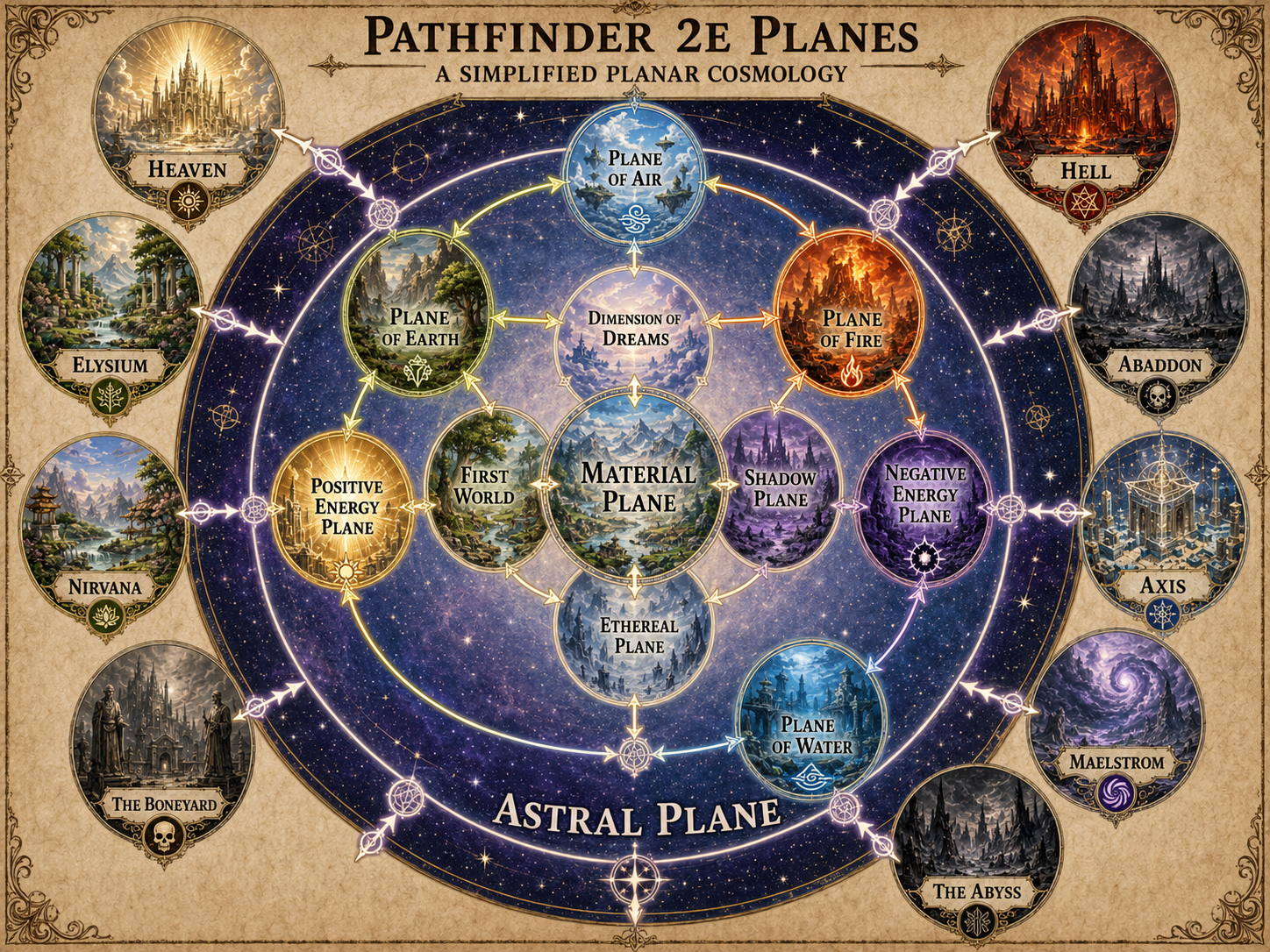
Thesalon is part of a larger cosmos.
The mortal world is surrounded, connected, and sometimes pressured by elemental realities, divine domains, shadowed reflections, fey territories, fiendish realms, spiritual roads, bounded demiplanes, and stranger dimensions. These places are not distant metaphors. They can produce creatures, magic, materials, weather, dreams, curses, transformations, religions, political claims, and physical locations.
Most people never travel beyond the mortal world.
Many nevertheless live with the consequences of the planes.
A harbor may maintain a warning for a storm that moves through several realities. A Veyrskoldic hold may sit inside the fossilized remains of a planar titan. An Ilyrian stewardship court may accept testimony carried through plants and animals by a migrating intelligence. A Caerlonian oathbreaker may fear the next eclipse because something will begin following the broken bond. A Suthrani treaty may possess terms that exist only inside a palace in shadow.
The central planar rule of Thesalon is:
The planes are places, powers, sources, and pressures.
A plane can be visited.
A planar power can be bargained with, opposed, studied, worshiped, or misunderstood.
A plane can provide magic or material resources.
A plane can also press against a region without opening a gate to it.
Planar influence is local, uneven, and interpreted through culture. It should deepen the identity of a place rather than replace it.
Player Rules Summary
The planes are real
Planar creatures, planar magic, divine realms, demiplanes, and supernatural crossings exist.
No one institution possesses a complete map of the cosmos.
A thin place is not necessarily a portal
A place may show planar influence without allowing creatures to cross between realities.
Thin places, stable gates, magical travel, and planar absence are covered more fully in Thin Places, Gates, Magical Travel, and Planar Absence.
Stable gates are exceptionally rare
A reliable passage to another plane is a campaign-scale source of power.
Any stable gate is likely to be:
- hidden;
- sealed;
- guarded;
- regulated;
- worshiped;
- fought over;
- or misunderstood.
Planar powers are not automatically gods
A being may be ancient, immortal, worshiped, capable of granting magic, or powerful enough to alter a region without being one of Thesalon’s gods.
The distinction among god, demigod, monitor, celestial, archfey, fiend, spirit, elemental sovereign, and sentient demiplane is real but not always obvious to mortals.
Power creates claims
When planar power appears, people ask:
- Who owns the site?
- Who guards it?
- Who may use it?
- What law applies?
- What does it cost?
- What comes through?
- What is being kept out?
- Who benefits if it remains open?
- Who benefits if it closes?
Planar beings follow rules
A powerful being should not be assumed to possess unlimited power.
Most planar powers are constrained by:
- their nature;
- their home plane;
- an oath;
- an anchor;
- a gate;
- a cycle;
- a location;
- a treaty;
- a form of invitation;
- or the exact purpose for which they came into existence.
Learning those limits is often more useful than attempting to overpower the being directly.
The Pathfinder Cosmological Foundation
Thesalon uses the cosmological and mechanical assumptions of Pathfinder Second Edition Remaster while giving those assumptions Thesalon-specific names, histories, religious interpretations, and regional expressions.
Pathfinder’s current rules refer to the principal mortal reality as the Universe. In Thesalon, scholars also use terms such as:
- the mortal world;
- the Material World;
- the Waking World;
- the lived world;
- the ground beneath the planes.
These are cultural names for the reality in which Thesalon exists.
The standard Pathfinder planar categories remain available for rules involving creatures, spells, rituals, planar travel, summoning, souls, sanctification, and magical identification.
Major cosmic categories
| Cosmic category | Function in Thesalon |
|---|---|
| The Universe | The mortal reality containing Thesalon and other physical worlds |
| Elemental Planes | Primordial realities of Air, Earth, Fire, Metal, Water, and Wood |
| Ethereal Plane | A near-world medium associated with incorporeal movement, spirits, hidden proximity, and some crossings |
| Astral Plane | A transitive expanse associated with thought, souls, divine roads, and movement among distant realities |
| Outer Sphere | Divine, celestial, fiendish, monitor, philosophical, and soul-destination realms |
| Netherworld | A shadowed reflection associated with darkness, concealment, sorrow, distortion, and shadow travel |
| Creation’s Forge | A cosmic source associated with vitality and the beginnings of mortal souls |
| The Void | A reality of void energy, dissolution, emptiness, and destructive cosmic pressure |
| Demiplanes | Bounded realities formed through magic, catastrophe, divine action, planar pressure, imprisonment, or accumulated meaning |
| Other dimensions | Realities that do not fit the ordinary planar arrangement |
The Elemental Planes recognized under the Remaster rules are Air, Earth, Fire, Metal, Water, and Wood.
These categories are not required to appear under the same names in every culture.
Common regional names
| Pathfinder category | Example Thesalonian names |
|---|---|
| Astral Plane | Star-Road, Long Thought, Road Between Heavens |
| Ethereal Plane | Near Mist, Breath Behind the Wall, Unseen Shore |
| Netherworld | Grey Below, Long Shadow, Second Dusk |
| Plane of Wood | First Green, Rooting World, Forest Before Forests |
| Plane of Water | Measureless Sea, First Current, Water Without Shore |
| Plane of Air | Open Vast, Upper Wind, Breath Without Lungs |
| Outer Sphere | Divine Courts, Far Heavens, Realms Beyond Judgment |
| The Void | Last Emptiness, Hunger Outside Stars, Black Absence |
Using a local name does not create a new plane. It describes how a community understands a real cosmic category.
What Is a Planar Power?
A planar power is a being, intelligence, collective, or living place whose nature is substantially tied to another plane or cosmic principle.
Planar powers include:
- celestials;
- monitors;
- fiends;
- archfey;
- powerful spirits;
- elemental sovereigns;
- astral beings;
- ethereal beings;
- aberrant intelligences;
- sentient demiplanes;
- planar beasts;
- transformed mortals;
- and entities that do not fit mortal classification.
Not every extraplanar creature is a major planar power.
A common elemental or fiend may be dangerous without reshaping a region. A major planar power possesses enough continuity, influence, intelligence, authority, or unusual function to affect:
- settlements;
- travel;
- law;
- religion;
- weather;
- ecosystems;
- diplomacy;
- magical practice;
- or historical memory.
Pathfinder creature traits
When a planar power receives Pathfinder statistics, its rules traits must reflect what it actually is.
Common relevant creature traits include:
- astral;
- celestial;
- elemental;
- ethereal;
- fey;
- fiend;
- monitor;
- spirit;
- aberration;
- giant;
- plant;
- fungus;
- beast;
- construct;
- or undead.
Pathfinder creature design expects a creature’s type traits to affect identification, spells, weaknesses, and other rules interactions.
The setting’s public terminology does not always match the mechanical classification.
A Caerlonian may call Serevane a celestial hunter even when planar scholars classify it as a monitor. A sailor may call Aestra Morn a sky whale even though its eventual rules might classify it as an elemental beast. A cult may call Pale Night a goddess even if she remains a unique demon power rather than a deity.
Holy, Unholy, and Morally Unaligned Powers
Pathfinder Remaster does not use the former alignment system as the primary measure of a creature’s morality.
A creature or effect may possess:
- the holy trait;
- the unholy trait;
- neither;
- but not both simultaneously.
Holy and unholy describe powerful supernatural commitments rather than every aspect of personality.
This creates several important distinctions:
- A dangerous power is not automatically unholy.
- A holy being can still be frightening, rigid, or harmful in a specific circumstance.
- A fey bargain may be cruel without being unholy.
- A monitor may enforce cosmic order without being holy.
- A fiend such as Pale Night is normally unholy.
- A planar power can remain neither holy nor unholy.
The major planar powers described below are not divided into a simple group of benevolent protectors and malicious enemies.
Each possesses a purpose, a limitation, and a relationship with mortal society.
Gods, Planar Powers, and Worship
The gods of Thesalon are real and active.
Planar powers are also real and may receive:
- offerings;
- shrines;
- prayers;
- bargains;
- service;
- cult worship;
- legal recognition;
- fear;
- or ritual appeasement.
Worship alone does not determine whether a being is a god.
A planar power might be:
- a servant of a god;
- an ally of a divine court;
- a demigod;
- a rival to the gods;
- an independent cosmic intelligence;
- a creature mistaken for a god;
- a former mortal;
- or a living location that does not understand worship.
The gods are discussed in Gods and Widely Known Powers.
This page focuses on beings whose planar nature, location, or cosmic function is more important than formal temple worship.
Planar Pressure
Planar pressure is the influence that another reality exerts on part of the mortal world.
It does not require an open portal.
Planar pressure can alter:
- weather;
- gravity;
- dreams;
- plants;
- animals;
- birth;
- death;
- resurrection;
- emotion;
- memory;
- magic;
- architecture;
- time perception;
- local creatures;
- and physical materials.
Examples include:
- rain briefly falling upward beneath Aestra Morn’s migration;
- animals assembling into a speaking body for Uln Varesh;
- hidden treaty terms casting independent shadows;
- black ice spreading through the submerged remains of Thren Volos;
- fog preventing the alignment of Pale Night’s prison with Marithel;
- broken oaths becoming perceptible during a Caerlonian eclipse.
A planar pressure may be:
- stable;
- seasonal;
- cyclical;
- growing;
- fading;
- contained;
- exploited;
- or catastrophic.
Most planar pressures do not permit ordinary travel to the plane causing them.
Planes and Demiplanes as Locations
A demiplane is a bounded reality formed through a particular cause.
Possible causes include:
- deliberate creation;
- a magical disaster;
- divine intervention;
- accumulated memory;
- a prison;
- a treaty;
- an impossible death;
- a repeated ritual;
- the will of a powerful being;
- or a place separating from the Universe.
Pathfinder-created demiplanes ordinarily have finite boundaries, though powerful effects can alter their scope and traits.
When a Thesalon demiplane is later developed mechanically, the GM-facing entry should identify:
| Trait category | Questions |
|---|---|
| Scope | How large is it? Is it bounded? Can it grow? |
| Gravity | Is gravity normal, altered, subjective, or directional? |
| Time | Does time pass normally, irregularly, or at a different rate? |
| Morphic nature | Is the environment stable, metamorphic, or sentient? |
| Planar essence | Which cosmic forces strongly shape it? |
| Access | What allows entry or exit? |
| Control | Who governs or claims it? |
| Failure | What occurs if its central law collapses? |
A player-facing page does not always list these mechanical traits. It should still describe the reality consistently enough that those traits can later be assigned.
Major Planar Powers of Thesalon
The following are among the best-known, most consequential, or most actively disputed planar powers touching Thesalon.
This is not an exhaustive list.
Several truths remain uncertain, restricted, or deliberately concealed.
Othmarra, the Fogfather
Classification: Unique archfey and Gate-Seal Custodian Likely Pathfinder traits: Unique, Fey Primary region: Marithel Associated forces: Fog, fey influence, hidden water, concealment, custodianship Primary game function: Planar containment, forbidden navigation, cult investigation, seal maintenance
Othmarra appears as an elderly gnome with a great mane of white hair rising from his head and spreading into the surrounding sky.
The farther his hair extends, the less possible it becomes to distinguish hair from fog.
Maritheli names for him include:
- the Fogfather;
- Keeper of the Umbral Veil;
- Grandfather of Hidden Water;
- the White-Maned Warden;
- He Who Leaves No Wake.
Formal custodial records use the name Othmarra.
The Umbral Veil
Othmarra guards an ancient containment system called the Umbral Veil.
The Veil is not a curtain hanging over a physical doorway. It is a layered field of fey, ethereal, and shadowed containment spread among several anchors in Marithel.
Its known or suspected anchors include:
- a fogbound island;
- a submerged structure;
- an old lighthouse whose beam must never fully fail;
- a living fey grove;
- and a secret custodial name carried by mortal wardens.
The fog created or directed by the Veil prevents an exact planar alignment.
Something beyond the Veil possesses a connection to Marithel. The containment keeps that distant prison from becoming coincident with the mortal world.
What Othmarra can do
Othmarra can:
- move through fog connected to the Veil;
- sense damage to its anchors;
- conceal routes and islands;
- deny or permit passage through certain fogbanks;
- place custodial marks on mortal agents;
- confront creatures attempting to cross damaged alignments;
- and alter memory of routes whose knowledge would weaken the seal.
What Othmarra cannot do
Othmarra cannot leave the Veil’s connected fog without reducing the strength of the containment.
He also refuses to speak certain complete truths.
One explanation claims that clearly naming every anchor, reciting the Veil’s full structure, or describing the prisoner too precisely would help the two realities align.
As a result, Othmarra communicates through:
- warnings;
- incomplete instructions;
- route prohibitions;
- dreams;
- riddles tied to physical locations;
- and mortal custodians who each know only part of the system.
Mortal relationships
Othmarra has no unified church.
Those associated with him include:
- old lighthouse families;
- Fogfather wardens;
- hidden-island caretakers;
- Quiet Mapkeepers;
- sailors who survived forbidden routes;
- fey negotiators;
- and temporary custodians selected through dreams.
Some Maritheli leave him offerings.
Others insist that honoring a custodian does not make him a god.
Player interaction
Characters might:
- repair a failing anchor;
- transport something Othmarra cannot carry beyond the fog;
- investigate a false warden using his name;
- prevent a chart from recording too much of the Veil;
- cross a fogbank under negotiated conditions;
- rescue a mortal custodian;
- or enter the containment field without opening the prison.
Pale Night, the Power Beyond the Veil
Classification: Ancient demon power Likely Pathfinder traits: Unique, Fiend, Demon, Unholy Primary connection: The Umbral Veil beneath or beyond Marithel Associated forces: Demonic corruption, impossible form, veils, bone, transformation Primary game function: Campaign-scale imprisoned threat, cult conspiracy, high-level horror
Forbidden writings call the being beyond the Veil Pale Night.
No reliable public source establishes her full origin.
The strongest surviving claims describe her as:
- older than many present demon powers;
- feared by other fiends;
- possibly connected to the emergence of several demonic lineages;
- physically incompatible with ordinary reality;
- and confined in a distant demonic dominion whose alignment with Marithel is prevented by the Umbral Veil.
The white shroud
Descriptions of Pale Night consistently portray a humanoid silhouette wrapped in moving white cloth.
The cloth does not behave like ordinary fabric.
It moves as though caught in winds arriving from every direction.
Some demonologists believe the shroud is:
- an effect imposed by reality;
- a separate cosmic being;
- a containment layer;
- or the only portion of Pale Night that mortal senses can safely interpret.
Accounts of anything beneath it are contradictory.
Survivors report:
- missing memories;
- uncontrollable terror;
- bodily pain centered in the skeleton;
- altered identity;
- or an inability to describe what was seen.
The Bone Citadel
Cult texts place Pale Night within the Bone Citadel, a fortress of pale bones inside a hostile demonic dominion sometimes called the Bone Labyrinth.
Whether the Citadel is:
- a prison;
- a lair;
- a throne;
- or all three
remains disputed.
The exact demonic geography should not be treated as reliable public knowledge.
Silent cults
Pale Night rarely communicates directly with her mortal cults.
Her followers act on interpretations of:
- incomplete dreams;
- forbidden fragments;
- compulsions involving white cloth;
- damaged maps of the Veil;
- and promises that liberation will transform them into favored servants.
This makes the cults unusually dangerous.
They do not wait for clear orders.
They compete to prove what they imagine Pale Night desires.
Shrouded knights
The cults believe certain servants can become shrouded knights.
A shrouded knight resembles a mounted warrior hidden beneath white cloth. The apparent rider and mount are one demonic organism whose true structure is concealed by a lesser version of Pale Night’s veil.
Shrouded knights are:
- trackers;
- pursuers;
- defenders of Pale Night’s interests;
- and evidence that damaged portions of the Veil can permit more than dreams to pass.
They should function as a family of level-scalable fiendish adversaries rather than one fixed creature.
Public uncertainty
Most people in Marithel do not know Pale Night’s name.
They may know only that:
- the Fogfather guards something;
- certain fog routes are forbidden;
- white veils are used in dangerous cult rites;
- and some disappearances are followed by tracks resembling a horse and rider even where no separate hoofprints exist.
Serevane, Hunter of the Forsworn
Classification: Unique monitor commonly called a celestial hunter Likely Pathfinder traits: Unique, Monitor; possibly Holy depending on final statistics Primary region: Caerlon Associated forces: Oaths, reciprocal obligation, broken fealty, eclipses, pursuit Primary game function: Investigation under time pressure, supernatural chase, legal and political conflict
Serevane is a planar hunting beast that enters Caerlon during eclipses.
It pursues those who have deliberately broken a sworn bond while continuing to claim the bond’s benefits.
It does not hunt every liar.
It does not hunt every failed leader.
It does not punish casual promises.
Serevane responds to a narrower offense:
- A meaningful bond was knowingly accepted.
- The bond created real obligations.
- Another party changed their actions in reliance on it.
- One party deliberately broke the bond.
- The oathbreaker continues claiming protection, service, status, property, authority, or another benefit created by the bond.
Pathfinder already supports the idea that voluntarily breaking a meaningful vow can remove benefits or impose supernatural consequences until the vow is repaired or atonement occurs.
Bonds Serevane can follow
Serevane may respond to:
- fealty;
- protection oaths;
- military bonds;
- sanctuary vows;
- marriage compacts;
- guild charters;
- household obligations;
- fosterage;
- patronage;
- host and guest bonds;
- temple service;
- and treaties with planar beings.
The bond must still be active.
An old promise with no surviving obligations does not normally attract the Hunter.
Appearance
Serevane resembles a vast celestial hound or long-limbed hunting cat.
Witnesses consistently describe:
- a body of dark gold edged in eclipse-black;
- a circular black sun inside its chest;
- a mane or antlers made from broken oath-rings;
- jaws containing snapped chains, signets, badges, wedding bands, seals, and ceremonial weapons;
- no visible eyes until it identifies a quarry;
- and luminous cords trailing toward active bonds.
When Serevane selects a quarry, one cord becomes taut between them.
Why eclipses matter
Serevane hunts only during an eclipse.
Caerlonian theologians explain this through two conditions:
- the sun remains present, allowing the bond to be witnessed;
- the sun is obscured, weakening the protection of title, reputation, rank, and outward appearance.
During the eclipse, Serevane perceives the bond rather than the public identity of the people involved.
Healthy bonds appear complete.
Broken bonds may appear:
- severed;
- burned;
- knotted;
- stretched;
- divided among heirs;
- attached to the wrong person;
- or continuing to drain duty from only one side.
Why Caerlon is vulnerable
Caerlon’s old society depended heavily on reciprocal bonds:
- rulers received fealty in exchange for protection;
- nobles received labor or tax in exchange for shelter and defense;
- commanders received obedience in exchange for responsibility toward soldiers;
- temples received land and offerings in exchange for sanctuary, burial, healing, or public service;
- guilds received dues in exchange for support;
- households exercised authority over dependents while accepting obligations toward them.
The invasion destroyed many institutions without dissolving their bonds.
Caerlon therefore contains:
- towns still paying families that abandoned them;
- nobles retaining estates granted for protections no longer provided;
- soldiers bound to dead commands;
- temples invoking sanctuary authority after once closing their doors;
- resurrected people returning to vows others believed death had ended;
- and heirs receiving benefits without understanding the obligations attached to them.
Limits of the Hunter
Serevane can identify a broken bond.
It cannot always determine:
- whether the oath was coerced;
- whether the record is forged;
- whether fulfillment became impossible;
- whether the bond was privately released;
- whether an heir knowingly accepted the obligation;
- whether resurrection restored a dissolved bond;
- or which conflicting obligation held precedence.
For that reason, Serevane can follow the correct bond toward a disputed or incorrect person.
Mortal investigation still matters.
Ending a hunt
A hunted person can resolve the bond by:
- fulfilling the obligation;
- surrendering its benefits;
- releasing the other party;
- accepting restitution;
- transferring the obligation with consent;
- proving the bond invalid;
- or demonstrating that it was already dissolved.
Defeating Serevane’s manifested form does not permanently remove the bond.
A magical counteract effect may suppress a curse or mark, but it does not resolve the underlying obligation.
What Serevane takes
Serevane does not always kill its quarry.
It takes back what the broken bond granted.
Possible consequences include:
- loss of title;
- loss of command;
- loss of an estate;
- loss of sanctuary authority;
- release of sworn followers;
- collapse of an oath-granted magical benefit;
- dissolution of inherited privilege;
- or loss of a planar patron’s access.
When the benefit cannot be separated from the person, Serevane may take both.
Player interaction
Characters might:
- determine what oath was actually sworn;
- race ahead of the Hunter to locate witnesses;
- prove a bond was coerced;
- help an heir discharge an inherited obligation;
- defend someone from a misdirected hunt;
- pursue Serevane through the geography associated with an oath;
- or follow it across a planar boundary after a patron that continues collecting tribute.
Uln Varesh, the Green Current
Classification: Unique distributed planar spirit Likely Pathfinder traits: Unique, Spirit; individual manifestations may also gain Plant, Fungus, Animal, Beast, or Swarm traits Primary region: Ilyr Associated forces: Plane of Wood pressure, biological memory, ecological exchange, living testimony Primary game function: Environmental investigation, stewardship conflict, voluntary hosting, ecological disaster
Uln Varesh is not one creature moving from body to body.
It is a continuous intelligence flowing through living exchange.
It travels through:
- pollen;
- spores;
- fruit;
- sap;
- carrion;
- blood;
- parasitic insects;
- predator and prey;
- seeds caught in fur;
- roots sharing water;
- grafted tissue;
- healing procedures;
- and breath moving among dense plant life.
Ilyrian speakers compare Uln Varesh to a river because it possesses:
- channels;
- tributaries;
- seasonal flooding;
- divided courses;
- blocked reaches;
- and accumulations of pressure where the Current cannot move.
Manifestation
When Uln Varesh concentrates in one place, the occupied life temporarily reorganizes into the shape of a sentient being.
Examples include:
- vines braiding themselves into arms, shoulders, and a face;
- a swarm of moths forming a walking humanoid silhouette;
- flowers opening into eyes and a mouth across an animal’s side;
- reeds and roots creating a standing figure around a crocodile;
- a grove bending into the form of a seated council member;
- mushrooms growing into fingers that write across dead wood;
- or fish assembling beneath the surface into an enormous speaking face.
The individual host is not always controlled.
Many manifestations are collaborative structures made from several organisms.
When the Current leaves, the organisms normally return to their own lives, though some retain:
- new scars;
- altered color;
- unfamiliar instincts;
- or memories that do not belong to their species.
The memory carried by Uln Varesh
Uln Varesh carries the accumulated biological memory of Ilyr.
It can preserve:
- the passage of extinct migrations;
- ancient floods;
- burned settlements;
- old predator territories;
- medicines learned by repeated consumption;
- burial names absorbed by roots;
- injuries inflicted on a wetland;
- hidden communities betrayed through disturbed growth;
- and routes remembered through generations of seed, animal, and river movement.
It cannot remember an event unless some living system carried part of it forward.
It may remember blood entering soil.
It may remember words heard by insects.
It may remember a weapon swallowed by a beast.
It does not automatically know a decision made in a sealed stone chamber when that decision left no living witness or biological consequence.
Stewardship and testimony
Some Ilyrian stewardship courts accept Uln Varesh as a witness.
Others refuse.
Arguments in its favor include:
- continuity across generations;
- direct memory of ecological damage;
- independence from foreign written records;
- and an inability to be bribed in conventional ways.
Arguments against include:
- memories may merge;
- individual identities may be indistinct;
- Uln Varesh values ecological continuity differently from mortal courts;
- it can reveal protected routes;
- and its current manifestation may not represent the complete intelligence.
Damming the Current
The Current can be obstructed by:
- ecological isolation;
- poisoning;
- burning;
- monoculture;
- destruction of migration routes;
- extermination of pollinators;
- magical containment;
- or removal of species that act as biological bridges.
A dammed reach accumulates memory pressure.
Possible consequences include:
- plants reenacting an old massacre;
- insects repeating the speech of the dead;
- predators hunting people who resemble historical intruders;
- newborn creatures carrying centuries-old memories;
- old paths regrowing through settlements;
- and the landscape rearranging itself around remembered harm.
Hosting Uln Varesh
A willing sapient creature can temporarily host a concentrated portion of Uln Varesh.
Possible benefits include:
- access to ecological memory;
- the ability to perceive biological connections;
- communication with local organisms;
- or knowledge of a route no map retains.
Possible costs include:
- borrowed instincts;
- altered hunger;
- memories of being prey;
- responsibility toward a place the host has never visited;
- or difficulty separating personal emotion from the Current’s accumulated experience.
An unwilling sapient host cannot normally be fully controlled.
Uln Varesh may instead produce:
- dreams;
- involuntary gestures;
- short spoken phrases;
- redirected attention;
- or temporary physical signs.
Player interaction
Characters might:
- trace the Current through a food web;
- question a forest that has assembled a temporary body;
- restore a severed ecological channel;
- prevent a faction from bottling Uln Varesh into a magical archive;
- host the Current to recover a lost route;
- or decide whether living testimony should outweigh written law.
Aestra Morn and the Inverted Sea
Classification: Unique planar leviathan Likely Pathfinder traits: Unique, Elemental or Beast, Air, Water Primary region: Marithel’s upper routes and western atmospheric systems Associated forces: Planes of Air and Water, storms, gravity, high-altitude navigation Primary game function: Magical travel, environmental exploration, sky-yurt voyages, weather crisis
The Inverted Sea is an elemental boundary where the Planes of Air and Water press against the same region of the Universe.
It does not physically rest above the clouds.
It occupies the upper atmosphere while remaining out of phase with ordinary air.
From the ground, the Inverted Sea is usually invisible.
Signs of its proximity include:
- auroras resembling waves;
- cloud banks whose undersides resemble reef shelves;
- lightning moving like schools of fish;
- rain stopping in midair;
- stars distorting as if seen through water;
- and high-flying creatures briefly swimming instead of flying.
Aestra Morn
Aestra Morn is an immense migrating being of the Inverted Sea.
When partly visible, it resembles a translucent whale, ray, or other pelagic leviathan.
Its body appears to contain:
- a field of unfamiliar stars;
- drifting ruins;
- deepwater darkness;
- luminous swimming creatures;
- and fragments of storms.
Observers are not seeing through transparent flesh.
They are seeing through Aestra Morn into the Inverted Sea.
The migration
Aestra Morn’s movement redistributes elemental pressure between Air, Water, and the mortal atmosphere.
Where it follows its old route:
- upper winds stabilize;
- storms separate cleanly;
- water vapor passes safely between layers;
- and certain high-altitude currents become reliable.
Where it fails to pass:
- fog can gain weight and fall;
- rain can rise from the ocean;
- waves can form inside clouds;
- ships may become briefly weightless;
- flying creatures can drown in open air;
- and sky-tides can descend against exposed coasts.
Aestra Morn cannot simply stop migrating.
If trapped or seriously delayed, pressure accumulates around it.
The Larri routes
The Larri have learned to ride the lower edge of Aestra Morn’s wake using their balloon-supported traveling yurts.
They do not ordinarily enter another plane completely.
Their navigators identify a shared-buoyancy band where Material air and the Inverted Sea briefly obey compatible movement.
The route can provide:
- faster passage;
- escape from terrestrial hazards;
- access to rare materials;
- and entry to locations that cannot be reached from the ground.
It also exposes travelers to:
- reversed gravity;
- drowning air;
- lightning reefs;
- hostile upper-sea creatures;
- and sudden loss of the planar wake.
Larri knowledge of Aestra Morn is religious, technical, and familial. It combines wind observation, balloon tension, temperature, inherited route records, and devotion to Selari.
Current disruption
Aestra Morn has begun avoiding or delaying passage through one of its older migration corridors.
Possible explanations discussed publicly include:
- injuries caused by harvesting;
- disruption from a Maritheli weather device;
- disturbance by another Upper Sea predator;
- contamination from a damaged planar storm;
- changes in Larri traffic;
- or a reproductive migration not understood by mortal observers.
No public explanation has been confirmed.
The missed passage has begun affecting:
- Maritheli storm patterns;
- western Veyrskold routes;
- Larri caravans;
- and high-altitude magical navigation.
Player interaction
Characters might:
- ascend aboard a Larri sky-yurt;
- rescue a caravan from drowning air;
- enter a wreck drifting within the Inverted Sea;
- cross a lightning reef;
- determine why Aestra Morn changed course;
- treat a wound in the leviathan;
- negotiate with beings living on the underside of storms;
- or decide whether to preserve a profitable route that continues harming the migration.
Caldris Venn and the Eclipse Orphans
Classification: Astral custodian or unique monitor Likely Pathfinder traits: Unique, Astral or Monitor Primary region: Places with strong prophetic institutions; manifestations are most visible during eclipses Associated forces: Prevented futures, unrealized lives, prophecy, historical replacement Primary game function: Alternate-history encounters, moral choice, prophecy consequences
Successful prophecy changes the future.
A warned city evacuates.
An assassination is prevented.
A war never begins.
A child survives.
A disaster is diverted.
The prevented future does not become a second complete world.
Most possibilities dissolve without consequence.
Some do not.
Events that accumulated enough expectation, preparation, emotion, divine attention, or magical certainty can leave astral remains after they are prevented.
Those remains gather in a reality called:
- the Afterward That Never Was;
- the Unlived Country;
- the Absent Tomorrow;
- or Caldris Venn’s Keeping.
Caldris Venn
Caldris Venn tends the accumulated remnants of futures that came close enough to reality to produce meaningful lives, places, and memories.
No one agrees whether Caldris Venn is:
- the ruler of this place;
- its custodian;
- the first unrealized person;
- a monitor assigned to prevent abandoned futures from invading the present;
- or the intelligence produced by their accumulation.
Eclipse manifestations
During eclipses, unrealized remnants can become visible in the mortal world.
They may include:
- children who were never born;
- widows of people still alive;
- ruins of cities that were successfully saved;
- memorials to wars that never happened;
- roads built for migrations that were prevented;
- soldiers who remember battles erased from possibility;
- and settlements populated by descendants of people who made different choices.
These manifestations are called Eclipse Orphans.
Some know they are unrealized.
Some believe the present world is the false one.
The central conflict
Many Eclipse Orphans want only:
- to be witnessed;
- to preserve their memories;
- to speak to the people whose decisions erased them;
- or to receive recognition that their unrealized lives mattered.
Others want to become real.
Making an Orphan permanent may require replacing:
- a present person;
- a current event;
- a surviving settlement;
- or the chain of history that prevented the Orphan’s future.
Caldris Venn does not regard this as a simple moral question.
The unrealized possessed possible lives.
The living possess actual lives.
Limits
Caldris Venn cannot restore an entire prevented future without destroying or rewriting the present.
The custodian can sometimes permit:
- temporary manifestation;
- memory transfer;
- recovery of unrealized knowledge;
- or relocation into a bounded demiplane.
Each intervention increases the chance that the unrealized future will begin pressing against the present.
Player interaction
Characters might:
- meet a person who would have existed if they had made another choice;
- recover knowledge from a city that never fell because it was never built;
- stop an unrealized army from forcing its history into the present;
- protect an Eclipse Orphan seeking recognition;
- determine whether a prophecy prevented a tragedy or merely replaced it;
- or decide whether one unrealized life can be made permanent without displacing another.
Vharos Senn and the Palace of Second Terms
Classification: Unique shadow mediator Likely Pathfinder traits: Unique, Monitor or Spirit; possibly Shadow-associated Primary region: Suthrane, Selvarin, and cross-continental diplomacy Associated forces: Treaties, secrecy, political concession, shadow, suppressed obligation Primary game function: Diplomatic exploration, hidden-history investigation, treaty repair
Vharos Senn was once invoked when two powers needed peace but could not publicly admit the concessions required to achieve it.
He did not preserve every secret.
He took custody of the portion of an agreement that neither party could publicly own but both still expected to be fulfilled.
Those hidden terms accumulated into a bounded shadow demiplane called the Palace of Second Terms.
When a term enters the Palace
A hidden term becomes part of the Palace only when:
- the agreement prevents substantial violence, collapse, or public ruin;
- at least one party believes disclosure would destroy the agreement;
- all parties knowingly accept that part of the agreement will remain outside the official record;
- the concealed term creates a continuing obligation.
Ordinary lies, gossip, personal infidelity, and casual secrets do not create chambers.
The Palace as architecture
Every concealed concession becomes part of the Palace.
Examples include:
- a corridor built from territory surrendered but never publicly acknowledged;
- a nursery representing children promised in a dynastic agreement;
- a bridge made from debts one state denies owing;
- a flooded archive containing crimes forgiven for peace;
- a dining hall staffed by hostages omitted from the treaty;
- a ballroom reenacting gestures that changed negotiations;
- a locked garden representing a protected population never named in the agreement;
- or a barracks inhabited by soldiers officially recorded as having withdrawn.
The Palace is bounded but capable of growing as new qualifying terms are added.
Its interior is metamorphic.
Architecture changes when:
- an obligation is fulfilled;
- a term is violated;
- a treaty expires;
- or the parties renegotiate.
Vharos Senn
Vharos Senn appears as a tall diplomatic figure divided into several contradictory presentations.
Witnesses describe:
- one side dressed for mourning;
- one side wearing ceremonial armor;
- one hand extended openly;
- one hand always concealed;
- a face changing according to the negotiating party;
- and a shadow that speaks concessions he refuses to state.
He does not value secrecy for its own sake.
He values agreements that prevent greater harm.
His central flaw is that he may value continued peace more than justice for those sacrificed to maintain it.
What the Palace records
A chamber preserves:
- what a party intended;
- what it agreed to conceal;
- what obligation it accepted;
- and what it believed the other parties meant.
The Palace does not automatically preserve objective truth.
Different chambers created from the same negotiation can contradict one another.
Violated terms
When a hidden term is broken, its wing of the Palace begins to collapse.
The collapse may leak into the Universe as:
- shadows arguing independently from their owners;
- old borders appearing at dusk;
- treaty wording changing;
- hidden hostages appearing in reflections;
- assassinated diplomats returning as shadow witnesses;
- nightmares shared by entire governments;
- or peacekeeping magic failing.
Access and price
Vharos Senn cannot reveal a hidden term directly.
He can permit visitors to enter the chamber formed from it.
To access a concealed agreement, petitioners may be required to surrender a secrecy claim of comparable political weight.
The surrendered secret becomes public somewhere that matters.
It is not sufficient to whisper it privately inside the Palace.
Mortal positions
Those who work with Vharos Senn include:
- treaty mediators;
- Selvarin diplomats;
- Suthrani temple negotiators;
- ceasefire advocates;
- hostage-exchange officials;
- and governments trying to prevent renewed war.
Those who oppose him include:
- families of hidden victims;
- truth commissions;
- Olyrran archivists;
- Aurelian legal reformers;
- revolutionaries;
- and people whose lives were treated as unrecorded concessions.
Those who exploit the Palace include:
- rulers hiding abuse inside peace agreements;
- spies;
- blackmailers;
- and cults attempting to convert concealed agreements into permanent shadow law.
Player interaction
Characters might:
- enter a collapsing treaty wing;
- locate a hostage absent from every public record;
- compare contradictory versions of a negotiation;
- expose one secret to gain access to another;
- retrieve a diplomat’s surrendered shadow;
- fight creatures created from violated concessions;
- or decide whether revealing an atrocity justifies the war likely to follow.
Thren Volos, the Fallen North
Classification: Dead planar titan Likely Pathfinder traits if encountered through remnants: Unique, Giant or custom Titan classification; the geography itself is not an active creature Primary region: Veyrskold Associated forces: Giant-scale anatomy, fossilized magic, northern geography, alien contamination Primary game function: Anatomical megadungeon, regional exploration, black-ice investigation
Thren Volos is dead.
His remains extend beneath a vast portion of Veyrskold.
Mountains, fjords, basins, reefs, glaciers, and underground cavities have formed around or through the corpse.
No single visible skeleton lies neatly on the surface.
The body is:
- fossilized;
- buried;
- fractured;
- glaciated;
- mineralized;
- and integrated into the continent’s physical geography.
The Crown Basin
Thren Volos’s skull forms the underlying structure of a mountain-ringed basin.
Features attributed to the skull include:
- glacial lakes occupying the eye sockets;
- a wind-carved pass following the nasal cavity;
- white cliffs corresponding to teeth;
- warm settlements and mineral caverns inside the cranial space;
- and unusual auroras accumulating above the basin.
The Longback Range
A chain of broken mountains follows the titan’s spine.
Its vertebrae create:
- giant passes;
- sheltered basins;
- joint valleys;
- exposed black-white bone faces;
- and old roads following nerve channels.
Some peaks are exposed remains.
Others are ordinary mountains formed around the body.
The Fjord Gates
Thren Volos’s ribs curve beneath part of the northern coast.
Fjords run between them.
Settlements may occupy:
- sheltered rib channels;
- caverns beneath exposed arches;
- coastal cliffs formed from mineralized bone;
- and protected waters lying inside the thoracic region.
Sailors report that storms sound different between particular ribs.
The Shield Plateau
The sternum supports a broad elevated region used for:
- old giant roads;
- observatories;
- oath courts;
- settlements;
- and battlefields.
Cracks in the plateau sometimes lead into the thoracic interior.
The Heart Hollow
The heart is absent, destroyed, or fully decayed.
Its former cavity contains one of Veyrskold’s great unresolved geographic mysteries.
Reports describe:
- warm subterranean waters;
- cyclical sounds resembling a heartbeat;
- ruins on ledges too large for present peoples;
- buried fire;
- and passages leading deeper into the titan.
No unified authority has mapped the full Hollow.
The seaward hand
One arm extends beneath the Frostbitten Coast and into the ocean.
The finger bones create:
- shoals;
- islands;
- reefs;
- sea caves;
- and wreck channels.
Thirteen years ago, a rainbow-colored object fell into the water beyond this coast.
The region later became known as the Black Ice Coast.
The Zyllnar wreck
Beneath the water lies a vessel from the distant world of Zyllnar VII.
It carried three exiles whose bodies, technology, and requirements differ sharply from Thesalonian life.
The vessel’s damaged fuel source burns through an invisible chemical reaction.
The escaped material has corrupted local weather and contributed to the formation of black ice.
The ship struck or settled among the submerged bones of Thren Volos’s seaward hand.
Titan bone now acts as:
- magical catalyst;
- conduit;
- reservoir;
- and pathway for the alien contamination.
Black ice therefore spreads along:
- marrow channels;
- joints;
- porous fossil structures;
- and anatomical paths
rather than following ordinary currents alone.
The three exiles
The exiles can survive in Thesalon but consider their circumstances nightmarish.
They require bone marrow as food.
They possess transformational abilities useful for hunting and concealment.
Local stories call them:
- Bonesuckers;
- Wreckhaunters;
- Facegoopers;
- black melt-men;
- or marrow thieves.
The exiles have little interest in conquering Thesalon.
They want to repair their vessel and leave.
Their desperation has nevertheless led them to:
- kill;
- steal materials;
- impersonate locals;
- infiltrate settlements;
- and experiment with titan remains.
Regeneration cocoons
Each exile is bio-coded to a regeneration cocoon aboard the ship.
When an exile dies, a replacement body is produced.
The process may cause:
- memory degradation;
- altered personality;
- imperfect reconstruction;
- accumulation of discarded bodies;
- and biological contamination of the vessel.
Previous bodies may remain in Veyrskold.
Some may have been absorbed by Thren Volos’s marrow channels.
This creates conflicting sightings and the possibility that incomplete copies or contaminated remains now move independently.
Is Thren Volos conscious?
No public source can confirm whether any consciousness remains.
Possible signs include:
- shared dreams along nerve-like routes;
- bone regrowth;
- anatomical reactions to extraction;
- weather responding to damage;
- and movements deep within the Heart Hollow.
These may represent:
- residual magic;
- automatic bodily processes;
- local spirits;
- alien contamination;
- or actual awareness.
Player interaction
Characters might:
- map black ice through titan anatomy;
- enter marrow caverns;
- negotiate with an exile;
- kill an exile knowing it will regenerate;
- investigate a previous body acting independently;
- reach the submerged vessel;
- prevent extraction of titan bone;
- decide whether repairing the alien ship will end the contamination;
- or discover what occupies the Heart Hollow.
Vorun Azh, the Devouring Embassy
Classification: Unique fiendish living structure containing a bounded demiplanar interior Likely Pathfinder traits: Unique, Fiend, Unholy; possibly Construct or Aberration elements depending on final statistics Primary region: Vorrak, especially negotiations involving the Dread Synod Associated forces: Diplomacy, bodily transformation, hospitality, concession, predatory law Primary game function: Social dungeon, diplomatic crisis, living-location hazard
Vorun Azh is a living embassy.
It appears when a powerful state, Monster Court, or planar sovereign formally invites a hostile extraplanar party to negotiate under protected conditions.
The Embassy grows overnight from:
- red-black flesh;
- lacquered shell;
- ceremonial cloth;
- metal;
- horn;
- teeth;
- and architectural organs.
The building is Vorun Azh.
Its interior contains a bounded extradimensional or demiplanar space.
The law of the Embassy
Any accredited representative who enters under recognized diplomatic status receives protection from direct attack while negotiations remain active.
This protection applies even among parties that would ordinarily kill one another immediately.
Vorun Azh enforces one central principle:
No one may claim an agreement changed nothing.
Every accepted concession alters the negotiator physically to resemble the interests, nature, or power of the party receiving the concession.
Examples include:
- accepting a fiendish border term producing infernal eyes;
- conceding hunting rights creating claws or scent glands;
- accepting undead burial law removing body warmth;
- conceding to a brood power producing egg scars or vestigial mouths;
- accepting fey succession terms altering age or memory;
- conceding elemental water rights producing gills or translucent skin.
Minor alterations may fade after the agreement is fulfilled.
Repeated or fundamental concessions become permanent.
Why Vorrak uses it
The Dread Synod contains powers that do not trust one another to host negotiations.
Vorun Azh provides:
- enforced guest protection;
- visible proof of compromise;
- a neutral interior;
- and consequences that cannot be hidden easily from the participating courts.
This does not make the Embassy fair.
It makes betrayal procedurally difficult.
Internal chambers
Known rooms include:
Hall of Recognized Predators
Visitors are classified according to the legal status under which they entered:
- sovereign;
- emissary;
- hostage;
- servant;
- witness;
- prey;
- or unrecognized organism.
This classification determines which protections apply.
Dining Court
Food embodies offered obligations.
Accepting a dish may recognize:
- guest-right;
- tribute;
- nonaggression;
- hospitality;
- or inferiority.
Refusing every dish can be interpreted as refusing negotiation.
Hostage Nursery
Hostages promised under a potential agreement appear here as symbolic or temporary bodies before the clause is finalized.
A person who has never entered the Embassy may see a living likeness of themselves in the room.
Mouth of Appeal
Disputed interpretations can be presented before a vast mouth embedded in the wall.
The Mouth does not determine justice.
It determines whether the disputed reading is consistent with the agreement’s accepted terms.
Corridor of Revised Bodies
The corridor displays previous negotiators and the bodily transformations created by their concessions.
Some are:
- statues;
- preserved skins;
- memories;
- or living residents unable to leave.
Exit of Final Form
The final exit opens only after all parties acknowledge what they agreed to become.
Failed negotiation
Vorun Azh cannot negotiate on its own behalf.
It requires invited parties.
If negotiations collapse completely:
- corridors close;
- diplomatic protection weakens;
- exits relocate;
- unfinished clauses become predatory creatures;
- and the Embassy begins digesting the failed agreement.
Representatives may become trapped inside the consequences they refused to formalize.
Wider legal disputes
Selvarin jurists question whether bodily transformation invalidates consent.
Suthrani temple authorities debate whether anyone can knowingly consent to changes they cannot fully predict.
Caerlonian governments may refuse to recognize an envoy whose body has been transformed by a foreign agreement.
Vorrakian courts often treat the alterations as the most honest possible diplomatic record.
Player interaction
Characters might:
- escort a delegation;
- impersonate an accredited party;
- identify which concession caused a transformation;
- rescue a hostage from the Nursery;
- survive the collapse of negotiations;
- navigate the Embassy’s living chambers;
- accept a bodily change to secure peace;
- or expose a ruler who sent disposable negotiators to carry the consequences of an agreement.
Regional Planar Patterns
The major powers above are exceptional.
More ordinary planar influence follows recognizable regional patterns.
| Region | Frequent expressions |
|---|---|
| Caerlon | Battlefield shadows, oath consequences, lost-road hauntings, dead authority, damaged wards |
| Vorrak | Planar treaties, fiendish law, monstrous patronage, corpse jurisdictions, predatory rites |
| Suthrane | Sacred water, divine roads, treaty mediation, soul passage, elemental river pressure |
| Veyrskold | Giant remains, planar absence, elemental cold and buried fire, old containment, oath magic |
| Marithel | Fey routes, planar storms, hidden islands, drowned demiplanes, fog containment, upper-sea phenomena |
| Ilyr | Plane of Wood pressure, living memory, mist distortion, ecological intelligence, primal crossings |
| Selvarin and international enclaves | Planar scholarship, neutral negotiation, extradimensional archives, licensed summoning, treaty interpretation |
These are tendencies, not restrictions.
Any planar creature or phenomenon can appear elsewhere when the setting history supports it.
Institutions That Study or Control Planar Power
No global institution controls the planes.
Important institutional roles include:
Gate-Seal Custodians
Individuals or groups responsible for:
- maintaining seals;
- preserving access conditions;
- preventing unauthorized crossing;
- and responding when containment weakens.
Othmarra is an exceptional example rather than the ruler of all Custodians.
Quiet Mapkeepers
Restricted cartographers who record:
- thin places;
- unstable routes;
- possible gates;
- missing islands;
- moving planar sites;
- and locations that become more dangerous when precisely mapped.
Temple scholars
Religious specialists interpret:
- divine realms;
- celestial and fiendish beings;
- sanctification;
- soul movement;
- divine omens;
- and the legitimacy of worship directed toward planar powers.
Their conclusions vary by temple.
Arcane and occult institutions
These institutions may study:
- planar geometry;
- summoning;
- demiplane construction;
- extradimensional interiors;
- planar materials;
- astral movement;
- and the behavior of dimensional boundaries.
Monster Courts
Vorrakian courts may maintain treaties concerning:
- summoning rights;
- hunting territories;
- planar prisoners;
- guest-right;
- tribute;
- hostages;
- migration;
- and access to extraplanar weapons.
Druidic and stewardship traditions
These groups may monitor planar pressure through:
- plant response;
- animal behavior;
- ecological memory;
- seasonal change;
- and harm to living systems.
Harbor and route authorities
Maritheli institutions track:
- planar storms;
- impossible currents;
- missing routes;
- fog closures;
- upper-air disturbances;
- and vessels returning with altered crews or records.
Identifying Planar Creatures and Phenomena
The appropriate Pathfinder skill depends on the subject.
Common approaches include:
| Subject | Common skill |
|---|---|
| Celestial, fiend, monitor, divine servant | Religion |
| Fey, primal spirit, living-land manifestation | Nature |
| Astral, occult, shadow, dream, strange demiplane | Occultism |
| Constructed gate, magical geometry, arcane demiplane | Arcana |
| Historical planar treaty or regional event | Relevant Lore |
| Local taboo, route, custodian, or manifestation | Regional or institutional Lore |
Pathfinder generally uses Religion to identify celestials and monitors.
Possible Lore skills include:
- Planar Lore;
- Marithel Fog Lore;
- Umbral Veil Lore;
- Demon Lore;
- Caerlon Oath Lore;
- Ilyrian Stewardship Lore;
- Inverted Sea Lore;
- Suthrani Treaty Lore;
- Veyrskold Titan Lore;
- Black Ice Lore;
- Monster Court Lore;
- or Embassy Lore.
The GM may permit different skills when the character’s method is appropriate.
A sailor recognizing Aestra Morn’s wake might use Sailing Lore rather than Arcana.
An oath advocate identifying Serevane’s mark might use Legal Lore or Caerlon Lore rather than Religion.
Mechanical Forms of Planar Power
Not every planar power should be represented as a creature intended for combat.
| Power or phenomenon | Best mechanical forms |
|---|---|
| Othmarra | Unique creature, social encounter, patron, influence challenge |
| Umbral Veil | Complex hazard, long-term containment subsystem, exploration site |
| Pale Night | Mythic or very high-level unique fiend, cult influence, indirect threat |
| Shrouded knights | Scalable fiendish combat creatures |
| Serevane | Unique monitor, chase subsystem, curse, investigation clock |
| Uln Varesh | Influence subsystem, environmental manifestation, temporary bodies |
| Aestra Morn | Travel environment, complex hazard, high-level unique creature |
| Eclipse Orphans | Social encounters, haunts, temporary creatures, moral challenges |
| Palace of Second Terms | Bounded demiplane, exploration dungeon, influence encounter |
| Thren Volos | Regional environment, hazards, anatomical dungeons, residual creatures |
| Zyllnari exiles | Recurring unique creatures linked to regeneration infrastructure |
| Vorun Azh | Living dungeon, influence encounter, complex hazard, unique fiend |
This distinction prevents the planar chapter from becoming a catalogue of monsters.
Suggested Table Scale
| Power | Typical use |
|---|---|
| Othmarra | Negotiated with long before he is fought |
| Pale Night | Campaign-ending threat; mostly indirect |
| Shrouded knights | Recurring elite enemies at several tiers |
| Serevane | High-level hunter; lower-level characters investigate, evade, or redirect the hunt |
| Uln Varesh | Rarely fought as one entity |
| Aestra Morn | Environment and travel power; direct battle only at very high level |
| Caldris Venn | Custodian and moral authority rather than ordinary opponent |
| Vharos Senn | Negotiator and demiplane sovereign |
| Thren Volos | Dead geography rather than active monster |
| Vorun Azh | Living location whose organs, servants, and clauses may be fought |
Creature statistics should follow Pathfinder’s level-based creature-building rules rather than assigning numbers based only on narrative importance.
Planar Bargains
A planar bargain should specify:
- Parties — Who is bound?
- Offer — What does the power provide?
- Price — What must the mortal surrender or perform?
- Duration — When does the obligation end?
- Witness — What recognizes the agreement?
- Breach — What counts as breaking it?
- Consequence — What happens after breach?
- Release — How can the bargain be dissolved?
- Transfer — Can obligations pass to an heir, office, ship, temple, or polity?
- Jurisdiction — Which mortal or planar court recognizes it?
Possible costs include:
- service;
- memory;
- access;
- bodily change;
- oath;
- secrecy;
- route knowledge;
- name;
- political recognition;
- custody of a relic;
- future passage;
- or permission to act through the mortal.
A bargain should not become binding merely because a planar being speaks dramatically.
Consent, knowledge, coercion, and local law remain relevant.
Player Character Connections
A character may be connected to the planes without being a planar traveler.
Possible connections include:
- a family responsible for a seal;
- a failed oath marked by Serevane;
- a Larri household following Aestra Morn;
- temporary hosting of Uln Varesh;
- ancestry or versatile heritage connected to planar influence;
- a relic taken from Thren Volos;
- a parent altered in Vorun Azh;
- a treaty term preserved in Vharos Senn’s Palace;
- an Eclipse Orphan claiming connection to the character;
- a cult escapee pursued by a shrouded knight;
- or a scholar trained to recognize planar pressure.
Character creation questions
A planar-connected character should answer:
- What planar force touched your life?
- Was the contact chosen, inherited, accidental, or imposed?
- Who believes they own or regulate that connection?
- What visible or behavioral sign remains?
- What did the contact allow you to do?
- What did it cost?
- What institution understands it?
- What institution misunderstands it?
- What would happen if the connection intensified?
- What planar power might remember you?
What Most People Know
Most people in Thesalon know that:
- other planes exist;
- gods, fiends, fey, spirits, elementals, and celestials are real;
- planar creatures are not automatically gods;
- a strange place is not necessarily a portal;
- stable gates are rare;
- planar bargains can be dangerous;
- magic can reveal or suppress planar influence;
- temples, mages, druids, courts, and local specialists frequently disagree;
- and a planar being’s promises should never be accepted without asking what binds the being in return.
Common knowledge of the named powers varies.
Othmarra
Many Maritheli have heard of the Fogfather.
Few know the Umbral Veil’s structure.
Pale Night
Most people do not know the name.
Cult stories and sailor warnings use indirect titles.
Serevane
Caerlonian communities know that eclipses can bring the Hunter.
Legal specialists debate what kinds of bonds it recognizes.
Uln Varesh
Many Ilyrians recognize signs of the Green Current.
Outsiders frequently mistake its manifestations for possession or druidic transformation.
Aestra Morn
Larri communities possess the deepest practical knowledge.
Ground-dwellers may know only stories of a creature swimming above the clouds.
Caldris Venn
Prophets, occult scholars, and some temple authorities recognize the name.
Ordinary people usually speak only of Eclipse Orphans.
Vharos Senn
Diplomats know the warning:
Every peace has a second term.
Most citizens do not know the Palace is a literal place.
Thren Volos
Many Veyrskoldic communities know that parts of the land are called the titan’s bones.
Whether the whole region is literally one corpse remains debated publicly.
Vorun Azh
Vorrakian envoys recognize the Embassy.
Outside Vorrak, most stories portray it as either a diplomatic miracle or a building that eats ambassadors.
Deliberate Unknowns
This page does not resolve:
- Pale Night’s complete origin;
- whether her shroud is a separate being;
- the exact location of the Bone Citadel;
- every anchor of the Umbral Veil;
- whether Othmarra helped create the Veil;
- whether Serevane serves Aurelion directly;
- whether Uln Varesh emerged naturally or was created;
- the cause of Aestra Morn’s altered migration;
- the true origin of Caldris Venn;
- whether every Eclipse Orphan possesses a soul;
- whether Vharos Senn preserves peace or prevents justice;
- whether any consciousness remains in Thren Volos;
- the ultimate effects of Zyllnari contamination;
- or who first created Vorun Azh.
These mysteries are preserved for later regional pages, adventures, and DM-facing material.
Pathfinder Compatibility Summary
For Pathfinder Second Edition Remaster play:
- Thesalon exists in the Universe.
- The standard planar categories remain available.
- The Elemental Planes include Air, Earth, Fire, Metal, Water, and Wood.
- The Astral and Ethereal Planes retain their connective functions.
- Creation’s Forge and the Void retain their cosmic roles.
- The Outer Sphere contains divine, celestial, fiendish, monitor, and soul-destination realms.
- Holy and unholy replace alignment-based assumptions for relevant effects.
- Demiplanes are bounded realities with defined traits and access rules.
- Stable gates remain exceptionally rare.
- Planar pressure does not require a gate.
- Planar powers are not automatically deities.
- Souls, death, resurrection, and afterlife travel remain compatible with Pathfinder assumptions.
- Major planar beings should receive appropriate creature traits if statistics are created.
- Major locations can be represented as hazards, environments, subsystems, or demiplanes rather than conventional monsters.
- Permanent curses caused by unresolved bonds may be suppressed magically, but their narrative source can require direct resolution.
- Rare planar options require GM approval and should normally be introduced through the campaign.