Appearance
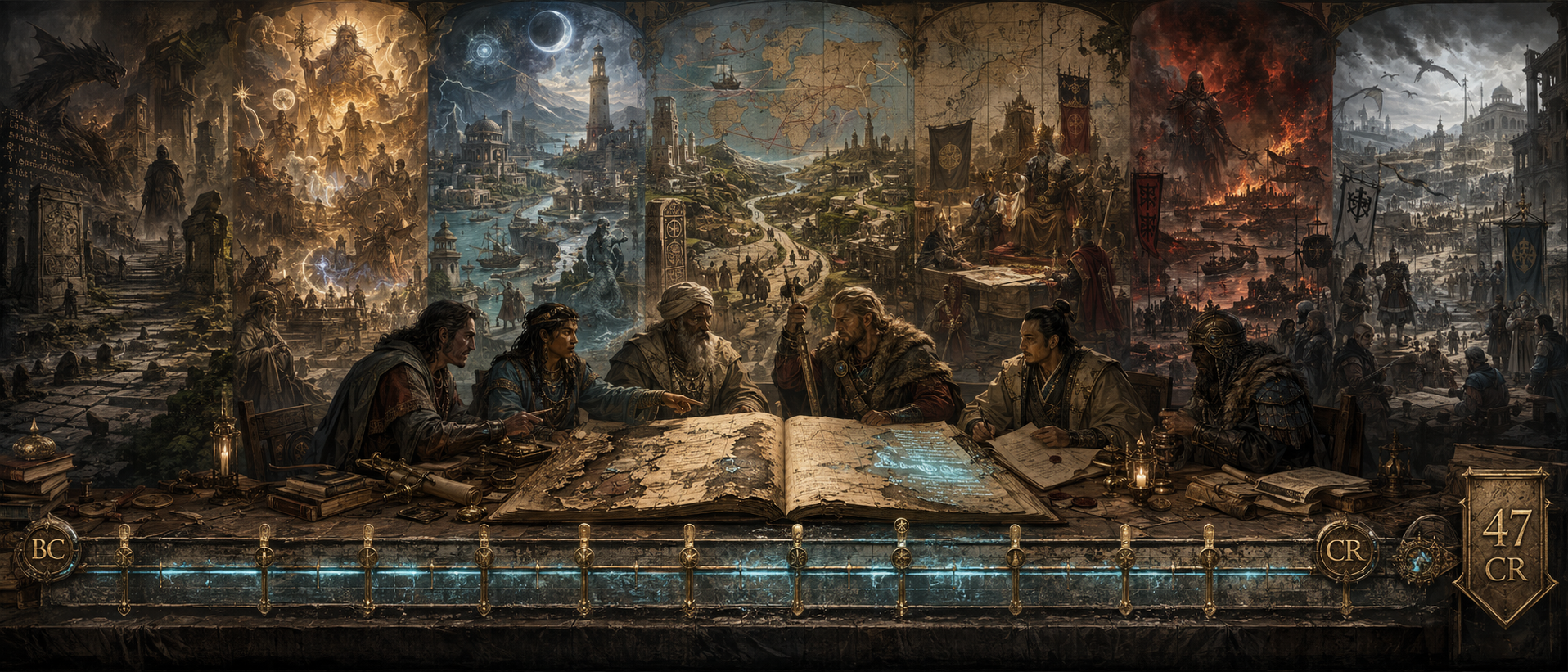
World Timeline
The history of Thesalon is recorded through the Concordance Reckoning, the shared calendar used in formal diplomacy, trade, temple records, archives, military reports, and intercontinental law.
Dates before the recognized end of the Caerlon invasion are written as BC, meaning Before the Crownless Age. Dates after the principal Vorrakian withdrawal are written as CR, meaning Crownless Reckoning.
The present campaign year is 47 CR.
Ancient dates are approximate. The surviving records of the Age of Blessings and the earliest foundations combine archaeology, temple traditions, court histories, oral accounts, magical testimony, later copies, and records produced centuries after the events they describe. Dates become more reliable during the Age of Roads and Covenants, when long-distance archives and shared calendars became common.
Even recent dates can be disputed. Caerlon, Vorrak, Marithel, and several religious institutions disagree over when the invasion technically began and whether it ever legally ended.
On This Page
- Using the Timeline
- Calendar and Dating
- Summary of the Historical Ages
- The Time Before
- The Age of Blessings
- The Age of First Foundations
- The Age of Roads and Covenants
- The Age of Expanding Powers
- The Age of Crowns
- The Invasion Years
- The Early Crownless Age
- The Reconstruction Generations
- The Present Decade
- Current Year: 47 CR
- Dates Commonly Disputed
- What Most People Know
- Related Pages
Using the Timeline
This page is a chronological reference rather than a complete account of every event. Major periods and turning points receive concise descriptions, while dedicated history pages contain the fuller political, military, cultural, and regional context.
Dates marked approximately indicate that surviving sources agree on the general period but not the exact year. A range separated by an en dash indicates that the event developed over several years. A question mark indicates a date accepted by some institutions but disputed by others.
Regional founding traditions sometimes give older dates than this timeline. Such traditions may refer to an earlier camp, shrine, harbor, court, or inhabited site rather than the later institution now using the name.
Calendar and Dating
The Concordance Reckoning developed from the calendar agreement reached at Selvarin during the Age of Roads and Covenants. Before that agreement, every continent and many individual polities used local regnal years, flood counts, winter records, feast cycles, harbor tallies, route seasons, or stewardship rotations.
The present system divides history around the end of the Caerlon invasion:
| Form | Meaning | Example |
|---|---|---|
| BC | Before the Crownless Age | 72 BC |
| CR | Crownless Reckoning | 18 CR |
| approximately | Exact year uncertain | approximately 640 BC |
| traditional date | Preserved by a major institution but not universally verified | traditional date: 411 BC |
| disputed date | Major sources disagree | 3 BC or 2 BC |
The transition from 1 BC to 0 CR marks the recognized withdrawal of the principal Vorrakian invasion host and the beginning of the postwar political order. There is no year 0 BC.
The invasion itself began before the Crownless Reckoning. Most modern histories treat 3 BC through 0 CR as the formal Invasion Years, although covert preparation began much earlier and some eastern communities continued fighting after 0 CR.
Summary of the Historical Ages
| Age | Approximate dates | Defining developments |
|---|---|---|
| The Time Before | Before approximately 2200 BC | Uncertain mortal beginnings, elder powers, divine multiplicity, and fragmentary prehistorical evidence |
| Age of Blessings | approximately 2200–1650 BC | Divine competition, the Gigantomaki, mortal alliances with gods, and the rise of the Primordial Few |
| Age of First Foundations | approximately 1650–1050 BC | First enduring cities, courts, harbors, holds, river authorities, stewardships, and public institutions |
| Age of Roads and Covenants | approximately 1050–720 BC | Long-distance roads, sea lanes, pilgrimage systems, shared calendars, route law, and intercontinental contact |
| Age of Expanding Powers | approximately 720–190 BC | Regional states, leagues, Great Seats, temple authorities, stewardship territories, and major political consolidation |
| Age of Crowns | approximately 190–3 BC | Mature international order, prosperity, permanent diplomacy, political confidence, and hidden invasion preparation |
| Invasion Years | 3 BC–0 CR | Ashen Banner betrayal, Vorrakian landings, Scouring, continental resistance, Synod fracture, and withdrawal |
| Early Crownless Age | 0–12 CR | Succession failure, emergency government, refugee crisis, tribunals, reconstruction compacts, and new regional legitimacy |
| Reconstruction Generations | 13–39 CR | Return, diaspora settlement, debt disputes, rebuilding, archive recovery, and institutional consolidation |
| Present Decade | 40–47 CR | Renewed Broken Chain tension, unfinished invasion investigations, rising political rivalry, and campaign-era instability |
The Time Before
Before approximately 2200 BC — The Unmeasured Past
The earliest period of Thesalon’s history cannot be reliably placed within the Concordance Reckoning. Surviving evidence includes old foundations beneath later cities, sealed ruins, divine traditions, giant roads, dragon memories, living-land impressions, funerary fragments, and inscriptions that do not use any recognized calendar.
Later cultures tell different stories about the first mortal peoples. Some claim mortals were created by individual gods. Others describe gradual emergence from rivers, forests, stone, sea, fire, starlight, shadow, or older worlds. Several traditions maintain that mortal civilizations existed before the gods took their present names.
No single account is accepted across Thesalon.
Approximately 2400–2250 BC — The Era of Many Domains
Temple traditions describe a world influenced by hundreds of gods, divine spirits, local powers, sacred beasts, personified forces, and unnamed beings with overlapping domains.
Several gods might claim the same harvest, storm, river, marriage, forge, death, road, or form of magic. Mortal communities negotiated among these powers through sacrifice, oath, service, and local tradition.
Later religious law describes the period as unstable because divine claims lacked clear boundaries. Some scholars argue that this judgment reflects the interests of the gods who survived.
Approximately 2250 BC — The Silencing of the Finch
A widely repeated divine tradition tells of a forgotten nature power who attempted to silence the Fool’s Gold Finch, the favored bird of Vaelthorn.
Vaelthorn answered by firing an arrow through the offending god’s neck.
Temple historians often identify this act as the first openly acknowledged killing of one god by another. The event’s location is traditionally associated with Finchfall Hollow, though no universally accepted site has been verified.
Approximately 2240–2200 BC — The First Divine Alliances
The death associated with the Finch divided the divine powers. Gods formed factions, recruited mortal followers, claimed sacred territories, and offered increasingly powerful blessings in exchange for loyalty.
Mortals ceased to be passive worshippers. Cities, clans, peoples, warbands, priesthoods, and magical traditions chose sides according to their own interests.
These alliances led into the Age of Blessings.
The Age of Blessings
Approximately 2200 BC — Beginning of the Age of Blessings
Mortals remember this period as the Age of Blessings because gods competed for worship through healing, protection, knowledge, fertility, military power, magical instruction, and supernatural gifts.
Several restricted divine sources call the same period the Gigantomaki, or War of the Gods.
The two names reflect different memories. Mortals remember what they received. Divine histories remember the war that produced those gifts.
Approximately 2170 BC — The First Blessing Courts
Temple settlements and ruler-priests establish formal courts for negotiating divine gifts. These courts record sacrifices, miracles, divine obligations, and the conduct expected of communities protected by a god.
The earliest blessing courts become predecessors of later temple law, oath law, divine contracts, and sacred witness traditions.
Approximately 2130 BC — The War of Shared Domains
Divine factions begin attacking rivals with overlapping authority. Conflicts over death, storms, growth, fire, prophecy, law, sea travel, and mortal kingship produce some of the age’s most destructive events.
Several locations associated with these struggles survive only as disputed or restricted sites:
- the Court of the Unshared Sun;
- the Moonless Stair;
- the Drowned Choir;
- the Garden That Refuses Names;
- the Broken Feast Hall.
Approximately 2090–2010 BC — Mortal Ascendancy Within the War
Mortal rulers, priests, mages, and communities learn to bargain between divine factions. Some change allegiance. Others force divine powers to recognize mortal conditions before receiving worship.
This period produces the oldest traditions in which mortals judge gods rather than merely obey them.
Several saints, legendary rulers, and culture founders are placed in this period, though surviving accounts often combine multiple historical people into one figure.
Approximately 1980 BC — The Great Refusals
Several mortal coalitions refuse to continue supporting divine wars without limits on the destruction of mortal settlements.
The coalitions’ exact names have been lost or absorbed into later religious traditions. Their actions are credited with forcing some gods to negotiate domain boundaries and mutual restrictions.
Approximately 1900–1760 BC — Decline of the Divine Factions
The number of openly active gods decreases through death, absorption, exile, loss of worship, transformation, withdrawal, and negotiated surrender.
Divine beings once treated as gods become saints, spirits, fiends, planar powers, monsters, ancestral beings, or unnamed remnants in later traditions.
Approximately 1700 BC — The Division of Dominion
The surviving gods establish a new order in which major divine domains no longer openly overlap without agreement.
This settlement is associated with the rise of the Primordial Few, the divine powers recognized by most modern temple systems.
Whether the Division of Dominion was a formal compact, a gradual outcome, or later temple propaganda remains disputed.
Approximately 1650 BC — End of the Age of Blessings
Open divine warfare recedes. Mortal institutions retain blessings, laws, magical traditions, sacred sites, and unresolved divine obligations.
The decline of direct divine conflict allows permanent mortal settlements to expand without being continuously reorganized around divine war.
The Age of First Foundations begins.
The Age of First Foundations
Approximately 1640 BC — The First Public Granaries of Caerlon
Communities in the Heart Plains establish protected grain stores governed by shared locks and public witness. Later Heartplain tradition attributes the system to the Nine Granary Mothers.
The granary system becomes one of the oldest continuous public obligations in Caerlon.
Approximately 1620 BC — Avenor Hall
Aeva Maren establishes the political and archival foundations later associated with Avenor Hall and Crownward Seat.
The early hall is remembered as an open court where rulers, road representatives, farmers, and petitioners could enter under public protection.
Approximately 1590 BC — The Torin Crossing Compact
Settlements near the Torin crossing formalize ferry, bridge, toll, and refuge obligations under Torren Vale and the early bridgewardens.
The crossing later becomes Torinbridge and the center of the Torin Freeholds.
Approximately 1570 BC — Varrow Anchorage
Celene Varrow expands a protected western anchorage into a permanent harbor and refuge system.
The settlement later becomes Highharbor.
Approximately 1550 BC — Silveredge Gatehold
Dorran Kes and allied mountain communities establish guarded pass, quarry, refuge, and sealed-site procedures in the Silveredge Mountains.
These institutions become predecessors of the Silveredge Holds.
Approximately 1630 BC — Maulhall and the Maw Court
Gurakh establishes an early feast and hunting authority in Vorrak at the site later known as Kharzug-Maul.
The court’s authority rests on protection, feeding, hunting rights, and submission.
Approximately 1600 BC — Neth-Kharn
Neth Varkul develops the sepulcher settlement and death registry that become the foundation of the Hollow Crown.
The early court records names, inheritance, burial, and obligations continuing after death.
Approximately 1560 BC — Drakkar-Grim
Hadrakka establishes the first recognized fortress authority at the Grimspine heights.
The settlement later becomes the center of the Grimspine Dominion.
Approximately 1530 BC — Ashak Furnace-Crown
Varkhûl consolidates several volcanic forge works into the first Furnace-Crown authority.
Its workshops become the institutional ancestors of the Ashen Throneholds.
Approximately 1500 BC — The First Iron Road
Urgath Korr organizes mobile tribute, road protection, supply marks, and traveling judgment along the early Iron Road.
Approximately 1590 BC — Anuth-Selai
Selai Anuth establishes one of the earliest formal water courts along the Anointed River.
The court’s records become foundational to Suthrani river law.
Approximately 1560 BC — Ivratha
Ivrath Bel organizes floodplain granaries, levee obligations, and seed protection in the Ivory Floodplain.
Approximately 1530 BC — Mereth-Kai
Kai Mereth establishes a protected Inner Sea harbor and maritime assembly.
The settlement later becomes a major center of the Inner Sea admiralties.
Approximately 1500 BC — Osseran
Ossa Ren formalizes desert well law, caravan refuge, and route witness around Osseran.
Approximately 1470 BC — Kharad-Sur
Sur Kharad establishes guarded passage through a principal Sundered Mountain route.
Approximately 1610 BC — Skeldheim
Yrsa Skeld organizes shared hearth, refuge, winter food, and hall obligations in southern Veyrskold.
Approximately 1570 BC — Stonewake Hold
Palvar establishes permanent watch and maintenance at ancient sealed sites.
Approximately 1540 BC — Hrafnvik
Maeva Hrafn develops a northern rescue harbor and seasonal sea assembly.
Approximately 1510 BC — Dromgard
Torva Linn and the giant Drom Stone-Son establish the first recorded mortal–giant road agreement at Dromgard.
Approximately 1480 BC — Emberdeep
Arn Kael organizes safe access to geothermal heat, forge vents, and underground fire.
Approximately 1600 BC — Whiteglass Harbor
Merai Whiteglass establishes a harbor, pilot house, lens workshop, and safe-water court in Marithel.
Approximately 1570 BC — Tidewall and Highfall
Nara Highfall develops a defended harbor and elevated warning system at the eastern maritime approaches.
Approximately 1540 BC — Windrider Mooring
Talis Windrider establishes the open mooring and guest-right customs that later develop into Windrider Freeport.
Approximately 1510 BC — Lanternhold
Elira Lanternbearer establishes the earliest recognized monastery and lighthouse community at Lanternhold.
Approximately 1480 BC — Stormgate
Sera Chainwake and Volan Marr establish an engineered passage authority controlling chains, warning, closure, and pilotage.
Approximately 1450 BC — Reefcourt
Sula Reefborn establishes one of the earliest formal reef adjudication traditions.
Approximately 1600 BC — Aelora
Aela Rootspeaker establishes formal canopy stewardship, bridge maintenance, and water-sharing practices.
Approximately 1570 BC — Saren-Tel
Saren Tel organizes wetland channels, floating markets, fishing rights, and flood movement.
Approximately 1540 BC — Emerald Crown
Ila Ven and Korren Mossback establish plateau stewardship over springs, terraces, grazing, and old-growth ridges.
Approximately 1510 BC — Mistwell
Olyen Mistmark formalizes guide law and protected entry along the Mists of the Unknown.
Approximately 1480 BC — Namarra
Namar Ra establishes healing gardens, medicine exchange, and restrictions on harmful plant removal.
Approximately 1050 BC — End of the Age of First Foundations
The earliest cities and institutions are now linked by growing regional routes. Their local agreements become the foundation for wider road, river, harbor, pilgrimage, and stewardship systems.
The Age of Roads and Covenants
Approximately 1040 BC — Expansion of the Archive Road
Caerlonian road communities connect Avenor Hall, the Heart Plains, Torin crossings, Highharbor, and several eastern and mountain routes.
Road maintenance becomes an obligation shared among crowns, towns, estates, granaries, and bridge authorities.
Approximately 1010 BC — The Nine-Lock Charter
The Heartplain granaries formalize protected seed, famine relief, and public access under the Nine-Lock Charter.
The charter becomes one of Caerlon’s most enduring legal traditions.
Approximately 990 BC — The Open Span Agreement
Torin crossing communities establish shared bridge repair, ferry backup, evacuation, and toll procedures.
The agreement restricts any one ruler from closing the crossing without local consent.
Approximately 970 BC — The Highharbor Refuge Wall
Highharbor expands its protected anchorage and builds the Inner Refuge Wall, providing shelter for civilian vessels during storms and coastal violence.
Approximately 1030 BC — The Iron Road Expansion
Vorrakian tribute systems connect the Maw Court, Varkul, Grimspine routes, Ashen forges, and outer court territories.
Iron Tables begin recording passage, protection, obligation, and court affiliation.
Approximately 990 BC — The Antler Path Covenants
The Blackwood authorities establish negotiated routes through protected forest territory.
The covenants regulate medicine, timber, hunting, refuge, and the conduct of armed travelers.
Approximately 950 BC — The First Court Marks
Vorrakian courts develop portable marks recognizing envoys, tribute, challenge, protection, death claims, and passage.
These marks later allow hostile courts to negotiate without accepting common law.
Approximately 1020 BC — The High Water Roads
Suthrani river communities coordinate canal, barge, flood, and pilgrimage movement along the Anointed River.
Approximately 980 BC — The Procession Roads
Major temple precincts establish recognized pilgrimage routes, refuge stations, burial grounds, and water rights.
Approximately 940 BC — The Nine Wells Circuit
Osseran caravan houses formalize a major desert route linking wells, caravanserais, temples, river markets, and mountain approaches.
Approximately 1000 BC — The Giant Step Accord
Mortal holds and giant communities in Veyrskold establish recognized rights on roads too large or old for ordinary settlement law.
Approximately 960 BC — The Ember Road
Veyrskoldic communities link geothermal settlements, winter refuges, mines, and southern trade routes.
Approximately 920 BC — The First Warden Chain
Stonewake and neighboring holds begin exchanging sealed-site warnings through coded stone records and trusted runners.
Approximately 1010 BC — The Nine Rescue Fires
Maritheli harbors establish mutual rescue districts, emergency lights, and harbor refuge obligations.
Approximately 970 BC — The Great Light Standards
Major lighthouse communities begin sharing procedures for lenses, oil, keeper training, warning, closure, and signal authentication.
Approximately 930 BC — The Open Mooring Compact
Windrider establishes protections for foreign crews, temporary names, neutral repairs, and guest hearings.
Approximately 990 BC — The Living Bridge Routes
Aeloran canopy communities establish shared construction, inspection, fire response, and evacuation standards.
Approximately 950 BC — The Moving Channel Agreements
Saren-Tel communities coordinate wetland routes and establish procedures for boundaries altered by floods.
Approximately 910 BC — The First Mist Guide Circles
Mistwell route-keepers establish licensed entry, protected waiting grounds, and limits on unrestricted mapping.
Approximately 880 BC — The First Regular Intercontinental Routes
Sustained sea and caravan connections emerge among Caerlon, Marithel, Suthrane, Veyrskold, Ilyr, Selvarin, and controlled Vorrakian landing sites.
Trade, pilgrimage, diplomacy, mercenary service, medicine, and migration increase.
Approximately 835 BC — Founding of the Selvarin Meeting Courts
Selvarin becomes a regular neutral meeting place for foreign merchants, temple judges, harbor representatives, rulers, and route authorities.
803 BC — The Concordance of Days
Delegates at Selvarin adopt the calendar framework that becomes the Concordance Reckoning.
The agreement does not erase local calendars. It creates a shared dating system for treaties, long-distance trade, religious correspondence, and historical archives.
Approximately 770 BC — The First Continental Route Disputes
Conflicts emerge over whether control of a route gives authority over the communities it serves.
The resulting rulings distinguish maintenance obligation, toll rights, military access, ownership, stewardship, and public passage.
Approximately 720 BC — End of the Age of Roads and Covenants
Route authorities possess enough wealth, records, labor, and force to become regional powers.
The Age of Expanding Powers
693–611 BC — The Maren Consolidation
Queen Elira Maren expands Crownward authority through road protection, grain obligations, archives, marriage, and military force.
The Renewal of the Open Hall in 667 BC formalizes Crownward protection and regional service.
654–651 BC — The Western Road War
Lord Harven Dain attacks Crownward road construction. Engineer Maela Pell traps his force at Dain’s Cut.
The captured estate becomes the Westroad Court and Survey House.
638 BC — Recognition of Estenmark
The defensive command organized by Coren Esten becomes a recognized eastern polity centered on Estenwatch.
617–612 BC — The Black Barge Campaign
Estenmark commander Ysella Reedwatch defeats raiders attacking river traffic and uncovers links to foreign and Highharbor buyers.
604 BC — The First Heartplain Assembly
Arelia Tallseed becomes the first recognized speaker of the regional grain and road assembly.
571 BC — The Torin Freehold Declaration
Bridgewarden Selka Vale establishes the constitutional foundation of the Torin Freeholds.
538 BC — The Highharbor League Charter
Seven coastal settlements establish shared convoy, harbor, court, refuge, and anti-piracy obligations.
502–476 BC — The Verdant Return
Princess Maevra Ellisar returns from exile and establishes the council of principal houses later known as the Verdant Court.
449 BC — The Silveredge Hold Compact
Mountain authorities establish shared pass defense, mine law, avalanche response, and sealed-site restrictions.
408 BC — Recognition of the Elderidge Oathlands
Judge Ysolde Renn formalizes the principle that certain lands and structures can be held only through continuing oath and maintenance.
701–642 BC — Expansion of Kharzug-Maul
Kharzug the Vast expands Maw Court claims through hunting, feast law, tribute, and protection.
674–608 BC — The Hollow Crown Consolidation
Queen Nethra Varkul expands control through death records, inheritance, burial, and the Quiet Annexations.
631 BC — Formation of the Grimspine Dominion
Drakkar Stone-Wing unites high passes, cliff settlements, fortress roads, and draconic alliances.
622–557 BC — Consolidation of the Ashen Throneholds
Varkhûla Ember-Crowned organizes the Seven Furnace Thrones and expands the Ash Road.
596–531 BC — The Walking Treasury
Urgath Korr V transforms the mobile Iron Tribute Host into one of Vorrak’s Great Seats.
580–519 BC — Expansion of the Blackwood Covenants
Grathmora Veyk extends forest protection, medicine, refuge, and route agreements beyond the Blackwood interior.
544 BC — Formation of the Red Waste Kharruk
Kharrokh Zul unites mobile communities around wells, routes, storehouses, and the Oath of Moving Ground.
518 BC — Recognition of the Dreadshore Eyries
Skarth Eyrak unites cliff settlements and signal houses controlling western Vorrakian waters.
497 BC — First Gaping Coast Brood Council
Ghorvash Many-Mouthed establishes negotiated law among several coastal broods.
411 BC — The First Dread Synod
Quinna of the Black Tongue convenes the Great Seats and outer powers to prevent route collapse and establish coordinated procedures.
681 BC — Establishment of the Anuth-Selai River Authority
Tessa Anuth establishes the High Water Bench and regional jurisdiction over cross-district river disputes.
652–571 BC — Expansion of the Grand Temple Precincts
High Custodian Avara Selen establishes the Procession of Eight Courts.
628–566 BC — Growth of the Ivory Floodplain Estates
Grain-Prince Oren Ivrath expands levees, raised roads, grain stores, and estate obligations.
611–538 BC — Formation of the Inner Sea Admiralties
Admiral Mara Kai establishes the Concord of Inner Waters.
587 BC — Organization of the Sunroad Caravans
Sera Maq II creates registered caravan banners, shared water audits, and rescue procedures.
558–506 BC — The Kharad-Sur Gate Dominion
Gate-Prince Halem Sur expands mountain toll and pass authority.
Approximately 530 BC — The War of Three Passes
Independent communities and caravan houses resist Kharad-Sur’s attempt to close alternate routes.
472 BC — The Temple and River Concord
Suthrane divides regional responsibilities among river, temple, floodplain, Inner Sea, and caravan authorities.
689 BC — Founding of the Skeldheim Hearth League
Eira Skeld establishes shared winter shelter, famine relief, road clearing, and defense.
646 BC — Formation of the Stonewake Warden Chain
Pala Stonewake links ruin-watching communities and establishes the Black Bell Protocol.
618 BC — The Dromgard High Compact
Mortals, giants, and dragon witnesses formalize roads, settlement, burial, and defense obligations.
593 BC — Formation of the Emberdeep Fireward
Runa Kael II establishes controlled access to geothermal and elemental resources.
Approximately 588 BC — The Red Thaw
Torvik Ashpick’s illegal excavation melts part of a glacier and destroys two settlements.
566–497 BC — The Hrafnvik Sea Crown
Arva Hrafn expands rescue, escort, trade, and fjord defense.
441 BC — The Northern Seal Council
Hold leaders, giants, dragons, wardens, and specialists establish shared sealed-site classifications.
703–637 BC — The Whiteglass Ascendancy
Serai Whiteglass expands influence through lensmaking, pilots, lighthouse repair, and controlled technical knowledge.
665–601 BC — The Highfall Watch Dominion
Nessa Highfall unites defended lights, convoy warning, rescue, and harbor military authority.
624 BC — The Windrider Freeport Charter
Judge Elian Blue-Lantern and Mara Windrider establish the Freeport Assembly and formal guest law.
581 BC — The League of Nine Harbors
Major Maritheli harbors establish shared rescue, convoy, chart, defense, and recognition systems.
Approximately 557 BC — The Red Wake Agreement
Vara Blackwake organizes the Tidebound private fleets under registered contract law.
528–472 BC — Formation of the Saltglass Principalities
Prince Calen Saltglass builds a network of island courts through dowry, glass, harbor investment, and diplomacy.
459 BC — Recognition of the Drowned Reef Cantons
Sulara Reefcourt unites reef communities against unrestricted outside salvage claims.
421 BC — The Sirenward Compact
Survivors, healers, lighthouse keepers, and navigators establish exclusion, rescue, and quarantine procedures near Siren’s Deep.
696 BC — The Aeloran Canopy Union
Lysa Aela links canopy communities through bridge, fire, water, and evacuation obligations.
653 BC — The Saren-Tel Channel Council
Pel Tel establishes regional wetland coordination and the Moving Boundary Rule.
626–548 BC — The Emerald Plateau Stewardship
Korra Mossback formalizes managed springs, terraces, forests, grazing circuits, and storm refuges.
604 BC — The Namarra Healing Network
Veyra Namar organizes medicine cultivation, quarantine, training, and the Closed Seed Rule.
571 BC — Recognition of the Mist Boundary Circles
Olyra Mistmark formalizes protected entry and guide licensing.
539–487 BC — Formation of the Thornward Marches
Vessa Thornward II organizes defended stewardship territory along western Ilyr.
512–507 BC — The War of the Taken Garden
Ilyrian stewards destroy a foreign plantation established using stolen medicinal life.
468 BC — Refusal of the First Complete Map
Guide authorities destroy a map that would have exposed protected Ilyrian communities and resources.
Approximately 300 BC — The First Caerlonian Balance
Caerlon’s major crowns, freeholds, assemblies, leagues, holds, oathlands, and principalities become recognizable as enduring political blocs.
Approximately 250–210 BC — Permanent Envoy Houses Expand
Selvarin and major foreign ports establish regular continental representation, archives, and treaty offices.
Approximately 190 BC — End of the Age of Expanding Powers
The principal political systems of the later Age of Crowns are in place.
The Age of Crowns
142 BC — Ascendancy of the House of Vaelor
King Aven Vaelor resolves the later Maren succession crisis through the Compact of Two Inheritances.
Approximately 135 BC — Creation of the Vaelor Crown
The Crown of Many Foundations is made from material associated with Caerlon’s major regions.
Critics call it the Borrowed Crown.
86–49 BC — Reign of Queen Elara Vaelor
Crownward diplomacy reaches its greatest influence. Permanent exchanges expand with Marithel, Suthrane, Veyrskold, Ilyr, Selvarin, and Vorrak.
79 BC — Creation of the Continental Seal
Queen Elara establishes a seal for treaties involving several Caerlonian powers.
Foreign governments increasingly mistake Crownward representation for direct continental rule.
74 BC — Opening of the Hall of Seven Delegations
Permanent regional delegations establish offices within Crownward Seat.
72–38 BC — Command of Marshal Torren Esten
Torren Esten expands eastern patrols, Broken Chain surveys, military roads, and warning towers.
69 BC — First Major Eastern Warning
Estenmark reports new Vorrakian route marks and unusual movement along the Broken Chain.
65 BC — Second Major Eastern Warning
Estenmark reports coordinated Dreadshore signals and growing Ashen material shipments.
61 BC — The Synod of Closed Mouths
Vrassa Black-Tongue convenes a secretive Dread Synod gathering concerned with internal pressure, western routes, foreign readiness, and resource needs.
Approximately 60 BC — Beginning of the Hunger Census
Vorga Feast-Count records population, food, herds, tribute, and war-host requirements across Vorrak.
Approximately 59 BC — Commissioning of the Empty Ledger
Nethra Oss Varkul oversees projected death and casualty records, including entries associated with Caerlon.
Approximately 58 BC — Expansion of the Ash-Oath Program
The Ashen Throneholds increase production of siege material, armor, road components, Warglass devices, and naval fittings.
Approximately 57 BC — Establishment of the Westward Tables
Urgath-Korr expands Iron Tables and supply records toward the Dreadshore and Broken Chain.
Approximately 56 BC — The Dreadshore Watch Accord
Signal houses standardize foreign fleet reports, hidden landing marks, storm messages, and long-distance warnings.
55 BC — The Eastern Readiness Grant
Crownward funds limited fortification and intelligence but does not establish a permanent continental army.
53 BC — Third Major Eastern Warning
Estenmark reports evidence consistent with coordinated overseas military preparation.
No general mobilization follows.
Approximately 52 BC — The Blackwood Refusal
Yara Grathmora refuses unrestricted support for a westward Synod war policy.
Several boundary groves are later burned.
Approximately 51 BC — The Red Waste Opposition
Kharra Zul refuses permanent Synod roads through Kharruk territory.
49 BC — Death of Queen Elara Vaelor
The Crownward succession passes through the Vaelor line amid growing regional disagreement over continental authority.
47 BC — Final Reorganization of the Crownward Road Surveys
Detailed maps of road capacity, bridges, depots, granaries, military relays, and travel time are copied into several archives.
Parts of these surveys later disappear.
Approximately 44 BC — Expansion of the League Debt Web
Coinmast and other Maritheli financial houses increase investment in Caerlonian roads, shipping, estates, and military supply.
42 BC — The Court of Second Return
Princess Aelia Ellisar establishes that resurrection restores personhood but not every former title, marriage, or estate.
39 BC — The False Light Reports Begin
Several Maritheli Great Lights transmit signals not matching official keeper logs.
38 BC — End of Torren Esten’s Command
Later eastern commanders inherit his warnings, surveys, and incomplete preparations.
Approximately 36 BC — The Western Dieback
Ilyrian stewards identify declining medicinal ecosystems associated with foreign extraction.
34 BC — The Mistwell Restriction
Ilyr limits foreign access to complete interior maps while continuing to provide destination and emergency routes.
Approximately 32 BC — Formation of the Ashen Banner Conspiracy
Brigadier Cassian Veyr and senior officers begin contact with intermediaries serving Vorrakian scouts and courts.
30 BC — First Confirmed Ashen Banner Information Transfer
Route surveys, patrol rotations, signal schedules, and bridge-capacity records pass through Broken Chain intermediaries.
27 BC — The Book of Unarrived Dead
Suthrani funerary authorities begin recording unexplained names and casualty estimates associated with deaths not yet known to have occurred.
24 BC — Namarra Military-Purchase Warning
Ilyrian healers identify foreign purchases consistent with preparation for mass mobilization.
21 BC — Velkorath’s Slate Warning
The Veyrskoldic dragon Velkorath the Slate-Eyed warns Estenmark that western heights are being measured from the east.
18 BC — Syraxa’s Ashen Production Testimony
Syraxa Ember-Memory concludes that the Ashen Throneholds are producing at wartime scale.
15 BC — Lawkeel Counterfeit-Seal Warning
Cargo-Judge Vessa Lawkeel proposes stronger recognition procedures after identifying sophisticated counterfeit seals.
The League delays implementation.
12 BC — The Far-Treaty Warehouse Fire
Records documenting unusual Vorrakian purchases are destroyed or dispersed.
10 BC — The Thornward Readiness Walk
Ilyrian patrols discover hidden stores, altered route marks, and measured water capacity near western approaches.
8 BC — The White Rope Closure
Veyrskold closes a major glacier route after unexplained black fractures appear beneath the ice.
7 BC — Final Farwake Defector Warnings
Farwake navigators transport witnesses describing Synod coordination and western military preparation.
6 BC — Last Major Prewar Crownward Conference
Crownward, Estenmark, Heartplain, Torin, Highharbor, and regional delegates fail to agree on permanent mobilization.
5 BC — Westward Synod Compact
The Great Seats and participating outer powers finalize the shared obligations enabling the invasion.
4 BC — Prefabrication of the Rookscar Bridge Frame
Ashen engineers construct reinforcement components using information supplied by the Ashen Banner Brigade.
The Invasion Years
3 BC — The Hidden Crossing
Vorrakian scouts, engineers, supplies, agents, forged documents, and route specialists move through the Broken Chain.
Dreadshore signal houses prepare staging points.
3 BC — Final Ashen Banner Preparations
Signal-Major Oren Pell alters warning schedules. Quartermaster Halvek Sorn moves reserve animals and bridge equipment. Loyal scouts are redirected. Ashen Banner engineers prepare Rookscar Gap.
3 BC — Opening of the Eastern Gate
Cassian Veyr reports the first landings as isolated raids and falsely declares the eastern line intact.
Vorrakian forces cross Rookscar Gap and seize signal heights.
3 BC — The First Landings
Dreadshore, Gaping Coast, Iron Tribute, Ashen, Grimspine, Maw Court, and Varkul forces establish multiple coastal and estuary positions.
3 BC — Fall of the Eastern Warning Line
False signals are transmitted from Rookscar Heights, Three-Bell Ridge, and other captured stations.
Marshal Elian Esten orders all eastern signals treated as compromised.
3 BC — Battle of Greywatch Junction
Loyal Ashen Banner companies seize their own headquarters and capture Oren Pell.
Cassian Veyr escapes under Iron Tribute protection.
Greywatch is later abandoned.
3–2 BC — The War of Roads
The invasion targets bridges, depots, records, signals, granaries, and junctions.
Major actions include the Battle of Five Milestones, Bellweather Ford, Redbank Crossing, and the defense of Pell Archive House.
2 BC — Burning of Hearthvale
Mara Keslin creates the False Census and saves hundreds before being executed.
Hearthvale is destroyed.
2 BC — Siege of Estenwatch
Drekar Stone-Wing and Furnace-General Varkessa Sar fail to take the fortress.
2 BC — The Long Withdrawal
General Maera Esten evacuates eastern communities and preserves much of the Estenmark army.
2 BC — Battle of Six Keys
Heartplain defenders disperse the grain supply and prevent the rapid seizure of the central stores.
2–1 BC — The Burned Furrow Campaign
Maw Court forces attack fields, mills, livestock, and agricultural settlements.
1 BC — First Battle of Torinbridge
The Freeholds refuse Iron Tribute passage and hold the eastern approach.
1 BC — Night of Closed Ledgers
Varkul agents enter Torinbridge among refugee columns and attempt to seize identity and inheritance records.
1 BC — Battle of the Three Spans
Bridgewarden Jessa Vale destroys the eastern span to stop the largest assault on Torinbridge.
1 BC — Battle of the Seven Roads
Caerlonian regional forces defend the approaches to Crownward Seat without surrendering their separate commands.
1 BC — Assault on the Continental Archive
Varkul and Ashen detachments seize or destroy records, though archivists preserve the oldest foundations and plant false documents among the captured material.
1 BC — Death or Disappearance of King Alaric Vaelor
The western command gallery is struck by Warglass. No universally accepted body is recovered.
The Vaelor crown disappears.
1 BC — Defense of the Open Hall Steps
General Seressa Vaelor, Dessa Tallseed, Maren Renn, and a mixed force hold the archive approaches until civilians and records are removed.
1 BC — The Western Lifeline Convoys
Highharbor, the League of Nine Harbors, Windrider, Suthrani suppliers, Veyrskoldic escorts, and Ilyrian healers expand foreign support.
1 BC — Battle of Saltwatch Roads
Highharbor defeats an attempt to close the western maritime route.
1 BC — The Field of White Cords
Suthrani funerary officials and Caerlonian defenders prevent Varkul from claiming a battlefield’s dead.
1 BC — Battle at Kesward Deep
Silveredge defenders stop an Ashen operation near a sealed mountain chamber.
1 BC — Defense of the Court of Returning Heirs
Verdant claimants and living successors protect resurrection and inheritance records.
1 BC — Fracture Over the Heartplain Grain
Maw Court, Iron Tribute, and Ashen forces fight over captured supplies and priority claims.
1 BC — Withdrawal of Varkul
Auditor Nethra Voss removes prisoners, bodies, royal objects, and archive chests from the Crownward campaign.
The eastern encirclement weakens.
1 BC — Death of Feast-Lord Kharzug Vorr
Caerlonian and Maw Court accounts disagree over whether he was killed by Heartplain archer Tessa Redsheaf II or by an Iron Tribute weapon.
1 BC — Breaking of the Ash Road
Silveredge engineers, Hidden Lantern saboteurs, Caerlonian scouts, and Maritheli raiders destroy the Chainfall Ravine bridge.
1 BC — Refusal at Rookscar
Red Waste Kharruk and Blackwood authorities restrict reinforcement routes after the Synod attempts permanent control.
1 BC–0 CR — The Continental Counteroffensive
Crownward, Estenmark, Heartplain, Torin, Highharbor, Marcher, foreign, and regional forces coordinate objectives without creating one permanent command.
0 CR — Retreat Across the Broken Chain
The principal Vorrakian invasion hosts withdraw east.
Some warbands, recovery teams, agents, and isolated units remain in Caerlon.
0 CR — Battle of Broken Chain Sound
Admiral Elya Farwake III attacks a major Dreadshore evacuation convoy but cannot close the eastern exit.
0 CR — The Last Eastern Road Decision
Marshal Elian Esten ends the principal pursuit at Rookscar Gap rather than carry the war into the Broken Chain.
0 CR — Beginning of the Crownless Reckoning
No peace treaty is signed.
The old Crownward succession remains unresolved, prisoners remain in Vorrak, and the political order begins reorganizing around surviving institutions.
The Early Crownless Age
0–1 CR — The First Postwar Winter
Grain shortage, damaged roads, refugees, isolated warbands, unburied dead, and foreign debt threaten Caerlon after the main withdrawal.
1 CR — The Winter of Six Tables
Major Caerlonian authorities meet in the Heart Plains to coordinate food, roads, burial, missing people, refugees, and foreign obligations.
Temporary offices created during the gathering later become permanent.
1 CR — Formation of the Council of the Empty Crown
Princess Elara Vaelor, General Seressa Vaelor, Archivist Merra Pell V, and other regional representatives establish emergency government in Crownward Seat.
1 CR — The Empty Throne Decision
The damaged Crownward throne is removed from its raised platform and placed behind a sealed screen.
No claimant is crowned.
2 CR — Eastern Defense Articles
Marshal Elian Esten establishes Estenmark’s independent control over frontier defense, patrols, officers, and Broken Chain monitoring.
2 CR — Creation of the Eastern Reconstruction Command
General Maera Esten classifies territory as Restored, Guarded, Contested, or Scoured.
2 CR — Heartplain Settlement
Protected seed law, famine priority, and limited repayment obligations are reaffirmed.
2 CR — Emergency of the Open Span Ends
Torinbridge returns from wartime emergency procedure to Freehold civil control.
3 CR — Rebuilding of the Three Spans Begins
Heartplain labor, Silveredge engineering, Estenmark security, Highharbor finance, and Maritheli fittings support the reconstruction of Torinbridge.
3 CR — Founding of the Registry of Closed Names
Orris Vale begins recording people whose legal identity disappeared during the Night of Closed Ledgers.
3 CR — Founding of the Marcher Concord
Survivor communities, forts, local councils, militia remnants, and rebuilt towns gather at West Hearthvale.
3 CR — West Hearthvale Articles
The Marcher Concord recognizes rebuilding, occupancy, local defense, protected defectors, and limits on outside military authority.
4 CR — The Western Reckoning
Highharbor begins reviewing wartime supply contracts, rescue claims, predatory loans, private military agreements, and foreign debt.
4 CR — Formation of the Harbor of Names
Highharbor establishes identity and refugee hearings in the western warehouse districts.
4 CR — The Court of Living Succession
The Verdant Principalities expand post-resurrection law to address disappearance, refugee occupation, wartime marriage, and inherited office.
4 CR — Kesward Restrictions
The Silveredge Holds classify mountain works and restrict excavation near sealed or unstable depths.
5 CR — The Ashen Banner Articles
The brigade is dissolved, but collective punishment of ordinary soldiers and their families is rejected.
5 CR — Greywatch Tribunal Opens
Surviving conspirators, loyal soldiers, defectors, financial witnesses, and archivists testify.
5 CR — Death of Oren Pell
The captured signal major dies before full public examination.
5 CR — Execution of Halvek Sorn
The former quartermaster admits moving supplies and receiving foreign payment.
6 CR — Tessa Marr Receives Protected Witness Status
Her sealed testimony implicates wider political and financial networks.
6 CR — Road and Bridge Compact
Caerlon’s major powers divide responsibility for strategic route reconstruction without creating one central ministry.
6 CR — Western Relief Accord
Highharbor, Grainwake, Suthrani grain authorities, and the Heartplain Assembly coordinate emergency food movement.
6 CR — Missing and Dead Concord
Caerlonian, Suthrani, Torin, and Highharbor institutions establish shared procedures for conflicting identity, casualty, burial, and refugee records.
7 CR — Marcher Return Agreement
Estenmark and the Marcher Concord establish procedures for refugee resettlement and military closure in damaged territory.
7 CR — Common Return Mark
Crownward, Estenmark, Torin, Highharbor, and Marcher documents gain a shared recognition symbol after the War of the Five Stamps.
8 CR — Homeward Lantern Fleet
The first large organized refugee return fleet sails from Windrider Freeport to Highharbor.
8 CR — Dual Name Hearings
Returnees gain the right to preserve recognized refuge names while reopening earlier Caerlonian identities.
8 CR — Founding of New Bellweather
The rebuilt settlement installs the cracked warning bell in its public hall.
9 CR — Establishment of Low Lantern Refuge
Windrider’s wartime sanctuary becomes a permanent refugee, identity, and legal district.
9 CR — Expansion of the Caerlon Steps
Grainwake formalizes raised housing and public kitchens for Caerlonian refugee families.
9 CR — Founding of Lantern House East
Vorrak-born defectors and Hidden Lantern survivors establish a protected community near Estenwatch.
10 CR — Great Reconciliation of Records Begins
Archivist Merra Pell V organizes conflicting Crownward, foreign, family, military, temple, refugee, and enemy records.
10 CR — Establishment of the Foreign Archive Rooms
Crownward creates dedicated collections for Maritheli, Suthrani, Veyrskoldic, Ilyrian, and Vorrakian records.
10 CR — Formation of the Unreturned Offices
Permanent offices open in Crownward Seat, Estenwatch, Highharbor, Torinbridge, and Selvarin.
11 CR — Establishment of the White Cord Houses
Suthrani funerary institutions create permanent communities for families of the missing, unburied, and Varkul-claimed.
11 CR — Founding of Northfire Camp
Caerlonian and Veyrskoldic workers establish a reconstruction and forge settlement near Emberdeep.
12 CR — Council of the Empty Crown Extended Indefinitely
The Crownward emergency government formally abandons its last fixed dissolution date.
The Crownward Remnant becomes a lasting polity.
The Reconstruction Generations
13 CR — Completion of the Principal Torinbridge Reconstruction
The repaired bridge incorporates original spans, wartime structures, and new construction.
14 CR — Establishment of the Six-Key Council
Heartplain emergency grain procedure becomes a permanent institution.
14 CR — Expansion of the Road Recovery Board
Regional offices begin maintaining shared route condition, closure, toll, and bridge records.
15 CR — Valenic Compact Recognized
River and freight communities formalize barge, warehouse, towpath, bridge, and emergency transport cooperation.
15 CR — Founding of New Ivrath Ford
Caerlonian refugee farmers and Suthrani floodplain communities establish a mixed agricultural settlement.
16 CR — Opening of the House of Two Births
A major Suthrani adoption institution begins preserving both known birth identities and later household identities.
16 CR — Northfire Warm Roof Articles
Foreign and local workers gain winter housing rights even after employment contracts end.
17 CR — Hrafnvik Oar Quarter Recognized
Caerlonian refugee crews, Veyrskoldic rescuers, and mixed maritime families establish a permanent harbor district.
17 CR — Green House of Returning Breath
Namarra opens a major recovery institution for Warglass injury, captivity, magical exhaustion, and war-related illness.
18 CR — Aeloran Guest Platform Procedures
The Canopy Union formalizes seasonal education and residence requirements for foreign arrivals.
18 CR — Free Passage Review
Windrider advocates begin challenging Debtwater passage contracts that transfer inheritance or bind families across generations.
19 CR — The Coinmast Harbor Cases Begin
Maritheli creditors attempt to enforce reconstruction liens against Highharbor quays, Torin tolls, Marcher roads, and Verdant estates.
19 CR — First Major Archive-Recovery Expeditions
Record recoverers enter the Scoured Marches, Broken Chain depots, foreign markets, and private collections.
20 CR — The House at Four Claims Ruling
A Marcher court divides title, occupancy, debt, and military access among four claimants to one fortified farmstead.
20 CR — Recognition of Ghoran’s Tideminders
Gaping Coast defectors receive protected settlement near Highharbor’s outer estuary.
21 CR — Establishment of the Three-Yard Houses
Ropefall formalizes a mixed shipworker and refugee district around three repair yards.
21 CR — Seven Lantern Society Founded
Families begin coordinated searches for the Gentle Rain, North Road, Lantern’s Mercy, and their missing passengers.
22 CR — First Verified Return From a Varkul Living-Dead Register
A Caerlonian prisoner returns alive despite having been declared legally dead by the Hollow Crown.
The case reshapes identity and inheritance law.
23 CR — Expansion of the Return Houses
Permanent return institutions open in Highharbor, Torinbridge, Crownward Seat, Estenwatch, and New Bellweather.
23 CR — Chainfall Watch Established
Veyrskoldic and Silveredge specialists create a long-term containment camp above Chainfall Ravine.
24 CR — First Exile Councils Recognized Abroad
Caerlonian diaspora councils gain formal standing in Windrider, Grainwake, Selvarin, Anuth-Selai, and Hrafnvik.
25 CR — Marcher Patrol Crisis
Estenmark and the Marcher Concord nearly enter armed conflict over patrol authority in contested territory.
The crisis is resolved through local route agreements.
26 CR — Partial Reopening of Greywatch West
Estenmark establishes an active post outside the ruined Ashen Banner headquarters.
27 CR — Discovery of Varkul Archive Fragments
Recovered ledgers contain names linked to prisoners, missing officials, and possible royal transport.
28 CR — Broken Chain Recovery Missions Expand
Private rescue crews, spies, smugglers, families, and state agents increase travel toward the old invasion depots.
29 CR — Grainwake Refugee Council Recognized
The Caerlon Steps receive formal representation in harbor relief and labor decisions.
30 CR — Second Western Reckoning
Highharbor reopens wartime debt cases after new Coinmast and Debtwater records emerge.
31 CR — Ashen Banner Descendant Petition
Families of loyal brigade members seek public restoration of service records and protection from collective discrimination.
32 CR — First Public Dispute Over Tessa Marr’s Testimony
Crownward and Highharbor officials argue over whether the sealed record should be released.
33 CR — The Blackwood Root Warning
A root-message claims that one Great Seat sabotaged another during the invasion and that a protected Caerlonian collaborator remains unidentified.
34 CR — Saelkh Varn-Under-Seal Identified
Reports emerge of a Vorrakian invasion-audit proof-holder carrying contradictory court seals and evidence of internal sabotage.
35 CR — Renewed Ashen Production Detected
Veyrskoldic, Maritheli, and Hidden Lantern sources report increased siege and Warglass activity in Vorrak.
36 CR — Broken Chain Depot Seizures
Several old invasion depots change control among Dreadshore powers, smugglers, hidden communities, and unidentified military forces.
37 CR — Living-Dead Claim Crisis
Varkul expands claims over Caerlonian prisoners and descendants listed in wartime death records.
38 CR — Third Great Stewardship Moot of the Crownless Age
Ilyrian authorities strengthen restrictions on military medicine, living-resource export, foreign mapping, and wartime ecological extraction.
39 CR — Revision of the Northern Seal Warnings
Stonewake records suggest that Warglass activity and several sealed-site disturbances may be connected.
The Present Decade
40 CR — Estenmark General Readiness Review
Eastern commanders warn that Broken Chain traffic resembles pre-invasion preparation at a smaller scale.
Other Caerlonian powers reject permanent continental mobilization.
40 CR — Expansion of Marcher Concord Patrols
The Concord pushes farther into the middle Marches and begins regular reconnaissance toward the coastward ruins.
41 CR — Lawkeel Seal Reform
The League of Nine Harbors begins replacing older cargo recognition procedures after decades of dispute.
Counterfeit legacy seals remain in circulation.
41 CR — Debtwater Ledger Disappearance
Records potentially linking wartime finance to the Ashen Banner conspiracy vanish before a League hearing.
42 CR — Renewed False Light Incidents
Several Maritheli lights report signals that do not match keeper logs, weather conditions, or visible ships.
42 CR — Sirenward Boundary Expansion
The Sirenward Compact moves part of the exclusion line after altered survivors return from a previously accepted route.
43 CR — Highharbor Unreturned Demonstrations
Families of missing prisoners demand more aggressive Broken Chain recovery and direct negotiations with Varkul.
43 CR — Torin Registry Recovery
Pages believed to come from the Night of Closed Ledgers appear in a private Maritheli collection.
Their authenticity remains under review.
44 CR — Crownward Succession Petition
Royalist factions demand that Princess Elara Vaelor’s surviving line or another recognized claimant be prepared for coronation.
The Council of the Empty Crown refuses to begin the ceremony without the original crown, verified royal remains, or wider regional recognition.
44 CR — Marcher Land and Noble Return Crisis
Newly recovered records revive several prewar estate claims against rebuilt communities.
45 CR — Ashen Engine Testing Reports
Hidden Lantern sources report that new siege systems are being tested on subject districts in Vorrak.
45 CR — Red Waste Mapping Conflict
Iron Tribute and Ashen surveyors attempt to convert Kharruk routes into controlled infrastructure.
45 CR — Blackwood Covenant Accusation
Root-witnesses claim that an invasion-era boundary violation remains unresolved and implicates both a Vorrakian court and foreign buyers.
46 CR — Coinmast Reconstruction Lien Offensive
Maritheli creditors renew claims against Caerlonian ports, estates, tolls, and reconstruction revenue.
46 CR — Varkul Corpse-Audit Expansion
Caerlonian prisoner families learn that living captives may be listed as future legal and military assets.
46 CR — Greywatch Vault Disturbance
A newly opened section beneath Greywatch Junction reveals false orders, Vorrakian court marks, and unidentified bodies.
The site is closed again after a Warglass reaction.
46 CR — New Bellweather Fourth-Bell Reports
Residents report hearing a bell beneath the old ridge despite no functioning fourth bell being known.
47 CR — Current Campaign Year
The world remains in the Crownless Age.
No new invasion has begun, but the conditions that once allowed the Great Seats to coordinate are returning. Ashen production is increasing. Broken Chain depots are active. Varkul is expanding death claims. The Red Wastes are being mapped. The Blackwood is accusing old powers of broken covenants. A protected invasion-audit witness may possess proof of Synod sabotage and an undisclosed Caerlonian collaborator.
Caerlon remains divided over succession, military readiness, debt, refugee identity, land restoration, and the political authority of the Marches. Estenmark demands greater preparedness. The Crownward Remnant insists on continental continuity. The Heartplain Assembly controls essential reserves. Torinbridge rejects permanent garrisons. Highharbor faces foreign financial pressure. Recovered records threaten rebuilt communities.
Marithel remains the principal route connecting these disputes. Its harbors carry refugees, heirs, spies, investigators, prisoners, cargo, war material, debt instruments, and evidence. False lights and Sirenward changes raise questions that may be unrelated to Vorrak—or may be signs of a wider instability.
Suthrane’s temples and river authorities face rising foreign demand for grain, burial, resurrection review, and identity law. Veyrskold’s wardens observe connections between ancient sealed dangers and modern weapons. Ilyr strengthens its restrictions while foreign powers seek medicine, routes, and living resources.
The present year is not defined by one open war.
It is defined by multiple powers preparing for the possibility that the unfinished war may resume.
Current Year: 47 CR
The following conditions define the campaign present.
| Region or power | Current historical pressure |
|---|---|
| Crownward Remnant | Succession petitions, missing royal evidence, incomplete archives, and disputed continental representation |
| Estenmark | Broken Chain vigilance, Greywatch investigation, pressure for wider military readiness |
| Heartplain Assembly | Grain authority, reserve disputes, refugee support, and foreign purchase pressure |
| Torin Freeholds | Recovered registry pages, bridge neutrality, and resistance to permanent garrisons |
| Marcher Concord | Expansion into contested territory, noble return claims, hidden settlements, and dangerous ruins |
| Highharbor League | Unreturned families, reconstruction debt, foreign liens, smuggling, and military shipping |
| Verdant Principalities | Resurrected and recovered heirs, estate claims, and disputed records |
| Silveredge Holds | Sealed sites, Chainfall salvage, Warglass contamination, and reconstruction demand |
| Vorrak | Synod rivalry, renewed Ashen production, Varkul claims, subject unrest, and invasion-history manipulation |
| Marithel | False lights, refugee identities, convoy finance, counterfeit seals, Sirenward changes, and foreign pressure |
| Suthrane | Grain demand, death-law disputes, refugee records, and contested neutrality |
| Veyrskold | Seal disturbances, foreign weapons research, escort policy, and rising resource demand |
| Ilyr | Medicine restrictions, ecological pressure, hidden witnesses, and resistance to foreign mapping |
| Selvarin | Competing diplomatic evidence, treaty disputes, prisoner negotiation, and intelligence activity |
| Broken Chain | Active depots, prisoner routes, hidden fleets, salvage, raiders, and uncertain military preparation |
Dates Commonly Disputed
The Beginning of the Invasion
Estenmark uses the date of the first confirmed landing. Crownward records use the declaration of continental emergency. Highharbor uses the first convoy loss. Marcher communities often use the date the first eastern settlement was abandoned.
The formal timeline uses 3 BC.
The End of the Invasion
The principal withdrawal occurred in 0 CR, but isolated fighting, prisoner seizure, raiding, and recovery operations continued afterward.
Some Marcher communities date the war’s end several years later. Some families of the Unreturned argue that the war has never ended.
The Death of King Alaric
The official date is 1 BC, but the absence of a verified body and conflicting Varkul records make the event uncertain.
The Beginning of the Crownless Age
Formal records use 0 CR, the year of the principal withdrawal.
Political historians sometimes argue that the age began at the Open Hall Steps in 1 BC, when defenders pledged themselves to a task rather than a throne. Others date it to 1 CR, when the Council of the Empty Crown began governing without a monarch.
Ancient Divine Events
Dates before approximately 1650 BC are reconstructed from much later sources. Their sequence is more reliable than their exact years.
Founding Dates
A city may possess several valid dates: first habitation, first shrine, first permanent structure, first charter, first ruler, first use of its current name, or recognition as a polity.
This timeline generally uses the earliest date associated with the enduring institution rather than the first evidence of human or other settlement.
What Most People Know
Most people know the broad sequence of Thesalon’s history.
They know that the gods once fought among themselves, that the surviving divine order emerged from that conflict, and that mortal civilizations later established the first cities, courts, harbors, holds, and stewardship systems.
They know that roads, river routes, pilgrimage paths, sea lanes, and intercontinental agreements connected the world. They know those systems grew into crowns, leagues, Great Seats, temple authorities, and regional powers.
They know that the Age of Crowns was prosperous and confident. They know Vorrak prepared an invasion while Caerlon remained politically divided. They know the Ashen Banner Brigade betrayed the eastern defenses and allowed the invading forces to bypass Estenmark’s strongest positions.
They know the invasion devastated eastern Caerlon, threatened Crownward Seat, and ended when resistance, foreign support, broken supply, subject sabotage, and conflict among the Great Seats forced a withdrawal.
They know no peace treaty was signed.
They know the Crownless Age began because Caerlon could not restore one uncontested crown and because the institutions that actually preserved the continent refused to surrender their authority afterward.
The present year, 47 CR, remains close enough to the invasion that veterans, returnees, former prisoners, collaborators, refugees, and children evacuated during the war are still alive.
History is therefore not confined to ruins and archives.
It sits in councils, harbors, family homes, prison ledgers, unpaid contracts, inherited names, missing-person offices, sealed testimony, and the memories of people who disagree about what happened to them.