Appearance
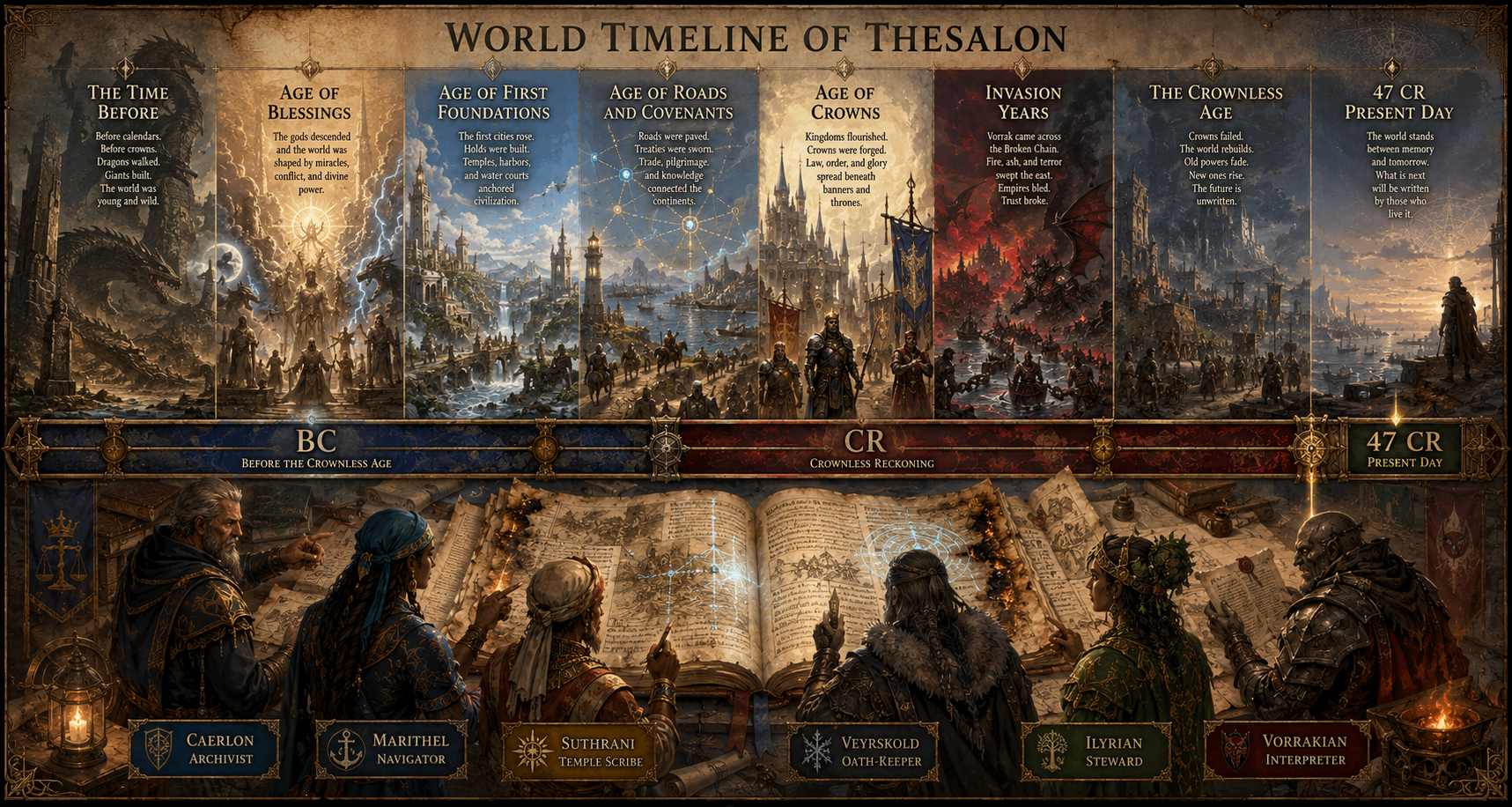
Broad Ages of Thesalon
Thesalon is ancient, but its history is not a single unbroken record.
Some events survive in court archives, temple rolls, harbor ledgers, oath-stones, river records, ship logs, funerary registries, giant inscriptions, dragon testimony, living landscapes, and ruins built beneath later cities. Other events survive only as songs, warnings, religious stories, family traditions, or names whose meanings have been forgotten.
The broad ages used by historians are shared across all six continents. They provide a common framework for comparing events in Caerlon, Vorrak, Suthrane, Veyrskold, Marithel, and Ilyr.
These ages do not mean that every continent changed in the same way at the same time. A Maritheli harbor might remember an era by the opening of a sea lane. A Suthrani temple might mark it by a flood ruling. A Veyrskold hold might date it by the breaking of an oath-stone. An Ilyrian community might remember the same period through the growth or death of a living landmark.
The calendar is shared. Memory remains local.
On This Page
The Shared Calendar
All six continents use the same formal calendar.
The shared calendar governs:
- civil records;
- diplomatic correspondence;
- trade contracts;
- ship manifests;
- military reports;
- temple archives;
- birth and death records;
- inheritance cases;
- resurrection review;
- route schedules;
- historical dating.
Regional cultures may use local names for seasons, festivals, floods, sailing periods, migrations, winters, flowering cycles, or sacred observances. Those names do not create separate year counts.
A merchant in Windrider Freeport, a temple judge beside the Anointed River, a Crownward archivist, a Vorrakian tribute clerk, a Veyrskold oath-keeper, and an Ilyrian route steward can all recognize the same numbered year.
Concordance Reckoning
The modern calendar is measured through Concordance Reckoning, abbreviated CR.
The calendar was standardized during the Age of Roads and Covenants, when long-distance travel, trade, pilgrimage, diplomacy, and maritime movement made incompatible regional calendars increasingly dangerous.
The formal agreement that established the calendar is remembered as the Concordance of Days.
Before the Concordance, a ship could appear to arrive before its recorded departure. A treaty copied between two courts might carry conflicting dates. A temple relic could be claimed as older or younger depending on which flood cycle, royal succession, winter count, or sacred observance was used.
The Concordance did not abolish local traditions. It created a common legal and historical reference.
Years before the Concordance are marked BC, meaning Before Concordance.
Years after it are marked CR, meaning Concordance Reckoning.
Examples include:
417 BC1 CR603 CRapproximately 1,900 BCtraditional date: 2,700 BC
The exact current campaign year will be established in the completed world timeline after the chronology of the Caerlon invasion is fully reconciled.
Limits of Early Dates
Dates become less reliable the farther they extend into the past.
Historians generally describe ancient dates using one of four terms.
| Historical status | Meaning |
|---|---|
| Confirmed | Supported by multiple independent records |
| Reconstructed | Assembled from incomplete records, ruins, oral accounts, or later copies |
| Traditional | Accepted by a culture, temple, polity, or community without independent proof |
| Contested | Reliable sources disagree about the event, date, cause, or participants |
A contested date is not automatically false.
Many historical disagreements persist because the surviving evidence supports more than one interpretation.
The Broad Historical Ages
The history of Thesalon is commonly divided into eight broad ages.
| Age | Broad character |
|---|---|
| The Time Before | Creation, primordial existence, and events beyond reliable mortal chronology |
| The Age of Blessings | The era of abundant divine intervention and the conflict later called the War of the Gods |
| The Age of First Foundations | The rise of the earliest enduring cities, courts, temples, holds, harbors, and stewardship centers |
| The Age of Roads and Covenants | The expansion of routes, diplomacy, trade, pilgrimage, rescue law, and common standards |
| The Age of Expanding Powers | The growth of kingdoms, courts, leagues, temple powers, tribute systems, and regional authorities |
| The Age of Crowns | The period of widespread confidence in established political and religious institutions |
| The Invasion Years | The Vorrakian invasion of Caerlon and the wars surrounding it |
| The Crownless Age | The present era of reconstruction, contested legitimacy, migration, and unresolved authority |
The names are historical tools rather than universal native terms.
Some communities use older or more local names. The broad sequence remains recognizable across Thesalon.
The Time Before
The Time Before refers to existence before a reliable historical sequence can be reconstructed.
It includes stories concerning:
- the birth or shaping of Thesalon;
- the arrival of the earliest divine beings;
- the ordering of the sun, moon, seas, death, magic, wilderness, and mortal life;
- primordial beings and powers;
- landscapes that existed before current coastlines and river systems;
- civilizations whose names no longer survive;
- ruins older than any known people;
- events remembered only by gods, dragons, giants, immortals, or the land itself.
The Time Before is not usually assigned ordinary dates.
Even the oldest temples disagree over whether time moved consistently during this period. Certain Veyrskold traditions claim that years did not pass in equal measure until the sun and moon were bound to predictable paths. Some Maritheli accounts describe seas that flowed uphill, coastlines that moved between dawn and dusk, and islands that existed in more than one place. Ilyrian traditions speak of forests that remembered futures not yet lived.
Most scholars treat these accounts as symbolic.
Some planar scholars do not.
The First Orderings
The most widely accepted religious traditions hold that the fundamental cycles of the world were not always fixed.
The sun did not always cross the sky in one direction.
The moon did not always follow a stable course.
The seas did not always obey the same tides.
Death did not always lead souls along one recognized passage.
Dreams, storms, seasons, growth, decay, memory, hunger, and magic may once have belonged to many overlapping divine powers.
The present gods are associated with stable domains:
- Aurelion judges;
- Morvane escorts the dead;
- Sylune governs the moon, dreams, secrets, and prophecy;
- Oranth governs the sun, fire, renewal, and vigilance;
- Thalara governs the sea, storms, navigation, and tides;
- Vaelthorn governs wilderness, beasts, growth, decay, and living land.
The oldest surviving stories suggest that these domains were once disputed.
Ruins Without Builders
Structures attributed to the Time Before are difficult to classify.
Some have no known builders. Others were clearly constructed by beings whose identities are preserved only through later names.
Examples include:
- foundations beneath later cities;
- stone chambers too large for ordinary mortal use;
- drowned walls beneath reef systems;
- roads that terminate beneath mountains;
- sealed rooms without visible entrances;
- stairways built into cliffs that no longer connect to shore;
- standing stones aligned to celestial patterns no longer visible;
- ruined halls incorporated into Veyrskold holds;
- carved channels beneath Ilyrian wetlands;
- ancient platforms below Suthrani temple precincts;
- deep foundations beneath Caerlonian royal and civic buildings;
- submerged works beneath Maritheli harbors.
Where possible, these sites are treated as earlier phases of existing locations.
Where no later settlement or landmark can claim them, they remain unmarked or restricted ruins within their parent region.
The Age of Blessings
Mortals call the second great era the Age of Blessings.
Certain old divine texts call it the Gigantomaki.
The word is most often translated as:
The War of the Gods.
The mortal and divine names describe the same period from opposite sides.
To mortals, it was an age of miracles.
To the gods, it may have been a war for survival.
The World Before Divine Order
The oldest surviving religious fragments describe a world watched over by hundreds of gods.
These powers were said to have been left across the planes by an unknown creator, first cause, or Demiurge. No surviving temple agrees on the identity of that being.
Some traditions claim the Demiurge created both gods and mortals.
Others say the gods were found rather than created.
A few forbidden texts suggest that the gods themselves do not know.
The old gods possessed narrow, overlapping, and sometimes contradictory domains.
There may have been separate gods for:
- the eastern dawn;
- the western sunset;
- high tide;
- low tide;
- river mouths;
- rain falling over stone;
- rain falling over grain;
- the first death in a family;
- the last death in a bloodline;
- songs sung at sea;
- songs sung in forests;
- birds with golden feathers;
- wolves born during eclipses;
- promises made beside bridges;
- promises broken beneath roofs.
The result was not harmony.
If several gods could command the same force, natural law depended on divine agreement.
When the gods disagreed, the world changed with them.
Ancient accounts describe:
- waves flowing against the wind;
- multiple suns appearing over different regions;
- moons stopping above one city while continuing elsewhere;
- rivers reversing after temple disputes;
- animals changing form between generations;
- the dead arriving at incompatible afterlives;
- seasons overlapping;
- forests growing across roads overnight;
- storms refusing to cross sacred borders;
- fire burning without heat or light;
- dreams becoming physically accessible.
The truth of these accounts remains disputed.
Their consistency across distant traditions is harder to dismiss.
The Crisis of Faith
The abundance of gods created a problem.
Mortals did not always know which god deserved worship.
When several powers claimed the same act, worship shifted from the divine being to the act itself.
People honored:
- the rising sun rather than one solar god;
- the sea rather than one sea goddess;
- burial rather than one keeper of death;
- growth rather than one god of wilderness;
- battle rather than one god of war;
- healing rather than one divine healer.
Some mortals abandoned formal worship entirely.
If any god could carry the sun across the sky, why worship one specific bearer?
If any river spirit could bless a harvest, why remain loyal to one temple?
If death led to different realms depending on which god answered first, why trust any priest?
The oldest surviving divine commentaries describe this as a collapse of faith.
Mortal traditions describe it as exhaustion.
The Fool’s Gold Finch
The event most commonly associated with the beginning of open divine conflict concerns a small bird.
The Fool’s Gold Finch is described in old bestiaries as a bright yellow songbird with dark wings and metallic markings that gleamed like gold in direct sunlight.
It was sacred to Vaelthorn.
The oldest versions of the story say that Vaelthorn loved the bird not because it was powerful, rare, or useful, but because its song changed with the health of the land.
A clear song meant that the surrounding forests, fields, waterways, and animal life remained in balance.
A broken or silent song warned of harm.
A long-forgotten nature god attempted to take away the finch’s voice.
The motive differs among surviving accounts.
Some say the god resented Vaelthorn’s growing influence.
Some say the god wanted silence to become the sacred sign of wilderness.
Some say the finch exposed corruption in a forest under that god’s protection.
One fragment claims the act was intended as a joke.
Vaelthorn responded by shooting an arrow through the other god’s throat.
The name of the slain god has been removed from nearly every surviving account.
Whether that erasure was part of the killing, a later punishment, or deliberate temple censorship remains unknown.
The First Divine Killing
The death of the forgotten nature god changed the balance among the divine powers.
Before this event, gods had fought, wounded, bound, displaced, humiliated, and deprived one another.
The death at the hands of Vaelthorn proved that a god could be permanently removed.
The act created immediate fear.
Some gods demanded judgment.
Some demanded revenge.
Some supported Vaelthorn.
Some argued that the forgotten god had violated an older agreement concerning the domains of other powers.
Some began preparing for their own destruction.
Aurelion’s oldest surviving legal tradition refers to the event as the First Irrevocable Judgment, though it does not clearly state whether Aurelion approved of the killing.
Morvane’s oldest funerary fragments call it the Death Without Escort.
This phrase has troubled theologians for centuries.
If Morvane did not escort the slain god, no accepted temple can say where that god went.
The War of the Gods
The divine powers divided into factions.
Their war was not fought only through direct battle.
The gods competed for mortal faith because worship strengthened their authority, expanded their reach, and helped secure their survival.
They offered mortals:
- healing;
- fertile land;
- safe childbirth;
- military victories;
- knowledge;
- fire;
- metalworking;
- navigation;
- prophecy;
- protection from monsters;
- resurrection;
- magical instruction;
- favorable weather;
- stronger crops;
- longer life;
- sacred weapons;
- defensive wards;
- hidden refuges;
- new animals and plants;
- power over rival communities.
These gifts gave the age its mortal name.
The blessings were real.
So were their costs.
A community favored by one god might become the target of another. A blessed crop might fail outside the territory of its patron. A sacred weapon could carry obligations its wielders did not understand. A magically protected city might survive one divine conflict only to become dependent on the power that saved it.
The surviving records describe both wonder and catastrophe.
Mortal Alliances
Mortals were not passive during the Gigantomaki.
Cities, tribes, courts, early temples, island communities, river settlements, giant halls, dragon domains, and monster societies chose divine patrons.
Some remained loyal.
Some changed allegiance.
Some attempted neutrality.
Some worshiped several competing gods at once.
Some tried to preserve the older practice of honoring forces rather than divine personalities.
Those choices shaped later cultures.
Several of the earliest known mortal foundations may have begun as divine strongholds, refugee settlements, fortified sanctuaries, or communities created to preserve one god’s worship during the war.
The later Age of First Foundations cannot be understood without these divine-era settlements.
Divine Gifts That Remained
Many features of the modern world are traditionally attributed to the Age of Blessings.
Claims include:
- the first stable resurrection rites;
- the fixing of the sun’s present path;
- the regular course of the moon;
- the binding of ordinary tides;
- the separation of burial and resurrection law;
- the first divine courts;
- the first sacred healing traditions;
- the earliest navigation stars;
- the domestication or transformation of certain animals;
- the establishment of magical traditions;
- the first oath-bound laws;
- the first sanctuaries protected from divine battle;
- the ordering of seasonal cycles.
Not every claim can be true in its current form.
Many institutions later attached themselves to ancient stories to justify modern authority.
The Primordial Few
The accepted pantheon contains eighteen major gods.
They are:
- Aurelion;
- Veyra;
- Morvane;
- Kharos;
- Thalara;
- Edrun;
- Sylune;
- Oranth;
- Myrrakai;
- Bravik;
- Selari;
- Nymora;
- Halven;
- Vaelthorn;
- Ruzhakar;
- Olyrra;
- Malrec;
- Istravell.
Public doctrine usually teaches that these gods established the present divine order.
Restricted traditions make a harsher claim.
They say that the eighteen are not merely the gods who created order.
They are the gods who won.
Under this interpretation, the presence of gods associated with love, healing, law, monsters, hunger, ruin, deception, death, craft, and war reflects an alliance created during the Gigantomaki.
The surviving gods did not need to resemble one another.
They needed one another to survive.
Once their enemies were defeated, the victors divided divine authority to reduce future conflict.
Each surviving god received recognized dominion without complete overlap.
Disputes that remained would be judged through mortal institutions, divine courts, local law, temple interpretation, or indirect conflict rather than another open divine war.
The name given to the survivors in certain forbidden texts is:
The Primordial Few.
The title is controversial.
Some temples consider it a valid ancient honorific.
Others condemn it as heresy because it implies that the gods’ authority comes from victory rather than inherent divinity.
The End of the Gigantomaki
No surviving public account explains exactly how the War of the Gods ended.
The broad tradition holds that:
- rival gods were defeated, destroyed, absorbed, forgotten, bound, exiled, or deprived of worship;
- the surviving eighteen established exclusive divine domains;
- the natural cycles of Thesalon became more stable;
- worship outside the surviving pantheon became impossible, ineffective, dangerous, or forbidden;
- mortal civilizations inherited divine gifts, scars, ruins, obligations, and sacred sites.
The final agreement is sometimes called the Division of Dominion.
No complete copy survives in a public archive.
Fragments are claimed by:
- Aurelion’s legal temples;
- Olyrran memory houses;
- Morvane’s oldest funerary institutions;
- restricted divine libraries;
- certain dragon collections;
- hidden Veyrskold archives;
- old Suthrani temple vaults;
- Maritheli chart houses preserving divine sea routes;
- Ilyrian stewardship traditions that reject written preservation;
- Vorrakian courts claiming descent from divine wartime allies.
Whether these fragments describe one agreement or several later arrangements remains unresolved.
Surviving Sites of the Age
The Age of Blessings survives through places as much as stories.
Some sites are existing locations built over older foundations. Others remain unmarked ruins known only to local communities, specialists, or restricted institutions.
The Finchfall Hollow
Location: Unmarked ruin within an old Vaelthorn-associated woodland Classification: Traditional location; exact placement restricted Historical association: The death of the forgotten nature god
Several Vaelthorn traditions claim that the first divine killing occurred in a forest clearing now called Finchfall Hollow.
The location is described as a circular hollow where no birds sing directly above the central stone.
The stone itself is said to contain a narrow hole that passes through it without splitting the surrounding rock.
Three different regions claim to contain the true Finchfall Hollow:
- a forested part of Caerlon;
- a hidden Ilyrian grove;
- an old woodland near the Blackwood frontier of Vorrak.
No accepted temple has confirmed which claim is correct.
It is possible that all three sites preserve later memorials rather than the original location.
The Court of the Unshared Sun
Location: Existing sacred foundation beneath a later Suthrani temple complex Historical association: Disputes over the movement of the sun
The oldest lower foundations beneath one of Suthrane’s major temple sites include a circular chamber whose walls show several suns crossing the sky along different routes.
Later temple construction preserved the chamber but sealed ordinary access.
The site’s modern custodians interpret the images as a symbolic warning against divided sacred authority.
Certain historians believe they depict an era when several solar gods competed over the movement of daylight.
The Moonless Stair
Location: Unmarked ruin in Veyrskold Historical association: Sylune’s consolidation of lunar authority
The Moonless Stair is described as a stone ascent built into a northern ridge.
At night, the stair casts no shadow beneath moonlight.
Local tradition claims that the structure once led to an observatory devoted to a rival lunar power.
The upper complex is no longer visible from the surrounding valleys.
The lower steps remain, but their exact route changes during certain phases of the moon.
The Drowned Choir
Location: Submerged ruin beneath Maritheli waters Historical association: Divine competition over sea songs and navigation
Maritheli navigators record a submerged structure whose stone arches produce different tones as currents pass through them.
The location is not marked on ordinary charts.
Several traditions connect it to sea gods defeated before Thalara gained uncontested authority over tides and navigation.
Ships passing nearby sometimes report hearing singing below the hull.
The Garden That Refuses Names
Location: Restricted living site in Ilyr Historical association: Erasure of defeated divine names
The Garden That Refuses Names is a living site where spoken proper names are said to fade from memory within minutes.
Local stewards do not permit excavation.
Some theologians believe the site was used to erase one or more defeated gods from mortal remembrance.
Others argue that the effect predates the Gigantomaki and was later interpreted through divine history.
The Broken Feast Hall
Location: Existing ruin within a Vorrakian court territory Historical association: Wartime alliance between surviving gods and monstrous powers
The Broken Feast Hall contains seating niches for beings of radically different sizes.
Later carvings claim that divine envoys, monsters, dragons, giants, and mortal rulers gathered there to negotiate wartime support.
The court controlling the ruin claims that Ruzhakar’s place in the surviving pantheon was secured through agreements made at this site.
Foreign scholars dispute the interpretation but have not been granted unrestricted access.
What Most People Know
Most people in Thesalon know that:
- the world is extremely old;
- the current gods are real and active;
- the Age of Blessings was a time of frequent miracles;
- the gods fought among themselves in the distant past;
- Vaelthorn killed another divine power after an insult involving the Fool’s Gold Finch;
- the conflict ended with the modern pantheon governing the major divine domains;
- many ancient ruins and sacred sites are associated with divine warfare;
- some divine gifts from the age remain part of modern life.
Most people do not know whether:
- hundreds of gods once existed;
- the modern pantheon consists only of the victors;
- defeated gods were destroyed, absorbed, exiled, or forgotten;
- the Division of Dominion was one agreement or several;
- worship of the old gods is truly impossible;
- forgotten divine powers still survive in sealed places;
- the title Primordial Few is accurate;
- the modern gods remember the war in the same way mortals do.
Related Pages
- Cosmology and Magic
- Planes, Demiplanes, and Planar Powers
- Temples, Saints, Cults, and Religious Law
- Gods and Divine Courts
- The Age of First Foundations
- The Caerlon Invasion
- Beginning of the Crownless Age
- World Timeline
- Historical Knowledge and Disagreement
The Age of First Foundations
The Age of First Foundations began when communities established cities, courts, temples, harbors, holds, roads, and systems of authority that endured beyond the lives of their founders.
Older settlements certainly existed. Many were destroyed during the Age of Blessings, abandoned when divine protection failed, absorbed into later cities, or left beneath forests, reefs, deserts, glaciers, and newer construction.
The foundations remembered from this age matter because they created continuity.
People could inherit a house, office, oath, burial place, harbor right, water claim, stewardship duty, or political obligation from someone they had never met. Records began to outlive rulers. Institutions survived disasters. Settlements rebuilt without becoming entirely new communities.
Historians traditionally place the Age of First Foundations between approximately 2,800 BC and 1,650 BC, though the oldest dates remain reconstructed or traditional.
On This Section
- Caerlon: The First Recorded Crownlands
- Vorrak: The First Claims and Monster Courts
- Suthrane: The First River Cities
- Veyrskold: The First Holds and Seals
- Marithel: The First Harbors and Sea Compacts
- Ilyr: The First Stewardships
- What Survived the Age
- What Most People Know
Caerlon: The First Recorded Crownlands
Caerlon’s earliest enduring institutions formed around its rivers, fertile plains, western harbors, defensible crossings, and old roads whose original builders were already forgotten.
Later Caerlonian historians described the period as the beginning of ordered kingship. Surviving evidence shows something more complicated.
The earliest Caerlonian foundations included:
- river councils;
- grain settlements;
- bridge communities;
- fortified estates;
- oath courts;
- mountain holds;
- harbor assemblies;
- temple record houses;
- several competing royal traditions.
The first crowns did not create Caerlon.
They emerged from communities that had already learned to govern themselves.
Crownward Seat and the House of the Open Hall
Traditional foundation: 2,612 BC Current location: Crownward Seat Region: Crownward Remnant Original settlement: Avenor Hall Founder traditionally recognized: Queen Aeva Maren, called the Open-Handed
The oldest continuously occupied political center in Caerlon is traditionally identified with the settlement that became Crownward Seat.
The first settlement was called Avenor Hall, after the long timber-and-stone meeting house built on a defensible rise above the surrounding road country. The rise stood near the junction of three early routes:
- the westward road toward the Sunset Gulf;
- the southern grain road toward the Heart Plains;
- the eastern road that would eventually lead toward Estenmark and the Dread Sea.
Avenor Hall began as a refuge.
During a series of failed harvests and local wars, nearby communities sent grain, livestock, records, and children to the hill because its central storehouse was protected by an earthwork wall and a spring-fed cistern.
The leader associated with its transformation into a permanent political center was Aeva Maren.
Aeva was not originally a hereditary queen. The oldest copies of the Avenor Hearth Roll call her the First Keeper of the Open Hall. She supervised the settlement’s granaries, heard disputes among refugee families, and required every armed household seeking protection to contribute labor to the walls and roads.
The title of queen appears in records copied several generations later.
Aeva’s most famous ruling was the Judgment of the Unlocked Granary. When several old landholding families demanded that stored grain be returned exclusively to those who had contributed it, Aeva ruled that grain placed beneath the protection of the hall had become a public trust during famine.
The ruling became an early foundation for Caerlonian emergency law.
The Open Hall
The original Open Hall no longer stands.
Its stone footings lie beneath the later Crownward Archive Court, where successive rulers built:
- Aeva’s timber meeting hall;
- the First Stone Hall;
- the Maren royal residence;
- the Crownward Palace;
- the modern archive and administrative complex.
A set of uneven foundation stones remains visible through protected floor panels in the eastern archive gallery.
Visitors still leave grain kernels between the stones when petitioning for public aid.
Aeva’s successors
Aeva was succeeded by her adopted daughter, Queen Thelora Maren, who established the first permanent road wardens around Avenor Hall.
Thelora’s reign is associated with:
- the first numbered roadstones;
- the first crown-maintained messenger stations;
- formal recognition of local councils;
- the earliest surviving list of communities owing mutual famine relief.
The early Maren rulers governed only the lands surrounding Avenor Hall. Later Crownward dynasties claimed Aeva as the first ruler of all Caerlon, but no evidence supports such a broad realm during her lifetime.
The Heartplain Granaries
Traditional foundation: 2,540 BC Current location: Heartplain Assembly Halls and surrounding grain district Region: Heart Plains Founders: The Nine Granary Mothers
The earliest enduring foundation in the Heart Plains was not a palace or fortress.
It was a cooperative storage system.
Nine farming communities built raised stone granaries around a central threshing ground after three years of alternating flood and crop blight. Each community retained ownership of its ordinary stores but contributed seed grain to a protected common reserve.
The founders are collectively remembered as the Nine Granary Mothers:
- Adelis Furrowmark;
- Brenna Tallseed;
- Corra Millward;
- Deyra Southfield;
- Elian Barleyhand;
- Faela Hearthgrain;
- Ilyra Rainwatch;
- Mara Winnow;
- Tessa Redsheaf.
Whether all nine were women is debated. “Mother” may have been an office meaning keeper, originator, or guarantor.
The Nine-Lock Charter required that the common reserve could be opened only when at least six keepers agreed that a regional emergency existed.
The system survived because no single village controlled it.
The modern site
The central threshing ground became the site of the Heartplain Assembly Halls.
The oldest granary vault still exists beneath the western assembly chamber. Its nine original lock recesses remain visible, though the doors and locking bars have been replaced repeatedly.
The modern Heartplain Assembly uses a nine-member emergency committee in deliberate imitation of the Granary Mothers.
The phrase “six keys make a famine” remains a Heartplain legal expression meaning that public emergency must be demonstrated rather than merely declared.
Torinbridge and the First Span
Traditional foundation: 2,431 BC Current location: Torinbridge and the Torin Bridgeholds Region: Torin Freeholds Founder: Torren Vale, bridgewright and ferry captain
The first permanent crossing of the River Torin was built at a broad stone shelf where the river divided around a low central island.
Before the bridge, the crossing was operated by rival ferry families. Their disputes frequently stranded travelers or divided armed companies on opposite banks.
The bridgewright Torren Vale proposed a three-part structure:
- a western timber span;
- a fortified central island platform;
- an eastern stone-and-timber span.
Torren did not rule the surrounding communities. He organized them.
Each settlement provided a specific contribution:
- cut timber;
- quarried stone;
- rope;
- iron fittings;
- boats;
- food;
- armed watch;
- skilled labor.
The bridge was completed after eleven construction seasons.
The settlement that grew around it took the name Torren’s Bridge, later shortened to Torinbridge.
The Bridge Oath
Torren required the participating communities to swear that no one could be denied emergency crossing during flood, fire, monster attack, or flight from war.
Ordinary tolls were permitted.
Emergency exclusion was not.
The original Bridge Oath survives in fragmentary form on the central island platform beneath later Bridgehold construction.
The Torin Freeholds still cite it when resisting outside authorities who attempt to close the crossing.
Highharbor and the Three Seaward Walls
Traditional foundation: 2,366 BC Current location: Highharbor Region: Highharbor Coast Founder: Harbormaster Celene Varrow
The first permanent harbor at Highharbor was built around a naturally protected inlet opening toward the Sunset Gulf.
The settlement was originally called Varrow Anchorage.
Its founder, Celene Varrow, commanded a coalition of fishers, coastal traders, storm refugees, and shipwright families. She ordered the construction of three defensive structures:
- the Outer Wave Wall;
- the Middle Mooring Wall;
- the Inner Refuge Wall.
The walls were not built at the same time. Each marked an expansion of the harbor.
The Outer Wave Wall was intended to break storms.
The Middle Mooring Wall protected working vessels.
The Inner Refuge Wall surrounded shallow berths where damaged ships and civilian boats could shelter without paying ordinary harbor charges.
Celene’s Refuge Berth Rule is one of the earliest recorded Caerlonian maritime laws.
It stated that a vessel in immediate danger could enter the refuge basin before its crew, cargo, nationality, or debts were examined.
The rule influenced later sanctuary and harbor law in both Caerlon and Marithel.
From Varrow Anchorage to Highharbor
The name Highharbor came into use after later rulers built elevated warehouses and watch stations above the original inlet.
The oldest portion of the Inner Refuge Wall remains beneath the modern Saltwatch Quays.
Its lower stones are visible at extreme low tide.
The Silveredge Gatehold
Traditional foundation: 2,290 BC Current location: Silveredge Gatehold Region: Silveredge Mountains Founder: Hold-Marshal Dorran Kes
The oldest documented mountain hold in Caerlon guarded a narrow western approach into the Silveredge Mountains.
The founder, Dorran Kes, was a quarry commander who fortified the pass after mining settlements suffered repeated attacks from creatures descending through the high valleys.
The original hold consisted of:
- a gatehouse;
- a lower quarry settlement;
- a signal platform;
- a spring chamber;
- a refuge tunnel.
Dorran established the Law of the Warm Gate, requiring the hold to admit travelers caught above the snow line, even when the gate was otherwise closed.
The law did not guarantee freedom, hospitality, or safe onward travel.
It guaranteed that a person would not be left outside to freeze.
The present Silveredge Gatehold incorporates the original spring chamber and portions of Dorran’s lower wall.
Vorrak: The First Claims and Monster Courts
Vorrak’s earliest foundations were not organized around citizenship or common territory.
They were organized around claim.
A settlement survived because someone or something powerful claimed:
- its people;
- its labor;
- its dead;
- its road;
- its hunting ground;
- its forge;
- its water;
- its tribute;
- its protection.
Later outsiders described these arrangements as primitive tyranny. Many were tyrannical, but they were not simple.
A recognized claim could protect a community from every predator except the claimant. An unclaimed settlement had no accepted protector, no recognized obligations, and no authority capable of demanding restitution after attack.
The earliest Monster Courts transformed predation into institutions.
Kharzug-Maul and the First Maw Hall
Traditional foundation: 2,584 BC Current location: Maulhall within Kharzug-Maul Region: Monster Courts Founder: Gurakh the First Feaster
The earliest known political foundation associated with the Maw Court began around a limestone sinkhole where hunting bands gathered to divide prey.
The original gathering place was called the Open Maw.
The court founder remembered as Gurakh the First Feaster ended a cycle of retaliatory killings by declaring that all kills brought into the sinkhole would be divided according to witnessed contribution.
The system was brutal but predictable.
It distinguished among:
- the hunter who struck first;
- the hunter who dealt the killing wound;
- the tracker;
- the driver;
- the guard;
- the claimant of the hunting ground;
- the host of the feast;
- dependents entitled to a share.
Gurakh’s rulings were cut into bone plates and hung around the edge of the sinkhole.
These became the First Hunger Articles.
Maulhall
A roofed hall was later constructed across part of the Open Maw. The modern court settlement known as Maulhall grew outward from it.
The original sinkhole remains beneath the central challenge floor.
Court tradition holds that Gurakh’s stone seat still stands on a ledge below the current hall, surrounded by the oldest bone articles.
Access is restricted to recognized Maw Court officials and those undergoing a formal claim challenge.
Varkul and the Ledger of the First Dead
Traditional foundation: 2,501 BC Current location: Neth-Kharn Sepulcher Seat Region: Varkul Neth-Kharn Founder: Neth Varkul, the First Crowned Dead
The earliest known Varkulian foundation began as a burial city built into a chalk escarpment.
The living settlement was called Kharn-of-the-Nine-Doors.
Its funerary officials maintained separate entrances for:
- household dead;
- soldiers;
- children;
- foreigners;
- executed criminals;
- oathbound servants;
- priests;
- rulers;
- unidentified remains.
The ruler now called Neth Varkul was originally a mortal death magistrate responsible for deciding where disputed bodies could be buried.
During a regional plague, Neth died while the burial courts remained overwhelmed.
According to Varkulian tradition, the magistrate returned to judgment without resurrection rites, took the funerary crown from their own corpse, and continued hearing cases.
Neth ordered the creation of the Ledger of the First Dead, recording:
- the legal identity of each corpse;
- the claimant entitled to bury it;
- unpaid debts;
- inherited obligations;
- restrictions on resurrection;
- crimes that survived death.
This ledger became the foundation of Varkulian death law.
The modern sepulcher city
Kharn-of-the-Nine-Doors expanded downward and was renamed Neth-Kharn after the authority of Neth Varkul became permanent.
The oldest nine entrances remain within the lower levels of the modern Sepulcher Seat.
Several have been sealed.
One opens only for unidentified dead.
Drakkar-Grim and the First Spine Oath
Traditional foundation: 2,442 BC Current location: First-Spine Hall beneath Drakkar-Grim Region: Grimspine Range Founder: Hadrakka Stone-Throat
The first durable power in the Grimspine Range formed around a high pass where giant-descended clans, draconic hunters, cave communities, and mountain predators competed for passage.
The leader Hadrakka Stone-Throat ended one season of continuous ambushes by demanding that every claimant meet on a ridge exposed to the same storm.
There, Hadrakka established the First Spine Oath:
- no recognized claimant could attack within sight of the oath pillars;
- all who crossed owed food, labor, information, or blood according to status;
- anyone refusing claim protection could be hunted beyond the pillars;
- anyone violating the truce lost all recognized mountain rights.
The first hall was carved beneath the ridge to store tribute and shelter witnesses.
It became known as First-Spine Hall.
Later construction buried the original entrance beneath the fortress complex of Drakkar-Grim, but the oath pillars remain visible above the pass.
Varkhûl-Ashak and the Furnace Crown
Traditional foundation: 2,390 BC Current location: Ashak Furnace-Crown Region: Ashen Peaks Founder: Varkhûl Ash-Hand
The earliest Ashen Thronehold formed around a volcanic forge where metal could be worked without ordinary fuel.
The forge was controlled by Varkhûl Ash-Hand, a war-smith whose surviving depictions show one arm formed from blackened stone.
Varkhûl required every settlement using the forge to contribute:
- ore;
- labor;
- captives;
- weapons;
- technical knowledge;
- a portion of finished goods.
In return, the forge produced tools and arms no single community could have made alone.
The first Thronehold was not a city. It was a ring of workshops, barracks, slave quarters, shrines, cooling trenches, and defensive towers built around the central vent.
The Furnace Crown was the elevated ring from which Varkhûl’s overseers could watch every major forge floor.
The modern Ashak Furnace-Crown still occupies the same volcanic complex, though repeated eruptions and reconstruction have shifted its outer districts.
Urgath-Korr and the Iron Road Claim
Traditional foundation: 2,321 BC Current location: Korr Ironroad Hold Region: Iron Tribute territories Founder: Urgath Korr
The first Iron Tribute power began with a road rather than a city.
Urgath Korr, commander of a heavily armored migratory host, seized a chain of wells, causeways, and defended camps connecting the central Monster Courts to the eastern interior.
Instead of destroying every settlement along the route, Urgath imposed fixed tribute.
Communities that paid received:
- marked protection posts;
- recognized access to the road;
- warning of approaching war-hosts;
- the right to petition for retaliation against unauthorized raiders.
Those that refused were classified as unclaimed prey.
The route became known as the Iron Road.
Korr Ironroad Hold was built at the largest fortified well along the route. The original well chamber still exists beneath the current tribute hall.
Urgath’s iron route markers became the model for later court marks across Vorrak.
The Blackwood Root Covenant
Traditional foundation: 2,270 BC Current location: Grathmora Root-Hall Region: Blackwood Founder: Veyk of the Seven Antlers
The earliest Blackwood authority did not conquer the forest.
It negotiated with it.
The figure called Veyk of the Seven Antlers gathered seven communities at the roots of an immense black-barked tree after uncontrolled hunting, burning, and harvesting provoked attacks from forest creatures and awakened growths.
Veyk established the First Root Covenant.
The signatories accepted limits on:
- where trees could be cut;
- what animals could be hunted;
- when fires could be set;
- which names could be spoken within sacred groves;
- how outsiders could be admitted;
- what restitution followed a breach.
The central meeting place became Grathmora Root-Hall.
The hall is not entirely constructed. Its chambers lie among living roots that have been shaped, hollowed, and reinforced over generations.
Some rooms have shifted since the first covenant.
The original covenant marks remain visible on seven root arches.
Suthrane: The First River Cities
Suthrane’s earliest enduring cities formed along the Anointed River, the Ivory Floodplain, the Inner Sea, protected wells, mountain passes, and caravan routes.
Water determined where people could settle.
Law determined whether those settlements survived.
The first Suthrani rulers were often:
- water measurers;
- canal keepers;
- temple judges;
- granary authorities;
- caravan protectors;
- burial custodians;
- rulers who controlled several of these functions at once.
Anuth-Selai and the First Confluence Court
Traditional foundation: 2,675 BC Current location: Anuth-Selai, central city of the Grand Temple Precincts Region: Anointed River and Grand Temple Precincts Founder: Selai Anuth, First River Witness
The earliest recognized city of Suthrane was established where three major branches of the Anointed River approached one another before spreading into the upper Ivory Floodplain.
The original settlement was called Selai’s Measure.
Its founder, Selai Anuth, was a river surveyor and ritual witness who marked the annual flood against a white stone stair cut into the riverbank.
Several nearby communities depended on different channels. When floodwaters ran low, each accused the others of diverting water.
Selai established a public measurement system using:
- river stairs;
- marked pillars;
- canal gates;
- witnessed opening schedules;
- written allocation tablets;
- temple-supervised appeals.
The settlement grew around the measurement court.
After Selai’s death, the city was renamed Anuth-Selai, preserving both the family name and personal name in reversed order.
The White Stair
The oldest section of the White Stair remains beneath the present Flood Observatory.
Several original measurement marks are still visible below later carvings.
Suthrani legal tradition treats the first visible waterline of each flood season as a continuation of Selai’s original testimony.
Ivratha and the First Floodplain Granaries
Traditional foundation: 2,598 BC Current location: Ivratha Fields, an inhabited agricultural district of the Ivory Floodplain Region: Ivory Floodplain Founder: Steward Ivrath Bel
The settlement of Ivratha formed on a low natural terrace above the floodplain.
Its founder, Ivrath Bel, organized a system of raised granaries connected by stone walkways. During ordinary floods, water passed beneath them. During extreme floods, the walkways allowed food and seed to be moved without boats.
Ivrath’s Law of Seed Before Tax required that enough grain be reserved for the next planting before temple shares, royal levies, caravan contracts, or private debts could be collected.
Several later rulers attempted to abolish the rule.
Each failed after public unrest or poor harvests.
The modern Ivratha Fields remain one of the major grain-producing districts of the floodplain. The oldest raised granary, Bel’s High Store, has been rebuilt repeatedly on its original stone piers.
The Inner Sea City of Mereth-Kai
Traditional foundation: 2,511 BC Current location: Mereth-Kai Region: Inner Sea Founder: Kai Mereth, fisher-admiral
The oldest continuously occupied Inner Sea port was founded at a sheltered crescent bay on the sea’s western shore.
The founder, Kai Mereth, united fishing villages after raiders began taking boats and blocking access to offshore spawning grounds.
Kai ordered the construction of a chained harbor entrance using floating timber booms anchored to stone towers.
The settlement was first called Kai’s Mooring.
It later became Mereth-Kai after the founder’s descendants established a harbor court.
Kai’s Open Net Judgment declared that no family could permanently claim the full movement of a fishery. Fishing grounds could be regulated, rested, or protected, but migratory fish belonged to no household while moving through common water.
The ruling still influences Inner Sea fishery law.
The original southern chain tower survives inside the modern harbor fortification.
The Well-City of Osseran
Traditional foundation: 2,447 BC Current location: Osseran Region: Northern edge of the Scorching Expanse Founder: Well-Keeper Ossa Ren
The desert city of Osseran began around a deep artesian well hidden beneath a limestone shelf.
The founder, Ossa Ren, belonged to a caravan community that discovered the water while sheltering from a sandstorm.
Rather than claim the well privately, Ossa established the Three-Draw Rule:
- the first draw belonged to the dying;
- the second to animals carrying people or essential goods;
- the third to residents and travelers according to measured need.
Commercial storage began only after those obligations were met.
The settlement’s prosperity came from protecting the well rather than concealing it.
Osseran’s original shaft remains in the House of the First Bucket, now a civic and religious building.
The first bucket is preserved there, repaired with bands of bronze and silver.
Kharad-Sur and the Mountain Gate
Traditional foundation: 2,385 BC Current location: Kharad-Sur Region: Sundered Mountains Founder: Gate-Judge Sur Kharad
The first enduring Suthrani mountain city guarded a pass connecting the Inner Sea basin with southern caravan roads.
Its founder, Sur Kharad, was a judge appointed to end disputes among caravans, miners, mountain communities, and temple pilgrims using the pass.
Sur established:
- a fixed passage toll;
- emergency shelter obligations;
- protected burial space;
- weight limits for bridges;
- penalties for blocking the pass;
- separate rules for armed companies and civilian caravans.
The original settlement was called Sur’s Gate.
It became Kharad-Sur after several surrounding communities accepted the gate court’s authority.
The first stone gate stands inside the modern city. It no longer marks the outer wall; later expansion placed it near the center of the upper market district.
Veyrskold: The First Holds and Seals
Veyrskold’s earliest foundations were built where people could survive winter and where older dangers could be watched.
The first holds formed around:
- geothermal valleys;
- defensible fjords;
- glacier-fed rivers;
- whale routes;
- iron deposits;
- forest margins;
- ancient roads;
- ruins that required permanent guardianship.
Veyrskoldic tradition does not separate settlement from obligation.
A hold existed because someone agreed to maintain:
- a fire;
- a road;
- a warning bell;
- a seal;
- a guest hall;
- a watch;
- an oath.
Skeldheim and the First Shared Fire
Traditional foundation: 2,630 BC Current location: Skeldheim Region: Southern Veyrskold fjord country Founder: Hall-Mother Yrsa Skeld
The earliest enduring mortal city of Veyrskold formed at the head of a deep southern fjord where hot springs kept part of the shoreline free of winter ice.
The founder, Yrsa Skeld, ordered five feuding winter camps to build one stone hall around the largest spring.
The hall contained a central hearth that was never permitted to go out.
Yrsa’s Law of the Shared Fire required every household to contribute fuel, food, or labor. In return, any resident or traveler admitted to the hall received:
- heat;
- drinking water;
- one sleeping place;
- one meal;
- protection until the next morning.
The settlement became Skeldheim, meaning the home or hold of Skeld.
The original hearth remains beneath the present Hall of Five Roofs. Its fire is said to have been transferred continuously through every rebuilding.
Stonewake Hold and the First Sealwardens
Traditional foundation: 2,554 BC Current location: Stonewake Hold Region: Interior ruin belt Founder: Oath-Keeper Palvar Stonewake
Stonewake Hold was established beside a buried structure whose doors opened during earthquakes.
The founder, Palvar Stonewake, gathered survivors after creatures emerged from the ruin during a summer thaw.
Palvar did not claim to understand the structure. He established a permanent watch around it.
The first sealwardens maintained:
- stone braces;
- warning carvings;
- listening chambers;
- evacuation paths;
- records of vibrations;
- strict speech taboos near the entrance.
The original settlement was a ring of low houses surrounding the sealed approach.
The modern hold has expanded upslope, but the oldest warden ring remains closed to ordinary residents.
The first oath-stone stands in the central watch chamber.
Hrafnvik and the Law of Returning Boats
Traditional foundation: 2,487 BC Current location: Hrafnvik Region: Western storm coast Founder: Captain Maeva Hrafn
The first major Veyrskoldic harbor was established in a narrow western inlet protected by black cliffs.
The founder, Maeva Hrafn, commanded a whaling and rescue fleet.
After a storm destroyed several neighboring settlements, Maeva required every seaworthy vessel entering Hrafnvik to accept a rescue assignment when the harbor bells sounded.
This became the Law of Returning Boats.
A captain could refuse ordinary trade, military service, fishing duties, or passenger contracts.
A captain could not remain safely in harbor while another vessel was known to be sinking within reachable waters.
The original harbor bell was cast from recovered ship fittings.
It remains in the lower tower of the modern rescue house.
Dromgard and the Giant Compact
Traditional foundation: 2,420 BC Current location: Dromgard Region: Giant-road interior Founders: Torva Linn and Drom Stone-Son
The settlement of Dromgard formed where a giant road crossed a sheltered valley used by mortal herders.
Repeated conflict ended when the mortal negotiator Torva Linn and the stone giant Drom Stone-Son established a shared boundary.
The compact divided vertical space rather than land alone.
Mortals received:
- the valley floor;
- lower forest;
- riverbanks;
- ordinary road use.
The stone giants retained:
- the high cliffs;
- quarries above the third ridge;
- buried halls;
- the right to move loads too large for mortal roads.
The settlement took Drom’s name because the giant raised the first defensive wall. Torva’s name survives in the Linn Gate, the only original opening sized primarily for mortal traffic.
Emberdeep and the Buried Fire
Traditional foundation: 2,351 BC Current location: Emberdeep Region: Geothermal interior valley Founder: Forge-Warden Arn Kael
Emberdeep was established around a geothermal fissure used to heat homes and work metal.
The founder, Arn Kael, discovered that drawing too much heat caused nearby ice to crack and exposed a deeper chamber filled with moving fire.
Arn sealed the lower shaft and established the Measure of Coals, limiting how much heat could be taken during each season.
The settlement’s survival depended on restraint.
The first forge remains within the present Emberdeep works. Its lower door is marked with Arn’s warning:
“Warmth is borrowed. Fire remembers the debt.”
Marithel: The First Harbors and Sea Compacts
Marithel’s earliest foundations formed around safe water.
A small island with a reliable spring, sheltered anchorage, navigable channel, visible headland, or storm refuge could become more important than a much larger island without safe approach.
The first Maritheli authorities were often:
- harbormasters;
- pilots;
- rescue captains;
- lighthouse keepers;
- shipwright councils;
- shrine custodians;
- route witnesses;
- island assemblies.
Marithel’s oldest cities grew from repeated arrival.
Shardcrown and Whiteglass Harbor
Traditional foundation: 2,608 BC Current location: Whiteglass Harbor, Shardcrown waters Region: Shard Isles Founder: Pilot-Captain Merai Whiteglass
The oldest enduring harbor foundation in Marithel was established on the lee side of a jagged island later called Shardcrown.
The island’s high volcanic ridges broke western storms, but the approach was obstructed by pale reefs and narrow channels.
The pilot Merai Whiteglass marked a safe route using polished white stones mounted on cliff posts. At sunrise and sunset, the stones reflected enough light to distinguish the channel from the surrounding reef.
The settlement was first called Merai’s Refuge.
It became Whiteglass Harbor after local craftspeople learned to make pale storm-resistant lenses from volcanic sand and mineral deposits found on Shardcrown.
Merai established the First Pilot’s Refusal, recognizing that a pilot could refuse to guide a vessel considered incapable of surviving the passage.
A ruler, admiral, merchant, or captain could not legally compel a pilot to take responsibility for a doomed crossing.
The oldest white marker remains on the western approach cliff beneath a later signal tower.
Tidewall Harbor and the First Watch Light
Traditional foundation: 2,532 BC Current location: Tidewall Harbor Region: Highfall Isles Founder: Keeper Nara Highfall
The earliest major harbor of the Highfall Isles formed beneath steep cliffs facing a narrow eastern approach.
Nara Highfall, a shrine keeper and weather observer, maintained a fire on the upper cliff to guide fishing boats home through fog.
After a storm drove several foreign vessels into the rocks, Nara organized a permanent watch.
The first light consisted of:
- an enclosed oil brazier;
- polished bronze reflectors;
- a bell platform;
- a flag mast;
- a cliff stair;
- a rescue boat station below.
The settlement beneath it became Tidewall Harbor after sea walls and elevated docks were built around the lower anchorage.
Nara’s Rule of the Visible Flame required the light to remain active for any vessel approaching in honest distress, including enemies.
The modern Highfall defenses and lighthouse systems occupy the same cliff line.
The base of Nara’s original brazier is preserved within the oldest light chamber.
Windrider Freeport and the Open Mooring
Traditional foundation: 2,461 BC Current location: Windrider Freeport Region: Windrider Gulf Founder: Harbormaster Talis Windrider
The settlement that became Windrider Freeport began as a neutral mooring ground in the sheltered Windrider Gulf.
Its founder, Talis Windrider, commanded neither a kingdom nor a fleet.
Talis maintained freshwater cisterns, repair beaches, and mooring posts used by vessels from several island groups.
Conflict began when rival captains attempted to reserve the anchorage for their allies.
Talis cut down the private claim posts and replaced them with the Open Mooring Ring, a circle of heavy stone anchors assigned by vessel need rather than political allegiance.
The first harbor law declared:
- a ship could enter before being judged;
- immediate danger took priority over debt;
- weapons had to remain secured within the inner anchorage;
- disputes begun outside the harbor could not be settled by violence inside it;
- false names were permitted for temporary safety but not for theft of another person’s property or identity.
The settlement was first called Windrider Mooring.
It became Windrider Freeport after later assemblies expanded its neutrality into a formal civic identity.
Several stones from the Open Mooring Ring remain incorporated into the oldest inner docks.
Lanternhold and the First Monastic Anchorage
Traditional foundation: 2,405 BC Current location: Lanternhold Monastery Isle Region: Sea of Whispers approaches Founder: Sister Elira Lanternbearer
The first sanctuary community on Lanternhold Monastery Isle was established by Elira Lanternbearer, a Thalaran devotee who survived a wreck near the island’s eastern shelf.
Elira and other survivors built a stone refuge above the landing cove and maintained a lantern visible from the outer approach.
The community offered:
- water;
- food;
- medical care;
- burial;
- route information;
- temporary shelter;
- neutral witness for disputes among rescued crews.
Elira refused political rule over the surrounding waters.
She claimed authority only over the refuge, lantern, landing cove, and those who accepted sanctuary.
The monastery that later developed on the site retained this limited jurisdiction.
The oldest refuge chamber survives beneath the present monastery complex, while the original lantern base remains incorporated into the current signal structure.
Stormgate and the First Chain Compact
Traditional foundation: 2,338 BC Current location: Gate of Wind and Law and Convoy Bell Harbor Region: Stormgate Strait Founders: Admiral Sera Chainwake and Engineer Volan Marr
The first permanent control works at Stormgate Strait were created after repeated wrecks on its tidal crossing grounds.
The admiral Sera Chainwake and engineer Volan Marr organized the construction of:
- controlled channels;
- tide markers;
- movable chain barriers;
- beach structures;
- flood gates;
- inspection platforms;
- warning bells.
The earliest complex was called the Wind Gate Works.
Its purpose was to control passage during dangerous tides rather than to collect ordinary tolls.
The First Chain Compact placed limits on closure authority:
- the strait could be closed for immediate danger;
- every closure required a witnessed reason;
- stranded civilian vessels had to be offered refuge;
- closure could not be used solely to favor one merchant house;
- the chains had to be lowered once the stated danger passed.
The later Gate of Wind and Law and Convoy Bell Harbor developed from these works.
Portions of Volan Marr’s first tidal foundations remain beneath the present engineered beach crossing.
Reefcourt and the First Wreck Judgment
Traditional foundation: 2,279 BC Current location: Reefcourt Platform Region: Drowned Reefs Founder: Adjudicator Sula Reefborn
The earliest recognized legal foundation among the Drowned Reefs was a timber platform raised above a broad reef shelf.
The adjudicator Sula Reefborn gathered wreck survivors, reef families, salvagers, and ship owners to settle a dispute over a vessel broken across three channels.
The owners claimed the cargo.
The salvagers claimed what they had recovered.
The reef families claimed that the wreck had damaged their fishing grounds and ancestral markers.
Sula’s ruling divided the claim among:
- surviving passengers;
- crew wages;
- rescue costs;
- reef damage;
- burial obligations;
- proven cargo ownership;
- lawful salvage.
The ruling became the First Wreck Judgment.
Reefcourt Platform has been rebuilt many times, but it remains in the same general position above the original reef shelf.
Ilyr: The First Stewardships
Ilyr’s earliest enduring foundations were not necessarily cities in the architectural sense used elsewhere.
They included:
- river settlements;
- elevated wetland communities;
- canopy platforms;
- plateau courts;
- medicinal gardens;
- protected clearings;
- living boundary sites;
- seasonal meeting grounds.
Authority developed through stewardship.
A community demonstrated legitimacy by maintaining the land, route, water, species, or seasonal obligation on which others depended.
Aelora and the First Root Court
Traditional foundation: 2,641 BC Current location: Aelora Region: Living Canopy Founder: Steward Aela Rootspeaker
The earliest continuously recognized Ilyrian city is Aelora, a layered settlement built around and among several colossal living trees.
The founder, Aela Rootspeaker, united families living at different canopy levels after disputes over fruiting branches, water collection, hunting paths, and falling debris led to violence.
Aela established the First Root Court, which treated each great tree as a living jurisdiction with:
- protected roots;
- shared lower paths;
- assigned dwelling branches;
- seasonal harvesting limits;
- nesting protections;
- rules for fire;
- obligations to repair damaged platforms.
The settlement was constructed without cutting the central trees.
Walkways, platforms, dwellings, gardens, and water collectors were attached through methods designed to expand as the trees grew.
The oldest court platform remains within the heart of modern Aelora, though the tree supporting it has widened around several original beams.
Saren-Tel and the Meeting of Waters
Traditional foundation: 2,566 BC Current location: Saren-Tel Region: Endless Wetlands Founder: Channel-Keeper Saren Tel
The wetland settlement of Saren-Tel formed where five navigable channels met around a chain of raised islands.
Its founder, Saren Tel, created the first publicly maintained channel markers after seasonal flooding repeatedly erased local routes.
The markers used:
- carved poles;
- woven reed signs;
- living mangrove shapes;
- floating bells;
- color-coded rope;
- seasonal replacement schedules.
Saren’s Law of the Fifth Channel required that at least one navigable route through the meeting waters remain open to communities not represented in the local council.
This prevented the largest settlements from closing all passage to smaller wetland communities.
Modern Saren-Tel still occupies the same island chain.
Several of the oldest raised foundations lie beneath current civic platforms.
Emerald Crown and the Plateau Accord
Traditional foundation: 2,493 BC Current location: Emerald Crown Region: Emerald Plateau Founders: Ila Ven and Korren Mossback
The earliest major plateau settlement formed around a defensible spring basin near the western escarpment.
Two leaders are credited with its foundation:
- Ila Ven, a settlement mediator;
- Korren Mossback, guardian of the basin’s old growth.
Ila represented migrant communities seeking permanent settlement.
Korren represented older stewards who feared that dense construction would damage the plateau’s water source.
Their Plateau Accord divided the basin into:
- protected spring ground;
- agricultural terraces;
- dwelling zones;
- seasonal grazing land;
- restricted old-growth ridges;
- public paths to the escarpment.
The settlement became Emerald Crown because its terraced gardens formed a green ring around the central spring when viewed from the lower country.
The original accord stones remain in the spring court, though roots have lifted several from their first positions.
Mistwell and the First Guide Compact
Traditional foundation: 2,414 BC Current location: Mistwell Region: Western edge of the Mists of the Unknown Founder: Guide Olyen Mistmark
The settlement of Mistwell formed around a clear spring immediately outside a region of persistent mist.
The founder, Olyen Mistmark, was a guide who led lost travelers out of the obscured interior.
Olyen established the First Guide Compact:
- no guide could be compelled to reveal a protected community;
- guides were responsible for those who followed their directions;
- travelers who ignored a guide’s warning lost the right to demand rescue without restitution;
- false guides could be denied protection by every signatory settlement;
- route knowledge could be withheld when disclosure would cause harm.
Mistwell became a meeting place where outsiders could request guides without entering protected territory uninvited.
The original spring remains inside the present Guide Court.
Namarra and the Garden of Measured Taking
Traditional foundation: 2,352 BC Current location: Namarra Region: River country between the Living Canopy and Endless Wetlands Founder: Healer Namar Ra
The settlement of Namarra began as a medicinal garden and recovery community.
Its founder, Namar Ra, cultivated plants gathered from forests, wetlands, rivers, and plateau slopes. Namar discovered that several valuable medicines failed when harvested too aggressively or transplanted without their supporting species.
The Garden of Measured Taking established rules for:
- how much could be harvested;
- which seeds had to be replanted;
- what knowledge could be traded;
- which medicines could not be exported alive;
- who received treatment first during shortage;
- how foreign healers could study without claiming ownership.
Namarra grew into a major healing and botanical center.
The original garden remains at its core, though many plant beds have moved as river channels and shade patterns changed.
What Survived the Age
The Age of First Foundations remains visible throughout modern Thesalon.
| Continent | Foundation still visible |
|---|---|
| Caerlon | Avenor Hall foundations beneath Crownward Seat; the Heartplain granary vault; Torinbridge’s central platform; Highharbor’s refuge wall; the Silveredge spring chamber |
| Vorrak | the Open Maw beneath Maulhall; the nine doors of Neth-Kharn; the First Spine oath pillars; the Furnace Crown; the first Iron Road well; the seven arches of Root-Hall |
| Suthrane | the White Stair of Anuth-Selai; Bel’s High Store; Mereth-Kai’s chain tower; the First Bucket of Osseran; the old gate inside Kharad-Sur |
| Veyrskold | Skeldheim’s shared hearth; the Stonewake oath-stone; Hrafnvik’s rescue bell; Dromgard’s Linn Gate; Emberdeep’s first forge |
| Marithel | Merai’s white marker; Nara Highfall’s brazier base; the Open Mooring stones; Lanternhold’s refuge chamber; the foundations of the Wind Gate Works; Reefcourt’s original reef shelf |
| Ilyr | Aelora’s first court platform; Saren-Tel’s island foundations; the Emerald Crown accord stones; Mistwell’s spring; Namarra’s original medicinal garden |
These places are not museum pieces separated from ordinary life.
They remain:
- courts;
- markets;
- harbors;
- temples;
- halls;
- roads;
- granaries;
- workshops;
- refuges;
- public symbols;
- sources of legal authority.
Their oldest rulings continue to shape modern law.
What Most People Know
Most people know that:
- the earliest enduring settlements grew around food, water, shelter, roads, harbors, and protection;
- many modern cities stand directly over their oldest foundations;
- early rulers were not always monarchs;
- several modern laws began as practical responses to famine, flood, cold, war, wreck, or dangerous travel;
- Caerlon’s first crowns grew from refuge and recordkeeping;
- Vorrak’s first courts transformed claims and predation into recognized law;
- Suthrane’s first cities controlled water and measured obligation;
- Veyrskold’s first holds preserved fire, hospitality, watch, and containment;
- Marithel’s first harbors established rescue, pilotage, neutrality, and wreck law;
- Ilyr’s first stewardships protected living routes and shared resources.
Travelers can still visit many of the places where these traditions began.
Whether the surviving institutions still honor their founders’ intentions is another question.
The Age of Roads and Covenants
The Age of Roads and Covenants began when the earliest enduring settlements learned how to remain connected across distance.
Before this age, most communities depended on local paths, inherited seasonal knowledge, short river crossings, coastal sailing, familiar mountain tracks, and agreements enforced only by neighbors. Trade existed, pilgrims traveled, armies marched, and ships crossed open water, but movement remained unreliable outside well-known territory.
The new age did not begin with one road or one treaty.
It began when roads, rivers, sea lanes, caravan routes, wetland channels, mountain passes, guide networks, harbor laws, rescue obligations, and shared records became dependable enough that strangers could plan around them.
A traveler could leave one polity, cross several jurisdictions, and expect at least some of the following to remain recognizable:
- a marked route;
- a known toll;
- a legal place to rest;
- a recognized messenger seal;
- a harbor signal;
- a guide’s obligation;
- a measure of weight;
- a rule of guest-right;
- a calendar date;
- a court willing to hear a dispute involving foreigners.
The world became larger because it became more connected.
It also became more dangerous.
Routes carried grain, metal, pilgrims, medicine, tools, stories, refugees, armies, plague, spies, monsters, debt, and law. Every road created a new dispute over who maintained it, who could use it, who controlled its gates, and who was allowed to close it.
Historians usually place the Age of Roads and Covenants between approximately 1,650 BC and 720 BC.
On This Section
- Caerlon: Roads, Bridges, and River Compacts
- Vorrak: Tribute Roads and Court Passage
- Suthrane: River Law, Caravan Roads, and Pilgrimage
- Veyrskold: Oath Roads, Fjords, and Giant Passages
- Marithel: Sea Roads, Harbor Compacts, and Rescue Law
- Ilyr: Living Routes, Guide Compacts, and Seasonal Passage
- The Concordance of Days
- The First Intercontinental Routes
- The Great Route Disputes
- What Survived the Age
- What Most People Know
Caerlon: Roads, Bridges, and River Compacts
Caerlon’s route systems grew from the need to move grain, messages, troops, refugees, timber, quarried stone, river cargo, and legal records between its early foundations.
The oldest roads followed higher ground above floodplains, river terraces, defensive ridges, and existing footpaths. Their surfaces varied widely. Some were paved. Some were compacted earth. Some were only marked by stones, shrine posts, ditches, or maintained tree lines.
The first great achievement of Caerlonian route-building was not construction.
It was shared maintenance.
The Three Roads Compact
Traditional date: 1,594 BC Location: Avenor Hall, beneath modern Crownward Seat Principal signatories:
- Queen Thelora Maren of Avenor Hall;
- Speaker Jessa Longfurrow of the Heartplain granary communities;
- Bridgewarden Korrin Vale of Torinbridge;
- Harbormaster Dalen Varrow of Highharbor;
- Hold-Marshal Brann Kes of Silveredge Gatehold.
The Three Roads Compact joined three previously separate route systems:
- the Heartplain Grain Road;
- the Torin Crossing Road;
- the western Highharbor Road.
The compact did not place them under one ruler.
Instead, it divided maintenance obligations by section.
Avenor Hall maintained the central roadstones and messenger houses.
Heartplain communities repaired grain bridges and drainage ditches.
Torinbridge maintained the principal crossing and emergency ferries.
Highharbor maintained the western coastal approach and warehouse road.
Silveredge Gatehold supplied stonecutters and protected mountain material shipments.
The Roadstones
The compact standardized the first widely recognized Caerlonian roadstones.
Each marker included:
- direction;
- distance to the next shelter;
- distance to the next water source;
- the authority responsible for maintenance;
- the route’s emergency signal mark;
- an empty panel for temporary warnings.
The original markings were not numbers alone.
Travelers who could not read recognized combinations of carved symbols:
- grain sheaf;
- bridge arch;
- wave;
- crown hall;
- mountain gate.
Several early roadstones survive along rural stretches of the Heartplain Grain Road.
Later rulers carved their own emblems above the original symbols, but the older route marks remain visible below.
Arven Pell and the King’s Measure
The engineer Arven Pell served under Thelora Maren and spent twenty-three years surveying the compact roads.
Arven introduced the King’s Measure, a standard road-distance unit based on the average length traveled by a loaded grain wagon during one clear-weather hour.
The name later caused confusion because the measure was not originally based on a king, and Thelora herself was a queen.
Arven’s journals explain that the phrase referred to the road authority’s responsibility to provide an official measure.
The King’s Measure spread because it was practical enough for merchants, soldiers, messengers, and tax collectors to use.
Later Caerlonian dynasties presented it as proof of early royal standardization.
Heartplain scholars insist it originated as a cooperative measure rather than a crown decree.
The River Esten Barges
First securely recorded: 1,521 BC Location: Middle River Esten Principal organizer: Neral Estenward
The River Esten became Caerlon’s first major inland freight route after the boatwright Neral Estenward developed standardized flat-bottomed cargo barges.
Earlier river craft varied by town and could not always use the same docks, ropes, or towing paths.
Neral’s design established common dimensions for:
- beam width;
- shallow draft;
- tow-ring placement;
- cargo compartment size;
- emergency flotation;
- pole length.
The design allowed vessels from different settlements to use the same river infrastructure.
Neral also organized the Esten Towpath Brotherhood, a cooperative of boat crews, draft-animal owners, rope makers, dock workers, and riverbank communities.
The brotherhood maintained:
- towpaths;
- mooring posts;
- warning bells;
- flood markers;
- emergency grain sheds;
- common rope stores.
The oldest surviving brotherhood house became the foundation of the later Esten River Exchange.
The Judgment at Redbank Ferry
Date: 1,473 BC Location: Redbank Ferry, lower River Esten Judge: Aurelian oath-priest Mara Venn
Redbank Ferry became the site of a major legal dispute after a local lord refused passage to families fleeing an armed feud.
The ferry was privately operated, but the western road feeding it had been maintained through public labor.
The lord argued that ownership of the boats gave him complete authority over crossing.
The refugees argued that public maintenance created a public obligation.
Judge Mara Venn ruled that any crossing forming the only practical continuation of a publicly maintained route carried emergency duties beyond private ownership.
Her ruling became known as the Redbank Passage Judgment.
It established that:
- ordinary tolls remained lawful;
- emergency refusal required a demonstrated danger;
- fleeing civilians could not be denied solely because of political allegiance;
- ferry operators could seek later compensation from responsible authorities;
- destruction of a ferry to prevent refuge constituted a crime against the road itself.
The modern Redbank crossing uses a stone bridge built centuries later, but its eastern gatehouse still displays a copy of Mara Venn’s ruling.
The Bellweather Way
Traditional completion: 1,388 BC Route: Heartplain communities to eastern Caerlon Founder: Road-Captain Bellan Weatherby
The Bellweather Way was created to connect grain-producing western regions with eastern settlements vulnerable to seasonal shortages.
Its founder, Bellan Weatherby, placed brass weather bells at exposed ridges, bridge approaches, and roadside shelters.
The bells served different purposes according to pattern:
- one long ring for approaching storm;
- three short rings for road blockage;
- alternating rings for armed danger;
- continuous ringing for evacuation.
The route became famous for its warning network.
The settlement called Bellweather Ford grew around one of its principal river crossings.
Much later, after the old settlement was destroyed, its descendants founded New Bellweather, preserving the route name.
The earliest surviving Bellweather bell hangs in the public hall at New Bellweather. It is cracked and no longer used for warnings.
The Archive Road
First recorded: 1,276 BC Route: Avenor Hall to Olyrran record houses and provincial courts Principal patrons:
- Queen Mereth Maren;
- Record-Priest Lysa Olyrran;
- Courier-Master Dorrik Penn.
The Archive Road was not one road but a protected courier network.
Sealed record chests moved among courts, temples, granaries, inheritance houses, military offices, and land registries.
The system used:
- registered couriers;
- paired seals;
- witness ledgers;
- relay houses;
- duplicate document packets;
- coded damage marks;
- penalties for unauthorized opening.
Record-Priest Lysa Olyrran insisted that no politically important document should exist in only one archive.
This rule preserved many early Caerlonian records through later fires and wars.
It also created the possibility of conflicting authentic copies.
The modern Crownward archive system still traces part of its authority to the Archive Road.
Vorrak: Tribute Roads and Court Passage
Vorrak’s major roads developed through competing claims.
A route was safe only when the powers capable of attacking it agreed not to do so, or when one claimant became strong enough to punish everyone else.
Vorrakian route law therefore grew from visible authority.
Travelers needed to know:
- whose land they crossed;
- which tribute had already been paid;
- what marks were recognized;
- which hunting rights remained active;
- whether guest-right applied;
- whether a road was protected by one court or contested by several.
The Iron Road Expansion
Traditional expansion period: 1,607–1,480 BC Route: Monster Courts to eastern Vorrak Principal ruler: Urgath Korr II, called the Mile-Eater
The original Iron Road created by Urgath Korr expanded under his successor, Urgath Korr II.
Known as the Mile-Eater, the second Urgath did not earn the name by personal speed. He was said to consume distance by forcing every settlement along the road to provide labor, replacement animals, food, and armed escorts.
Urgath II established permanent route stations called Iron Tables.
At each table, travelers declared:
- identity;
- court affiliation;
- cargo;
- weapons;
- destination;
- tribute status;
- claim protection.
The station keeper recorded the declaration on iron-edged tablets.
Travelers carrying valid table marks could demand recognition at the next station.
Forgery was punished by public removal of the offender’s legal name.
Kessra Nail-Eye
The station network was administered by Kessra Nail-Eye, a goblin-born route minister known for driving a bronze nail through each forged tablet she confiscated.
Kessra standardized:
- table symbols;
- axle measurements;
- tribute weights;
- guard rotations;
- replacement-animal obligations;
- penalties for attacking marked caravans.
She also created the Broken Mark List, circulated among courts to identify roads where protection had failed.
A court whose marks appeared too often on the list lost prestige and trade.
Several modern Vorrakian route officials still use Kessra’s nail emblem.
The Maw Road Feast Law
Traditional date: 1,522 BC Location: Maulhall Issuer: Feast-Lord Drav Gurakh
The Maw Court’s principal approach road became safer after Drav Gurakh, descendant of the First Feaster, established the Road Feast Law.
Traveling groups approaching Maulhall had to present one of three offerings:
- food;
- useful information;
- a witnessed challenge.
Once accepted, the travelers received temporary guest-right until the next moonrise.
The law prohibited recognized court hunters from attacking them during that period.
The offering was not symbolic.
Poor-quality food could be rejected.
False information could void protection.
A challenge judged cowardly could mark the entire group as prey.
The Road Feast Law created a dangerous but navigable form of access to the Maw Court.
The three original offering stones remain outside Maulhall’s eastern road gate.
The Nine-Door Procession Road
First recorded: 1,449 BC Location: Neth-Kharn Principal architect: Oss Veyl, funerary roadwright
The burial city of Neth-Kharn required a reliable way to transport dead bodies from subject settlements without confusing legal status.
The funerary roadwright Oss Veyl created the Nine-Door Procession Road.
Colored stone strips identified the legal category of the dead being transported.
The route divided near the city according to burial status.
Escorts were required to carry:
- identity tablets;
- claimant seals;
- debt records;
- resurrection restrictions;
- witness statements.
A body delivered to the wrong door could create generations of legal dispute.
The road remains in use, though modern procession traffic often arrives by newer routes before joining the old stone divisions near the city.
The Blackwood Antler Paths
Formalized: approximately 1,403 BC Location: Blackwood Principal negotiator: Vara Veyk, granddaughter of Veyk of the Seven Antlers
The Blackwood contained many paths, but few could be used safely by outsiders.
Vara Veyk negotiated the first recognized Antler Paths with forest communities and nonhuman powers.
The paths were marked by carved antlers indicating permitted activity:
- one tine for passage only;
- two for gathering fallen wood;
- three for hunting specified animals;
- four for armed escort;
- five for removal of medicinal plants;
- seven for covenant authority.
Travelers who left the marked path lost protection.
Vara also required every approved caravan to carry a living seedling from the forest’s edge and return with it alive.
This proved that the travelers had respected water, shade, soil, and fire restrictions during passage.
The seedling requirement remains part of formal Blackwood route law.
The Ashen Convoy Accord
Traditional date: 1,361 BC Route: Ashen Peaks to central courts Signatories:
- Forge-Tyrant Malka Varkhûl;
- Urgath Korr III;
- Dreadshore envoy Skel Eyrak;
- Maw Court claimant Ugra Feast-Blood.
The Ashen Peaks produced tools and weapons needed across Vorrak, but rival powers repeatedly attacked metal convoys.
The Ashen Convoy Accord created temporary neutrality for marked forge caravans.
Convoys carried black-red banners displaying a furnace surrounded by an open chain.
Attacking a valid convoy allowed every signatory court to seize equivalent value from the attacker’s territory.
The accord did not end raiding.
It made certain raids too expensive.
The agreement also established convoy days when independent merchants could follow behind forge caravans for protection, provided they accepted Ashen inspection.
The Court-Mark Controversy
As route marks spread, courts began recognizing claims far beyond their original territories.
A settlement marked by one power might lie physically closer to another.
This produced competing protections, tribute demands, and retaliatory raids.
The first major court-mark conference took place at Korr Ironroad Hold in 1,298 BC.
It was chaired by Quorra Three-Seals, an orc-born legal broker who carried marks from the Iron Tribute Host, Maw Court, and Blackwood Covenants.
Quorra established the principle that:
A road mark protects movement. It does not automatically transfer ownership of the land beneath the road.
The distinction remains central to Vorrakian route law.
Suthrane: River Law, Caravan Roads, and Pilgrimage
Suthrane’s route systems developed around water.
The Anointed River, the Inner Sea, floodplain canals, desert wells, mountain passes, and pilgrimage roads were part of one connected network.
A riverboat could carry grain to a temple city, transfer cargo to an Inner Sea vessel, exchange it for desert goods, and send those goods onward by caravan through a mountain pass.
The challenge was not simply finding the route.
It was preserving water, timing, shelter, and sacred obligation along it.
The River Table of Anuth-Selai
Date: approximately 1,612 BC Location: Anuth-Selai Principal authors:
- River-Judge Meret Anuth;
- Canal-Warden Yara Seli;
- Temple Scribe Oren Ka;
- Flood Surveyor Tessa Var.
The River Table of Anuth-Selai standardized navigation and water-use rules along the central Anointed River.
It established:
- common channel marks;
- minimum navigable widths;
- priority rules during low water;
- grain-boat precedence during famine;
- burial-procession precedence near funerary landings;
- limits on private canal barriers;
- penalties for moving flood markers;
- public access to emergency moorings.
The table was carved on a long white stone slab in the Confluence Court.
Later additions covered new channels, tolls, and temple jurisdictions.
The original upper section remains visible in the present court.
The Pilgrim’s Measure
Traditional date: 1,548 BC Route: Grand Temple Precincts and major river settlements Founder: Selari priest Tovan Stepscribe
The pilgrim warden Tovan Stepscribe created the Pilgrim’s Measure, a system for marking safe walking distances between water, shade, shelter, and ritual stations.
The measure did not assume that all travelers moved at the same speed.
Markers recorded:
- distance for a healthy adult;
- distance for a family with children;
- distance for a funeral procession;
- distance for a person carrying the sick;
- distance for a heavily loaded caravan.
Tovan argued that a road measured only for soldiers and merchants was not a complete road.
Pilgrim’s Measure stones used five carved footprints of different shapes.
Several survive along the oldest roads approaching the Grand Temple Precincts.
The Nine Wells Covenant
Date: 1,476 BC Location: Osseran Signatories: Nine desert well communities Principal negotiator: Ossa Mer, descendant of Ossa Ren
The Nine Wells Covenant linked Osseran with eight smaller desert communities.
The signatories agreed to maintain a shared caravan route through the northern Scorching Expanse.
Each well community accepted responsibility for:
- keeping one approach marked;
- maintaining emergency water;
- sheltering recognized messengers;
- reporting poisoned or collapsed wells;
- contributing guards during dangerous seasons;
- recording caravan departures.
The covenant also prohibited any signatory from concealing a newly failed water source for commercial advantage.
The penalty was exclusion from all nine wells.
The original covenant jars, each containing sand from one well, are preserved in the House of the First Bucket.
Sera Maq and the Shade-Road
The caravan architect Sera Maq designed the first continuous shade network between Osseran and the Anointed River settlements.
The route used:
- stone windbreaks;
- planted tamarisk lines;
- cloth-anchor posts;
- cistern roofs;
- hollow roadside markers containing emergency water tokens;
- night-travel signal towers.
Sera refused proposals for one monumental paved road.
She argued that a desert road must survive shifting sand and changing water rather than resist them.
The Shade-Road therefore consisted of linked safe intervals rather than one fixed surface.
Modern caravans still follow much of Sera’s route.
The Burial Road Accord
Traditional date: 1,421 BC Route: River settlements to major funerary precincts Principal authorities:
- Morvane priestess Halei Dhor;
- Aurelian judge Perrin Vael;
- Caravan-Master Suth Meran;
- River captain Jora Kai.
The Burial Road Accord resolved disputes over the transport of bodies through foreign jurisdictions.
It established that:
- a properly recorded corpse was not ordinary cargo;
- burial processions could not be taxed as luxury caravans;
- bodies under resurrection review required sealed custody;
- route authorities could inspect records but not desecrate remains;
- unidentified dead required temporary protection until lawful review;
- hostile political status did not remove burial rights.
The accord became especially important during later wars and migrations.
The Inner Sea Lantern League
Founded: approximately 1,337 BC Location: Mereth-Kai and surrounding Inner Sea ports Founder: Admiral-Lantern Eshra Mereth
The Inner Sea Lantern League coordinated harbor lights, storm warnings, rescue signals, and wreck reporting.
Admiral-Lantern Eshra Mereth divided the Inner Sea coastline into rescue districts.
Each district maintained:
- signal fires;
- bell codes;
- rescue boats;
- wreck ledgers;
- shoreline patrols;
- refuge berths.
The league’s lights used standardized colors and rhythms.
A vessel familiar with one port could understand warnings at another.
The oldest surviving league lantern remains in Mereth-Kai’s southern chain tower.
The Pass Compact of Kharad-Sur
Date: 1,284 BC Location: Kharad-Sur Principal judge: Mera Sur-Kharad
The mountain judge Mera Sur-Kharad expanded earlier pass law into the Pass Compact.
The compact regulated:
- bridge weight;
- snow clearance;
- landslide response;
- armed-company spacing;
- animal rest;
- emergency shelter;
- toll exemptions for temple relief;
- penalties for blocking switchbacks.
Mera also established the Witness Cairns.
Each caravan crossing the pass added one marked stone at the far gate. Missing caravans could be identified by unfinished cairn sequences.
Several ancient cairns remain above the modern mountain road.
Veyrskold: Oath Roads, Fjords, and Giant Passages
Veyrskold’s routes were seasonal, dangerous, and dependent on trust.
A road that existed in summer might vanish in winter. A fjord route might be safe only during one tide. A glacier crossing could shift each year. A giant road might be physically usable by mortals but legally forbidden.
Veyrskoldic route systems therefore relied on witnesses, warning traditions, hospitality, and repeated inspection.
The Seven Hearth Road
Traditional completion: 1,603 BC Route: Southern fjord settlements Founder: Yrsa Skeld II
The Seven Hearth Road connected Skeldheim with six smaller winter settlements.
Each community maintained one public heated shelter.
The shelters were positioned so that an ordinary winter traveler could reach the next before nightfall under normal conditions.
Each hearth house contained:
- fuel;
- dried food;
- water or snow-melting equipment;
- blankets;
- route maps;
- warning records;
- a bell or horn.
The road itself was marked by paired standing stones.
The inner face pointed toward shelter. The outer face carried warnings about the next section.
Yrsa Skeld II required every community to record the names of travelers who passed during storms.
The practice later became the Veyrskoldic custom of asking:
“Who knows you are going?”
Maeva Hrafn and the Fjord Bells
Expansion period: 1,550–1,482 BC Location: Western Veyrskold coast Principal organizer: Captain Maeva Hrafn II
A later descendant of Hrafnvik’s founder expanded the Law of Returning Boats into a coastal signal network.
Maeva Hrafn II established standardized fjord bells.
Different metals indicated different conditions:
- bronze for storm;
- iron for ice;
- silvered alloy for missing vessel;
- cracked bell for forbidden water;
- bone clapper for silence-required approach.
Harbors copied the patterns, allowing sailors to understand warnings before entering unfamiliar fjords.
The network became known as the Fjord Bell Covenant.
The Giant Step Accord
Traditional date: 1,437 BC Location: Dromgard Signatories:
- Halla Linn, mortal road speaker;
- giant lord Dromm-Kar;
- hold judge Varik Stonehand;
- caravan master Issa Roan.
The Giant Step Accord regulated shared use of ancient giant roads.
The roads were broad, steep, and often crossed structures built for giant movement.
The accord established:
- times when mortal caravans could use the road;
- sections reserved for giant loads;
- warning horn patterns;
- bridge-clearance procedures;
- compensation for damage;
- restrictions on excavation beneath the road;
- rules for finding giant objects abandoned on the route.
The accord’s most famous clause declared that a giant burden could not be moved through a mortal settlement without three days’ warning.
The surviving agreement is carved in two scripts and at two heights on the Linn Gate.
The White Rope Stations
First recorded: 1,361 BC Route: Interior glacier crossings Founder: Ice-Surveyor Kelda Var
The ice surveyor Kelda Var created the White Rope Stations along a major glacier route.
Travelers tied into fixed guide ropes between marked anchor points.
Each station contained:
- rope drums;
- ice probes;
- wind shelters;
- emergency lamps;
- crevasse records;
- names of the missing;
- instructions for retreat.
Kelda required the route to be resurveyed every thaw.
She opposed rulers who wanted permanent mile markers placed on moving ice.
The White Rope route became a model for Veyrskold’s principle that reliable passage requires ongoing observation rather than confidence in old maps.
The Stonewake Silence Road
Traditional date: 1,309 BC Location: Ruin belt around Stonewake Hold Founder: Warden Ila Stonewake
The road approaching Stonewake Hold passed near sealed structures sensitive to sound.
Warden Ila Stonewake established the Silence Road.
Travelers had to:
- bind loose metal;
- cover bells;
- avoid shouting;
- stop wagons during certain underground vibrations;
- use hand signs near marked stones;
- obey warden escorts.
The road was not designed for secrecy.
It was part of containment.
Several modern travelers dismiss the silence rules as superstition. Stonewake wardens maintain that violations still cause measurable changes beneath the road.
The Northfire Exchange
Founded: approximately 1,241 BC Location: Emberdeep Principal founder: Smith-Envoy Runa Kael
The Northfire Exchange linked Emberdeep’s controlled geothermal forges with southern harbors and inland holds.
Smith-Envoy Runa Kael prohibited the export of certain deep-fire materials.
She permitted trade in:
- finished tools;
- tempered fittings;
- heating stones;
- controlled forge components;
- sealed fuel vessels.
The exchange created inspection houses along routes leaving Emberdeep.
Its records are among the earliest Veyrskoldic documents comparing prices and dates across several regions.
Marithel: Sea Roads, Harbor Compacts, and Rescue Law
Marithel’s roads were water.
Its route systems depended on harbors, pilots, currents, winds, reefs, tides, visibility, rescue stations, signal towers, and local agreements.
A line drawn across open water meant little unless ships could follow it safely.
The Age of Roads and Covenants transformed isolated island passages into recognized sea roads.
Merai’s White Route
Traditional opening: 1,618 BC Route: Shardcrown waters to nearby Shard Isles anchorages Founder: Merai Whiteglass II
A descendant of Whiteglass Harbor’s founder expanded the original approach markers into a chain of white-reflector posts.
The White Route connected:
- Whiteglass Harbor;
- Pearlglass anchorage;
- Crownspur landing;
- two protected reef channels;
- outer storm shelters.
The reflectors were positioned so that a vessel following the correct route saw each marker align with the next.
A vessel outside the channel saw the stones separate.
Merai Whiteglass II required every participating harbor to maintain its own markers while preserving the shared alignment.
This was one of Marithel’s earliest cooperative route systems.
The Windrider Mooring Compact
Date: 1,562 BC Location: Windrider Mooring, later Windrider Freeport Principal signatories:
- Harbormaster Arel Windrider;
- Galeport market speaker Sella Venn;
- pilot Neris Honest-Wind;
- shipwright Daro Keelmark;
- Thalaran shrine keeper Ila Stormcup.
The Windrider Mooring Compact formalized neutral access to the inner gulf.
It established:
- common approach markers;
- pilot rotation;
- emergency repair priority;
- limits on armed pursuit;
- standardized mooring fees;
- food-price protections during storm closure;
- guest-law procedures;
- a public record of detained vessels.
The compact also prohibited a harbor official from seizing a ship solely because a foreign creditor arrived first.
Claims had to be heard through the harbor court.
The compact became the legal ancestor of later Windrider Freeport neutrality.
The First Blue Lantern Hearings
Traditional date: 1,494 BC Location: Windrider Mooring Principal judge: Sera Blue-Lantern
The legal mediator Sera Blue-Lantern heard a series of disputes involving sailors traveling under false names.
Some had fled political retaliation.
Some were debtors.
Some were accused criminals.
Some had taken new names after shipwreck or enslavement.
Sera ruled that a temporary harbor name could be recognized for immediate safety without automatically erasing prior obligations.
She established three categories:
- shelter name;
- working name;
- sworn identity.
The first protected hearings were conducted under a blue-glass lantern hung outside the court.
The practice eventually gave its name to the Blue Lantern legal tradition.
The original lantern is said to survive in the lower archive of Windrider Freeport.
The Highfall Signal Accord
Date: 1,451 BC Location: Tidewall Harbor Principal organizer: Keeper Jora Highfall
The Highfall Signal Accord standardized lighthouse, bell, flag, and mirror signals across the eastern islands.
Keeper Jora Highfall assigned distinct signals for:
- storm;
- reef danger;
- quarantine;
- military closure;
- rescue request;
- safe pilot approach;
- false light warning;
- harbor overcrowding.
The accord required every closure signal to include an identifying authority mark.
A warning without authority could still be obeyed for safety, but it had to be investigated afterward.
This distinction later became central to Stormgate law.
The Stormgate Binding
Traditional date: 1,386 BC Location: Gate of Wind and Law Principal participants:
- Admiral Nessa Chainwake;
- engineer Orran Marr;
- temple witness Thala Ven;
- pilot master Corren Gale;
- compact advocate Lysa Stormledger.
The Stormgate Binding expanded the earlier First Chain Compact.
Its full terms are not publicly preserved.
Surviving clauses concern:
- closure authority;
- toll limits;
- rescue obligation;
- chain inspection;
- flood-gate operation;
- pilot responsibility;
- witness requirements;
- compensation for wrongful stranding.
Some legal traditions claim that the Binding also involved a promise to the sea, storm, or another power associated with the strait.
Modern scholars disagree whether this was metaphor, temple language, or a literal supernatural agreement.
The Nine Rescue Fires
Traditional establishment: 1,322 BC Location: Nine major Maritheli harbors Principal founder: Admiral-Rescuer Elya Farwake
The navigator and rescue captain Elya Farwake coordinated nine major harbor lights into the Nine Rescue Fires.
The fires were not yet the later League of Nine Harbors.
They formed a mutual-rescue system.
Each participating harbor agreed to:
- maintain one visible refuge light;
- dispatch rescue vessels into assigned waters;
- record wrecks;
- shelter survivors;
- exchange storm observations;
- honor recognized rescue signals;
- contribute supplies after major disasters.
The original nine sites are disputed because several harbors were renamed, relocated, rebuilt, or later replaced in the network.
Whiteglass Harbor, Tidewall Harbor, and Windrider Mooring are generally accepted as early members.
The Reef-Witness Compact
Date: 1,267 BC Location: Reefcourt Platform Principal adjudicator: Marra Reefborn
The Reef-Witness Compact established procedures for testimony about wrecks, channels, missing crews, and submerged property.
It recognized nonwritten evidence such as:
- reef markers;
- coral growth;
- tide damage;
- survivor scars;
- ship timber placement;
- ancestral claim objects;
- witness songs;
- recovered bells;
- channel changes.
Adjudicator Marra Reefborn argued that water moved evidence and that maritime law could not rely only on fixed land assumptions.
The compact remains influential in the Drowned Reefs.
The Farwake Hidden Routes
During the later part of the age, Farwake navigators began maintaining routes omitted from public charts.
These included:
- emergency refugee passages;
- hidden anchorages;
- routes opened by rare tides;
- channels through politically contested waters;
- approaches to islands requiring local permission.
The navigator Talan Farwake created the Three-Chart Rule:
- one public chart;
- one professional pilot chart;
- one restricted route memory.
The third was often preserved orally or through coded marks.
This system protected dangerous knowledge but also concentrated power in navigator lineages.
Ilyr: Living Routes, Guide Compacts, and Seasonal Passage
Ilyr’s routes could not always be stabilized through paving or permanent markers.
Wetlands flooded.
Canopy paths grew.
Roots lifted stones.
Mist obscured landmarks.
River channels shifted.
Wildlife altered movement.
Ilyrian route systems therefore depended on living markers, seasonal knowledge, local stewards, and guide obligations.
The Five Channel Compact
Date: approximately 1,602 BC Location: Saren-Tel Principal author: Channel-Keeper Mara Tel
The Five Channel Compact expanded Saren Tel’s earlier route law.
It assigned one channel each for:
- local trade;
- long-distance passage;
- fishing;
- flood overflow;
- emergency use.
The functions shifted seasonally.
Channel-Keeper Mara Tel required route councils to announce changes through floating bell patterns and reed-color signals.
Closing all five channels without regional emergency was forbidden.
The compact remains part of modern wetland law.
The Canopy Ladder Accord
Traditional date: 1,537 BC Location: Aelora Principal negotiator: Steward Leth Aela
The Canopy Ladder Accord regulated movement between different vertical levels of Aelora and neighboring settlements.
It established rights to:
- lower root paths;
- trunk ladders;
- shared platforms;
- bridge vines;
- rainwater collectors;
- emergency descent routes.
The accord prohibited households from cutting a bridge simply to isolate rivals.
It also required every major platform to maintain one independent evacuation path.
The first accord was tied to seven living trees using woven bands rather than carved into bark.
The descendant bands are renewed during each major growth cycle.
Olyen’s Guide Road
Expansion period: 1,489–1,420 BC Route: Mistwell to protected interior approaches Principal organizer: Guide-Speaker Tessa Mistmark
Tessa Mistmark, descendant of Olyen, organized guides into recognized route circles.
The circles maintained:
- meeting points;
- mist signs;
- safe retreat routes;
- guest conduct rules;
- witness records;
- protected-community boundaries;
- emergency shelters.
Guide knowledge was not made public.
Instead, the system allowed outsiders to request safe passage without receiving unrestricted maps.
The route network became known as Olyen’s Guide Road, though much of it consisted of changing paths rather than one physical road.
The Medicine Exchange of Namarra
Founded: 1,414 BC Location: Namarra Principal founders:
- healer Ilyra Namar;
- Suthrani physician Daro Selen;
- Maritheli herb trader Nessa Greenwake;
- plateau steward Kor Vale.
The Medicine Exchange of Namarra created the first durable long-distance trade system for Ilyrian medicines.
It distinguished among:
- common remedies;
- restricted plants;
- living specimens;
- prepared medicines;
- sacred compounds;
- dangerous extracts.
The exchange prohibited export of certain living plants without steward approval.
It also required foreign buyers to record:
- intended use;
- destination;
- storage method;
- responsible healer.
These rules protected ecological systems but gave Namarra considerable control over valuable medicine.
The Plateau Descent Road
Traditional completion: 1,358 BC Location: Emerald Plateau western escarpment Principal engineer: Vara Mossback
The engineer-steward Vara Mossback designed a switchback descent connecting Emerald Crown to lower river country.
Rather than cut a direct road, Vara used:
- terraced paths;
- rain channels;
- root-retaining walls;
- rest platforms;
- animal ramps;
- storm shelters.
The route was built in sections that could be closed during landslide risk.
The road remains the principal western descent from the plateau.
Several original retaining walls are still alive, formed from trained roots.
The Thornward Boundary Walk
Traditional date: 1,273 BC Location: Western Ilyr frontier toward Suthrane Principal participants:
- Ilyrian steward Vessa Thornward;
- Suthrani caravan judge Hara Maq;
- wetland guide Pel Saren;
- desert scout Ossa Venn.
The Thornward Boundary Walk established the first recognized overland passage between eastern Suthrane and western Ilyr.
The route crossed difficult terrain where desert, thorn growth, seasonal water, and unstable paths met.
The negotiators walked the route together and marked:
- water sites;
- forbidden harvest zones;
- temporary camps;
- defended passages;
- neutral meeting grounds;
- places where neither side promised rescue.
The route never became an open border.
It remained a controlled and dangerous crossing.
The Concordance of Days
The shared Thesalonic calendar emerged from the practical needs of this age.
The Problem of Unequal Dates
By the late Age of Roads and Covenants, intercontinental trade had become frequent enough that incompatible calendars caused serious legal disputes.
Examples included:
- debt coming due under one calendar before a ship arrived under another;
- inheritance claims depending on uncertain death years;
- temple relics receiving contradictory ages;
- military warnings appearing delayed because of conversion errors;
- pilgrim vows expiring on different dates;
- caravan contracts using flood cycles unfamiliar outside Suthrane;
- Veyrskold winter counts that did not align cleanly with southern years;
- Maritheli route years beginning with different storm seasons;
- Ilyrian seasonal records tied to living cycles;
- Vorrakian court years restarting after ruler succession.
The Gathering at Selvarin
Traditional date: 1 CR Location: Selvarin, a neutral island settlement in the Sea of Whispers Current status: Existing inhabited island and archive site Earlier name: Sel Varin Anchorage Principal delegates:
- Caerlonian archivist Merra Pell;
- Vorrakian route minister Kessra Nail-Eye II;
- Suthrani astronomer-priest Talen Or;
- Veyrskold oath-keeper Halla Var;
- Maritheli navigator Sera Farwake;
- Ilyrian seasonal recorder Namar Tel;
- host adjudicator Vara Selvarin.
Selvarin was chosen because it belonged to no continental crown or major court at the time.
It already served as a meeting anchorage for merchants, pilgrims, temple envoys, and navigators.
The gathering lasted eleven months.
Delegates compared:
- sun observations;
- moon cycles;
- flood records;
- ship logs;
- eclipse accounts;
- ruler lists;
- winter counts;
- flowering cycles;
- long-lived witness testimony.
Talen Or and the Fixed Year
The Suthrani astronomer-priest Talen Or proposed that the shared year be based on repeated astronomical observation rather than any ruler, temple, invasion, flood, or continent.
His calculations used Oranth’s solar cycle and Sylune’s lunar movement, but he insisted that the calendar itself remain civil rather than temple-owned.
This angered several religious delegates who believed celestial measurements belonged under sacred authority.
Talen’s position prevailed because no single temple tradition controlled every continent.
Merra Pell and the Archive Conversion Tables
The Caerlonian archivist Merra Pell created the first conversion tables aligning major regional calendars.
Her work did not erase older systems.
It allowed courts to compare them.
Merra required each participating delegation to preserve:
- the original date;
- the converted date;
- the conversion method;
- the uncertainty range.
Her practice remains the foundation of historical dating standards.
Sera Farwake and the Zero-Storm Objection
The Maritheli navigator Sera Farwake objected to beginning the year during a season that divided major sailing records.
She argued that a shared calendar had to support voyages crossing several climates and storm cycles.
Her compromise established a civil year independent of regional sailing seasons.
Maritheli ports retained local storm calendars for navigation while using Concordance Reckoning for contracts and law.
The Final Accord
The Concordance of Days established:
- one numbered year;
- one shared civil date system;
- preservation of local seasonal and sacred names;
- recognized conversion of older dates;
- common archive notation;
- calendar neutrality among rulers and temples;
- synchronized contract and diplomatic dating.
The first full year after the accord became 1 CR.
Selvarin Today
Selvarin remains inhabited.
The original meeting hall has been expanded into the Concordance Archive.
The oldest structure survives beneath the present archive court.
Its central table is built from six joined materials:
- Caerlonian oak;
- Vorrakian ironwood;
- Suthrani white stone;
- Veyrskold black slate;
- Maritheli whiteglass;
- Ilyrian living rootwood.
Each material was contributed by one continental delegation.
The table is still used during major calendar disputes.
The First Intercontinental Routes
The Caerlon–Marithel Sea Road
The earliest durable intercontinental route connected Highharbor and the western Caerlonian coast with the Sea of Whispers and central Marithel.
The route used:
- Highharbor refuge berths;
- Sunset Gulf staging waters;
- Stormgate passage;
- Selvarin Anchorage;
- Windrider Gulf;
- Shard Isles pilotage.
The navigator Elya Farwake and Highharbor captain Mara Varrow produced the first jointly recognized route ledger.
The Suthrane–Marithel Southern Route
The southern route linked Suthrane’s coast and Inner Sea trade with the Southpoint Isles and southern Marithel.
It carried:
- grain;
- salt;
- medicines;
- glass;
- temple goods;
- tropical products;
- ship timber;
- pilgrims.
The route was formalized by Suthrani captain Jessa Kai and Maritheli pilot Dorran Southwake.
The Veyrskold–Marithel Northward Route
The northern route connected Veyrskold’s western fjords with the Northward Isles.
It carried:
- iron;
- amber;
- whale products;
- timber;
- lamp oil;
- glass;
- preserved food;
- navigational knowledge.
The route depended on seasonal refuge harbors and became impassable during severe ice years.
The Suthrane–Ilyr Thornward Passage
The Thornward Boundary Walk created a controlled overland route between Suthrane and Ilyr.
It never became ordinary mass transit.
It supported:
- medicine exchange;
- guide diplomacy;
- caravan passage;
- border negotiations;
- refugee movement during local crises.
The Vorrak–Caerlon Broken Chain Route
Movement across the Dread Sea existed long before the invasion.
The Broken Chain supported:
- trade;
- raiding;
- prisoner exchange;
- covert diplomacy;
- fishing;
- smuggling;
- monster-court contact.
No single power controlled every island or channel.
Early route records became strategically important during the later invasion.
The Great Route Disputes
The Closing of Redbank
A Caerlonian lord’s attempt to close Redbank Ferry produced one of the earliest rulings limiting private control over public routes.
The Three-Claim War
Competing Vorrakian route marks caused a series of attacks along the Iron Road and led to Quorra Three-Seals’ distinction between road protection and territorial ownership.
The Ninth Well Concealment
One signatory to the Nine Wells Covenant concealed the collapse of its water source to redirect trade.
The resulting deaths led to permanent exclusion of the settlement and stricter inspection law.
The Silent Bell Winter
A Veyrskold harbor failed to ring its ice warning after a local ruler ordered the route kept open for trade.
Seventeen vessels were trapped.
The event strengthened independent authority for harbor and route keepers.
The False Light Season
Several Maritheli vessels were wrecked after raiders displayed copied Highfall signals.
The incident led to authority marks, witness codes, and later lighthouse authentication procedures.
The Cut Ladder Dispute
An Aeloran household severed a canopy bridge during a feud, isolating families during a storm.
The resulting deaths led to stronger evacuation rights under the Canopy Ladder Accord.
What Survived the Age
The Age of Roads and Covenants remains visible in present-day infrastructure.
| Continent | Surviving legacy |
|---|---|
| Caerlon | Three Roads markers, Esten towpaths, Redbank ruling, Bellweather warning traditions, Archive Road seals |
| Vorrak | Iron Tables, Road Feast stones, Nine-Door procession routes, Antler Paths, Ashen convoy marks |
| Suthrane | River Table, Pilgrim’s Measure stones, Nine Wells covenant jars, Burial Road law, Inner Sea lantern network |
| Veyrskold | Seven Hearth shelters, fjord bell codes, Giant Step inscriptions, White Rope Stations, Silence Road |
| Marithel | White Route reflectors, Windrider mooring law, Blue Lantern hearings, Highfall signals, Stormgate Binding, rescue-fire traditions |
| Ilyr | Five Channel signals, canopy access law, guide circles, medicine exchange records, living Plateau Descent Road |
| Global | Concordance Reckoning and the Concordance Archive at Selvarin |
What Most People Know
Most people know that:
- the Age of Roads and Covenants connected the continents;
- many modern routes follow much older roads, channels, sea lanes, and passes;
- guest law, rescue duties, pilotage, water rights, and emergency passage developed during this age;
- the shared calendar began at the Concordance of Days;
- Selvarin hosted the calendar agreement;
- route authorities often became politically powerful;
- several modern disputes began as arguments over roads, bridges, wells, harbors, and signals;
- travel became safer, but it also allowed wars, debt, disease, and political influence to spread farther.
The age is remembered as a period of connection.
It was also the period when control over movement became one of the world’s most valuable forms of power.
The Age of Expanding Powers
The Age of Expanding Powers began when the institutions created during the Age of First Foundations and the route networks established during the Age of Roads and Covenants acquired the ability to project authority beyond their original settlements.
Expansion did not always mean conquering contiguous land.
A power could expand by controlling:
- a road;
- a river mouth;
- a mountain pass;
- a chain of harbors;
- a pilgrimage network;
- a protected forest;
- a tribute system;
- a lighthouse circuit;
- a burial registry;
- a medicine exchange;
- a series of wells;
- a stewardship obligation;
- a military frontier;
- a recognized court of appeal.
The period is generally dated from approximately 720 BC to 190 BC.
By its end, every continent possessed powers capable of influencing regions far beyond their founding cities. Many modern polities, courts, leagues, temple authorities, holds, and stewardship territories trace their present claims to this era.
The age produced new roads, ports, fortresses, markets, archives, and alliances.
It also produced conquered settlements, displaced communities, broken covenants, buried armies, abandoned courts, destroyed route stations, and political claims that remain unresolved in the Crownless Age.
On This Section
- Caerlon: The Growth of Crowns and Compacts
- Vorrak: The Great Seats and the First Synod
- Suthrane: River Authority, Temple Expansion, and Inner Sea Power
- Veyrskold: Holds, Dragons, Giants, and the Sealwardens
- Marithel: Harbor Leagues, Great Lights, and Maritime Power
- Ilyr: Stewardship Territories and the Defense of Living Routes
- Wars, Mergers, and Renamed Places
- The First Intercontinental Political Order
- What Survived the Age
- What Most People Know
Caerlon: The Growth of Crowns and Compacts
Caerlon’s expanding powers grew from roads, grain reserves, river traffic, fortified crossings, mountain resources, and public archives.
The earliest crowns claimed authority because they could protect routes and coordinate relief.
Later rulers claimed that those practical responsibilities proved an inherited right to govern.
The difference between service and sovereignty became one of the defining political arguments of the age.
The Maren Consolidation
Period: approximately 693–611 BC Center: Crownward Seat, then still commonly called Avenor Ruler: Queen Elira Maren Primary rivals: the Western Road Lords and the Southfield Grain Council
Queen Elira Maren transformed the old Avenor kingship from a central-road authority into the first durable crown power in central Caerlon.
Elira inherited:
- the Archive Road;
- crown-maintained messenger houses;
- several fortified granaries;
- road-repair obligations;
- legal influence over smaller councils;
- the symbolic legacy of Aeva Maren and the Open Hall.
She expanded through a combination of marriage, road protection, debt settlement, and force.
Elira’s most important political act was the Renewal of the Open Hall, signed in 667 BC.
The renewal required communities accepting crown protection to provide:
- road labor;
- grain reserves;
- mounted messengers;
- local census rolls;
- militia quotas;
- recognition of Crownward appeals.
In return, the crown promised:
- famine relief;
- road patrols;
- archive protection;
- bridge repair;
- military defense;
- recognition of local customs unless formally overruled.
The agreement was presented as a restoration of Aeva Maren’s public-trust tradition.
In practice, it gave Elira access to records, labor, food, and soldiers from communities previously outside direct crown control.
The Western Road War
Several road lords rejected the renewal.
The most powerful was Lord Harven Dain, whose fortified estate controlled a section of the Highharbor road.
Harven demanded payment from Crownward messengers and diverted freight toward warehouses owned by his family.
Elira responded by building a bypass road and recognizing nearby villages as crown-protected communities.
Harven attacked the road crews.
The conflict became the Western Road War, fought from 654 to 651 BC.
The decisive engagement occurred at Dain’s Cut, a narrow excavated road beneath a limestone ridge.
Crownward engineer Maela Pell collapsed the ridge behind Harven’s force, trapping his cavalry between roadworks and militia lines.
Harven surrendered after three days.
His estate was converted into the Westroad Court and Survey House.
The modern road still passes through the cut, while the original manor foundations remain beneath the later courthouse.
The Rise of Estenmark
Traditional founding: 638 BC Center: Estenwatch Founder: Marshal Coren Esten Geographic base: lower River Esten and its eastern approaches
The polity that became Estenmark began as a defensive river command.
Repeated attacks on eastern barges and settlements led several towns to appoint the soldier and river captain Coren Esten as joint marshal.
Coren established:
- fortified river stations;
- patrol barges;
- signal towers;
- mandatory bridge inspections;
- emergency levy rules;
- a rotating command council.
The principal fortress was built on a high terrace above the River Esten and called Estenwatch.
Coren refused a royal title.
He accepted the title Marshal of the Mark, arguing that the region existed to defend a boundary rather than rule a people.
Later successors made the office hereditary.
The name Estenmark originally meant the defended territory under Esten’s watch.
The Black Barge Campaign
From 617 to 612 BC, raiders used low-painted vessels to attack river traffic at night.
The campaign ended when patrol commander Ysella Reedwatch arranged false grain shipments guarded by hidden archers and river mages.
The captured raiders carried weapons and marks from several western and foreign buyers.
The investigation was suppressed after implicating merchants in Highharbor and Crownward Seat.
Fragments of Ysella’s report survive in the Estenwatch military archive.
The First Heartplain Assembly
Established: 604 BC Location: Heartplain Assembly Halls First speaker: Arelia Tallseed
The Heartplain communities resisted expansion by crowns and road lords by formalizing their own regional assembly.
The first speaker, Arelia Tallseed, was a grain assessor descended from one of the Nine Granary Mothers.
The assembly coordinated:
- grain reserves;
- road labor;
- flood response;
- militia support;
- refugee accommodation;
- market standards;
- negotiation with Crownward authorities.
Arelia’s Six-Key Address argued that no ruler could claim the Heart Plains without accepting the obligations established by the Nine-Lock Charter.
The assembly did not seek to conquer surrounding territory.
Its power came from feeding it.
By the end of the age, several rulers had learned that military pressure against the Heart Plains could produce immediate shortages in their own cities.
The Torin Freehold Declaration
Date: 571 BC Location: Torinbridge central platform Principal author: Bridgewarden Selka Vale
The Torin crossing communities had long cooperated without recognizing one permanent ruler.
Pressure from Crownward tax agents and competing nobles led Bridgewarden Selka Vale to issue the Torin Freehold Declaration.
The declaration stated that:
- every participating settlement governed its own internal affairs;
- the bridge, ferries, and emergency roads were held in common;
- no crown could close the crossing without local agreement;
- military access could be negotiated but not assumed;
- toll income funded route maintenance before outside taxation.
The declaration created the political foundation of the Torin Freeholds.
Crownward rulers initially refused recognition.
They accepted the arrangement after a failed attempt to seize the central platform left royal troops isolated between raised bridge sections.
The Highharbor League Charter
Date: 538 BC Location: Highharbor Founding harbors: Highharbor, Varrow Reach, Saltmere, Estenmouth, and three smaller coastal towns First league speaker: Captain Lena Varrow
The first Highharbor League Charter united seven coastal settlements for convoy defense, harbor maintenance, and foreign trade.
Captain Lena Varrow argued that inland crowns benefited from maritime trade while leaving coastal communities to fund their own defense.
The league charter established:
- shared convoy schedules;
- harbor inspection standards;
- joint anti-piracy patrols;
- mutual refuge rights;
- a common maritime court;
- limits on crown seizure of foreign cargo;
- pooled repair funds.
The league’s first council met in the upper chambers of the old Inner Refuge Wall.
Those chambers became the foundation of the modern Highharbor League Hall.
The Verdant Return
Period: 502–476 BC Region: later Verdant Principalities Principal figure: Princess Maevra Ellisar
The lands that became the Verdant Principalities were once governed by several small dynasties driven out during war and crop failure.
Princess Maevra Ellisar, born in exile, returned with a coalition of:
- displaced noble families;
- local farmers;
- forest communities;
- mercenary companies;
- temple mediators;
- resurrected claimants.
Her campaign was called the Verdant Return.
Maevra regained three ancestral estates but refused to merge them into one crown.
Instead, she established a council of principal houses whose authority depended on recognized local service and documented inheritance.
The settlement where the returning houses met became known as the Court of Returning Heirs.
Later generations shortened the formal title to the Verdant Court.
The original court occupied a renovated agricultural manor. Its audience hall still contains grain-storage arches from the building’s earlier use.
The Silveredge Hold Compact
Date: 449 BC Location: Silveredge Gatehold Principal signatories:
- Hold-Marshal Vessa Kes;
- Quarry-Lord Dolven Ar;
- engineer Nara Brann;
- Crownward envoy Halric Maren;
- mountain elder Sel Drava.
The Silveredge Hold Compact linked several mountain settlements without placing them beneath one ruler.
It coordinated:
- pass defense;
- mine access;
- avalanche response;
- road repair;
- emergency refuge;
- stone and metal export;
- restrictions on excavation near sealed chambers.
The compact resisted both Crownward annexation and private mining monopolies.
It became the basis of the modern Silveredge Holds.
The Elderidge Oathlands
Recognized: 408 BC Center: Elderidge Stonecourt Founding judge: Oathkeeper Ysolde Renn
The forested and upland communities of Elderidge organized around oath courts rather than a crown.
Judge Ysolde Renn settled a conflict among landholders, shrine communities, and returning soldiers by distinguishing ownership from custodial obligation.
Her ruling declared that certain forests, roads, bridges, gravefields, and boundary stones could be held only by those willing to maintain the associated oath.
The region became known as the Elderidge Oathlands.
The Elderidge Stonecourt occupies a former fortified manor whose central hall was opened to public judgment and stripped of its private gate.
The First Caerlonian Balance
By approximately 300 BC, Caerlon was no longer dominated by isolated settlements.
It contained recognizable political blocs:
- Crownward central authority;
- Estenmark’s defensive river command;
- the Torin Freeholds;
- the Heartplain Assembly;
- the Highharbor League;
- the Verdant principal houses;
- the Silveredge Holds;
- the Elderidge Oathlands;
- several smaller crowns, courts, and local councils.
No power ruled the entire continent.
The political pattern that later defined the Age of Crowns was already visible:
crowns were strongest where roads and records supported them, and weakest where local institutions controlled food, crossings, harbors, mountains, or oaths.
Vorrak: The Great Seats and the First Synod
Vorrak’s expansion was driven by tribute, predation, court law, war-hosts, corpse claims, hunting rights, forge monopolies, and control of subject settlements.
The great powers did not erase smaller courts.
They forced smaller courts to recognize where they stood within a larger hierarchy.
The titles later known as the Five Great Seats emerged during this age.
The Maw Court Expansion
Period: 701–642 BC Ruler: Kharzug the Vast Center: Maulhall Primary instrument: feast law and hunting claim
Kharzug the Vast expanded the Maw Court by converting seasonal hunting rights into permanent political obligations.
Communities within the court’s claimed range were required to provide:
- meat;
- scouts;
- trackers;
- warriors;
- information about trespassers;
- attendance at major feasts.
Kharzug established the Ring of Devouring Claims, a series of carved boundary stones around Maulhall’s wider territory.
Each stone listed what the court claimed from nearby settlements and what protection those settlements could demand.
Kharzug’s expansion culminated in the Feast of Seventy Banners, where seventy lesser hunting powers presented tribute.
The title Kharzug-Maul came to refer both to the ruling seat and the wider Maw Court polity.
The Hollow Feast Rebellion
Several subject settlements rebelled after Kharzug’s officials claimed famine stores as feast tribute.
The uprising was led by Mira Ash-Tongue, a goblin-born quartermaster.
Mira’s forces emptied tribute halls before abandoning them, leaving ceremonial dishes filled with ash.
The rebellion failed militarily but forced the court to recognize emergency exemptions for settlements facing proven famine.
The exemption remains part of Maw Court law.
The Hollow Crown of Varkul
Period of consolidation: 674–608 BC Ruler: Queen Nethra Varkul Center: Neth-Kharn
The undead ruler Nethra Varkul transformed the sepulcher city into a wider death-bound polity.
She required subject communities to submit:
- death rolls;
- burial records;
- inheritance disputes;
- resurrection notices;
- unclaimed bodies;
- military casualty lists.
In return, Varkulian courts recognized legal continuity across death.
A person’s debts, titles, contracts, and crimes could survive bodily death if properly recorded.
Nethra’s greatest expansion came through the Quiet Annexations.
Rather than conquer settlements directly, she offered to preserve their archives and dead during plague, war, or famine.
Communities that accepted Varkulian custody often discovered that control of their death records gave the Hollow Crown influence over inheritance, office, and land.
The Crown of Nine Voices
Nethra wore a funerary crown said to contain the preserved voices of nine earlier magistrates.
During judgment, witnesses claimed the crown spoke objections or recalled precedents.
The object remains part of Varkulian royal ceremony, though foreign scholars dispute whether the voices are souls, magical records, or court theater.
The Grimspine Dominion
Traditional formation: 631 BC Founder: Drakkar Stone-Wing Center: Drakkar-Grim
Drakkar Stone-Wing, a giant-descended warlord allied with several draconic lineages, united mountain passes and fortress settlements across part of the Grimspine Range.
Drakkar’s authority rested on control of vertical territory.
His dominion claimed:
- valley roads;
- high passes;
- cliff settlements;
- aerial routes;
- cave entrances;
- nesting heights;
- deep mineral works.
The Grimspine Elevation Code assigned different rights by height and depth.
A settlement could possess a valley floor while owing passage rights to those controlling the ridges above it.
A mining community could work one depth while deeper caverns remained under another claimant.
The code reduced some conflicts while making the dominion’s legal geography nearly incomprehensible to outsiders.
The Battle of Falling Horns
Drakkar’s greatest rival was Ghoran Red-Tusk, who attempted to seize a high signal ridge.
Drakkar’s allies loosened prepared rock shelves above the attacking force.
The resulting avalanche carried hundreds of war horns into the valley.
For years afterward, spring thaw exposed new horns from the debris.
The ridge became known as Falling Horns Height.
A fortress later built there now serves as a Dominion signal station.
The Ashen Throneholds
Consolidation period: 622–557 BC Ruler: Varkhûla Ember-Crowned Center: Ashak Furnace-Crown
Varkhûla Ember-Crowned transformed the Ashen Peaks’ forge network into a political power.
She controlled access to:
- volcanic furnaces;
- rare ores;
- fire-resistant stone;
- military workshops;
- weapon patterns;
- bound elemental labor.
Varkhûla established the Seven Furnace Thrones, each governing one major forge complex.
The rulers of those thrones owed weapons, engineers, and war material to the central Ashak seat.
Her greatest project was the Ash Road, a fortified transport route designed to move metal and weapons during eruption season.
The road included roofed sections, heat shelters, cooling cisterns, and slave-built bridges over lava channels.
Parts of the old Ash Road remain active.
Other sections are unmarked ruins beneath later flows.
The Iron Tribute Host
Period: 596–531 BC Ruler: Urgath Korr V, called the Walking Treasury Center: Korr Ironroad Hold and the mobile host
The Iron Tribute power became one of Vorrak’s Great Seats under Urgath Korr V.
Urgath traveled with a mobile court carrying tribute records, hostages, coin, weapons, and court marks.
The host itself functioned as:
- army;
- treasury;
- court;
- tax authority;
- diplomatic mission;
- moving capital.
Urgath introduced the Weight of Protection, a system calculating tribute according to the level of military defense a subject community demanded.
The arrangement allowed settlements to negotiate reduced tribute in exchange for fewer patrols.
It also allowed the host to blame undefended communities for attacks when they had purchased only limited protection.
The iron wagons associated with the Walking Treasury remain symbols of the Iron Tribute Host.
The Blackwood Covenants
Major expansion: 580–519 BC Principal figure: Grathmora Veyk Center: Root-Hall
The leader Grathmora Veyk expanded the Blackwood covenants by negotiating with communities beyond the forest’s interior.
Unlike the Great Seats, Grathmora rarely claimed direct rule.
She offered:
- access to medicinal plants;
- safe Antler Path use;
- protection from forest predators;
- timber rights;
- hidden shelter;
- information carried through root-message networks.
In return, signatories accepted ecological restrictions and political obligations.
The name Grathmora Veyk eventually came to identify both the ruling lineage and the wider covenant power.
The Burning of Three Groves
The Ashen Throneholds attempted to seize Blackwood fuel resources.
Three outer groves were burned before Grathmora’s forces destroyed the cutting camps.
The conflict ended with the Charred Root Agreement, which permitted limited deadwood collection but prohibited live extraction without covenant approval.
The burned sites remain as black clearings where new trees grow in spiral patterns.
The Red Waste Kharruk
Formation: approximately 544 BC Founder: Kharrokh Zul Region: Red Wastes
Kharrokh Zul united several mobile war and survival groups in the Red Wastes.
The Kharruk controlled:
- deep wells;
- salt routes;
- mobile camps;
- buried storehouses;
- seasonal hunting grounds;
- red-stone signal towers.
Kharrokh’s followers rejected fixed tribute to outside courts.
They paid through military service, raiding rights, or negotiated passage.
The Red Waste Oath of Moving Ground declared that no ruler could claim territory merely because a camp had left it for a season.
This brought the Kharruk into repeated conflict with the Iron Tribute Host.
The Dreadshore Eyries
Recognized as a major power: 518 BC Founder: Skarth Eyrak Region: Dreadshore Cliffs
The winged warlord Skarth Eyrak united cliff settlements, raiding nests, signal towers, and coastal watchers.
The Eyries controlled access through vertical approaches that ordinary armies struggled to reach.
Skarth developed a network of:
- cliff lifts;
- rope bridges;
- aerial signal fires;
- hidden landing caves;
- storm perches;
- sea-watch towers.
The Eyries became powerful by controlling information about ships entering Vorrak’s western waters.
Their records later proved critical to the invasion of Caerlon.
The Gaping Coast Broods
First unified brood council: 497 BC Founder: Ghorvash Many-Mouthed Region: Gaping Coast
The Gaping Coast contained cavern systems, estuaries, brood settlements, and living coastal formations.
Ghorvash Many-Mouthed established a council among several competing broods.
The council regulated:
- feeding territories;
- egg and young protection;
- access to tidal caves;
- corpse disposal;
- estuary passage;
- relations with surface settlements.
The power became known as the Ghorvash Brood-Coast.
Foreign accounts often described it as one enormous monster polity.
In practice, it remained a negotiated coalition of broods with sharply different forms and interests.
The First Dread Synod
Traditional date: 411 BC Location: the Synod Hollow, within the Monster Courts region Principal convener: Quinna of the Black Tongue Participants: representatives of the Five Great Seats and four major outer powers
The first recognized Dread Synod was convened after a series of court wars threatened the Iron Road, Ashen convoys, corpse routes, and western coastal trade.
The convener, Quinna of the Black Tongue, served no single Great Seat.
She was a diplomat, interpreter, hostage broker, and threat-reader who had survived service in several courts.
Quinna persuaded the major powers that none could expand safely if all route systems collapsed.
The first Synod established:
- recognized Great Seat precedence;
- rules for Synod envoys;
- limits on court warfare near major routes;
- shared warrants against certain rebels and raiders;
- formal hostage exchange;
- procedures for continent-wide threats;
- collective punishment for violation of Synod assemblies.
The Synod did not create unity.
It created a method by which rival monstrous powers could coordinate when their interests aligned.
The physical Synod Hollow was expanded from an older court arena. Each major power constructed its own entrance so that no delegation had to pass beneath another’s gate.
Suthrane: River Authority, Temple Expansion, and Inner Sea Power
Suthrane’s expanding powers grew through control of water, pilgrimage, grain, temple rulings, mountain passes, caravan protection, and Inner Sea trade.
The central political question was not simply who owned land.
It was who could lawfully direct the water that made land habitable.
The Anuth-Selai River Authority
Formal establishment: 681 BC Center: Anuth-Selai First high river judge: Tessa Anuth
The scattered river courts around Anuth-Selai were consolidated under Tessa Anuth, a descendant of the city’s first river witness.
Tessa established the High Water Bench, a court empowered to hear disputes involving more than one river district.
Its jurisdiction included:
- canal diversion;
- flood damage;
- navigation obstruction;
- shared levees;
- sacred access;
- upstream contamination;
- emergency water seizure;
- cross-district grain transport.
The authority did not directly own the Anointed River.
It claimed the right to determine when one local use endangered the wider river system.
The Seven-Gate Canal Dispute
The city of Hesaran built seven canal gates to redirect water toward newly expanded fields.
Downstream settlements suffered crop loss.
Hesaran argued that the gates stood within its territory.
Tessa Anuth ruled that physical location did not grant unlimited control over downstream consequence.
The decision, called the Seven-Gate Judgment, became a foundation of Suthrani river law.
Three of the original gates survive within the modern canal system. Four were dismantled and their stones used to build public flood shelters.
The Grand Temple Expansion
Period: 652–571 BC Principal organizer: High Custodian Avara Selen Center: Grand Temple Precincts
The Grand Temple Precincts expanded from several major sacred complexes into an interconnected religious and legal authority under High Custodian Avara Selen.
Avara coordinated temples associated with:
- healing;
- burial;
- law;
- memory;
- purification;
- sacred water;
- pilgrimage;
- harvest.
She established the Procession of Eight Courts, a formal route through the precincts by which major petitions could be reviewed by several divine traditions.
The process was intended to prevent one temple from claiming sole authority over complex cases such as:
- disputed resurrection;
- sacred water contamination;
- mass burial;
- oathbreaking;
- inheritance after presumed death;
- pilgrimage sanctuary;
- miraculous healing with political consequences.
The route connected eight existing temple courts.
Covered walkways, guest houses, record chambers, and water stations were built between them.
The present Grand Temple Precincts still follow much of Avara’s arrangement.
The Ivory Floodplain Estates
Expansion period: 628–566 BC Principal ruler: Grain-Prince Oren Ivrath Center: Ivratha
The agricultural administrator Oren Ivrath transformed the Ivratha granary system into a regional estate power.
Oren financed:
- levees;
- irrigation canals;
- raised roads;
- grain warehouses;
- flood shelters;
- armed transport barges.
In exchange, farming communities accepted long-term grain obligations.
Oren adopted the title Grain-Prince, claiming that stewardship of the floodplain justified political authority.
His expansion increased food production but concentrated debt.
The Threshing Riots of 579 BC began when estate officers attempted to collect grain reserved under the Law of Seed Before Tax.
The riots forced Oren’s successors to recognize protected seed reserves.
Several of the earliest estate houses survive as administrative centers, monasteries, or public granaries.
The Inner Sea Admiralties
Formation period: 611–538 BC Principal founder: Admiral Mara Kai Center: Mereth-Kai
The Inner Sea Lantern League developed into a maritime political bloc under Admiral Mara Kai.
Mara organized several ports into the Concord of Inner Waters.
The concord coordinated:
- anti-piracy patrols;
- fishery boundaries;
- navigation lights;
- harbor tolls;
- grain transport;
- military warning;
- rescue districts.
Mara built the Hall of Oars at Mereth-Kai using timber from captured pirate vessels.
The hall became both an admiralty court and meeting place for member ports.
The original structure burned during a later war. Its stone quay remains beneath the modern Inner Sea council complex.
The Sunroad Caravans
Formal organization: 587 BC Founder: Caravan Matriarch Sera Maq II Center: Osseran
The caravan leader Sera Maq II organized several independent desert routes into the Sunroad Caravans.
The Sunroad network connected:
- Osseran;
- the Nine Wells;
- the Anointed River;
- the Grand Temple Precincts;
- mountain approaches;
- southern coastal trade.
Sera introduced:
- registered caravan banners;
- guide certification;
- shared water audits;
- compensation for abandoned cargo during rescue;
- rules for recovering lost caravans;
- seasonal route closures.
The network increased Osseran’s influence without turning it into a territorial empire.
The Kharad-Sur Gate Dominion
Period: 558–506 BC Ruler: Gate-Prince Halem Sur Center: Kharad-Sur
Halem Sur converted Kharad-Sur’s pass authority into a mountain polity.
He fortified secondary passes, established mining taxes, and required caravans to use registered roads.
His officials claimed that unregulated routes endangered both travelers and sacred mountain sites.
Opponents argued that Halem was creating a monopoly.
The conflict culminated in the War of Three Passes.
The War of Three Passes
Three independent mountain communities opened alternate routes to avoid Kharad-Sur tolls.
Halem sent troops to close them.
The communities were supported by caravan houses and local temple officials.
The war ended after a landslide destroyed Halem’s main supply road.
The Three Pass Settlement recognized Kharad-Sur’s authority over the principal road while preserving two independently managed alternatives.
The ruins of Halem’s northern toll fortress remain above one secondary pass.
It is now an unmarked ruin known locally as the Empty Gate.
The Temple and River Concord
Date: 472 BC Location: Anuth-Selai Principal signatories:
- High River Judge Merra Anuth;
- High Custodian Selen Vara;
- Grain-Princess Ilya Ivrath;
- Admiral Tor Kai;
- Sunroad speaker Dessa Maq.
The Temple and River Concord prevented one institution from claiming sole authority over the Anointed River system.
It divided responsibility:
- river courts governed flow and navigation;
- temples governed sacred access and ritual contamination;
- floodplain authorities governed agriculture and levees;
- Inner Sea ports governed lakeward transport;
- caravan networks governed desert distribution.
The agreement shaped Suthrani politics for centuries.
Veyrskold: Holds, Dragons, Giants, and the Sealwardens
Veyrskold’s expanding powers grew through winter survival, fjord defense, giant roads, dragon agreements, controlled heat, mineral resources, and responsibility for ancient sealed sites.
Expansion was difficult because permanent authority required year-round presence.
A ruler who could claim a valley in summer but could not feed or defend it in winter did not truly govern it.
The Skeldheim Hearth League
Founded: 689 BC Center: Skeldheim Founder: Hall-Mother Eira Skeld
Eira Skeld organized seven southern settlements into the Hearth League.
Member communities agreed to:
- maintain winter shelters;
- share famine stores;
- keep fjord roads clear;
- provide rescue crews;
- accept displaced families during severe winters;
- coordinate defense against raiders.
Eira’s league expanded through mutual aid rather than conquest.
Its authority was strongest during crisis.
Communities sometimes ignored league rulings in good years and demanded assistance when winter returned.
The Hall of Five Roofs was expanded into the Hall of Seven Fires, though later rebuilding restored the older name.
The Stonewake Warden Chain
Established: 646 BC Principal organizer: Sealwarden Pala Stonewake Center: Stonewake Hold
The sealwarden Pala Stonewake linked several ruin-guarding communities into the Warden Chain.
Each hold monitored:
- specific sealed sites;
- ground movement;
- magical changes;
- missing animals;
- altered dreams;
- unusual weather;
- violations of local taboo.
The chain used coded stone tablets carried by trusted runners.
Pala also established the Black Bell Protocol.
If three neighboring holds rang black iron bells in sequence, all nonessential travel through the region stopped until the cause was investigated.
The protocol remains part of modern ruin containment.
The Dromgard High Compact
Date: 618 BC Location: Dromgard Principal signatories:
- mortal speaker Hessa Linn;
- stone giant lord Dromm-Avar;
- frost giant envoy Skara White-Brow;
- dragon witness Velkorath;
- hold judge Dorr Venn.
The Dromgard High Compact expanded the earlier Giant Step Accord into a regional political agreement.
It regulated:
- giant road use;
- quarry access;
- seasonal herd movement;
- mortal settlement expansion;
- dragon flight corridors;
- burial of oversized dead;
- defense against ruin breaches.
The dragon Velkorath served as witness rather than subject.
His presence gave the agreement authority among powers that did not recognize mortal courts.
The compact stones remain in Dromgard’s upper valley.
One is sized for mortal reading, one for giants, and one lies flat so it can be read from the air.
The Emberdeep Fireward
Formation: 593 BC Founder: Firewarden Runa Kael II Center: Emberdeep
The Emberdeep authorities expanded control over geothermal resources through the Fireward.
Runa Kael II established licensed use of:
- heating stones;
- forge vents;
- hot-water channels;
- fire-resistant materials;
- sealed elemental devices.
She prohibited private excavation beneath the Measure of Coals boundary.
A mining faction led by Torvik Ashpick violated the restriction and opened a lower chamber.
The resulting event, called the Red Thaw, melted part of a valley glacier and destroyed two settlements.
The lower works were resealed.
The ruined settlement of Ashpick Camp remains beneath a later lava crust east of Emberdeep. It is not marked on ordinary maps.
The Hrafnvik Sea Crown
Period: 566–497 BC Ruler: Sea-King Arva Hrafn Center: Hrafnvik
The rescue harbor of Hrafnvik became a maritime power under Arva Hrafn.
Arva organized:
- whale-route patrols;
- ice escorts;
- coastal taxation;
- rescue fleets;
- foreign trade convoys;
- fjord defense.
He accepted the title Sea-King, though his authority rested on harbor captains and winter assemblies.
Arva’s expansion was challenged by independent fjord settlements that feared rescue law would become compulsory military service.
The Winter Oar Revolt ended with an agreement distinguishing rescue duty from war levy.
The Dragon Courts of the High Ridges
During the age, several dragons established enduring political claims.
The most influential included:
- Velkorath the Slate-Eyed, judge of aerial boundaries;
- Syraxa Ember-Memory, keeper of volcanic histories;
- Orunth Vale-Watcher, guardian of a sealed mountain road;
- Kaelithra of the Nine Auroras, collector of oath records;
- Morn Drakesleep, ruler of a glacier-shadow valley.
These dragons were not one faction.
They negotiated, threatened, patronized, and opposed mortal and giant communities according to their own interests.
The Nine Auroras Judgment
Kaelithra resolved a dispute between three holds by requiring each to present its oldest oath record beneath an aurora.
One record changed when exposed to the light, revealing a hidden clause.
The event gave Kaelithra lasting influence over oath disputes.
Her observatory, Aurora Crown, remains an active location above the northern ridge routes.
The Northern Seal Council
Established: 441 BC Location: Stonewake Hold Principal convener: Pala Stonewake II
The Northern Seal Council brought together hold leaders, giant wardens, dragon witnesses, elemental specialists, and oathkeepers.
The council did not govern Veyrskold.
It coordinated response to ancient dangers.
Its first major decision was to classify sealed sites into four categories:
- Watch;
- Reinforce;
- Abandon;
- Never Name.
The final category applied to sites where speech, record, or memory itself might weaken containment.
The council’s sealed archive remains beneath Stonewake Hold.
Marithel: Harbor Leagues, Great Lights, and Maritime Power
Marithel’s expanding powers controlled movement rather than continuous territory.
A harbor capable of sheltering a fleet, repairing hulls, providing water, authenticating charts, or signaling through storms could dominate islands far larger than itself.
The age saw the emergence of:
- harbor leagues;
- lighthouse orders;
- pilot houses;
- rescue districts;
- shipwright syndicates;
- island principalities;
- convoy courts;
- private fleets;
- chart monopolies.
The Whiteglass Ascendancy
Period: 703–637 BC Center: Whiteglass Harbor Ruler: Lens-Princess Serai Whiteglass
Serai Whiteglass transformed Whiteglass Harbor from a respected pilot center into a regional maritime power.
She controlled the production of specialized lenses used in:
- lighthouses;
- signal towers;
- navigation instruments;
- long-distance observation;
- magical focusing devices.
Serai granted favorable lens contracts to harbors that recognized Whiteglass pilot standards.
She also required trained lenswrights to swear that certain methods would not be taught outside approved houses.
The Whiteglass Ascendancy extended through contracts rather than conquest.
Several harbors became dependent on Whiteglass repair and replacement.
The Broken Lens Revolt
A group of independent lenswrights led by Tava Shardhand rejected the monopoly.
They broke defective lenses publicly on the Whiteglass quay and distributed simplified designs.
Serai suppressed the movement, but the revolt forced recognition of limited independent craft rights.
The workshop where Tava worked became the later Shardhand Lens House.
The Highfall Watch Dominion
Period: 665–601 BC Center: Tidewall Harbor and Highfall Keep Founder: Warden-Admiral Nessa Highfall
Nessa Highfall united lighthouse keepers, harbor defenders, convoy captains, and cliff settlements.
She built Highfall Keep above Tidewall Harbor and expanded the signal system into a defended chain.
The Highfall authority controlled:
- eastern approach warnings;
- lighthouse oil distribution;
- lens inspection;
- convoy timing;
- military closure;
- rescue response;
- signal authentication.
Nessa argued that light without force could be copied or ignored.
Her critics argued that combining lighthouse authority with military power endangered neutral navigation.
The debate remains central to Highfall politics.
The Windrider Freeport Charter
Date: 624 BC Location: Windrider Freeport Principal drafter: Judge Elian Blue-Lantern Founding assembly speaker: Mara Windrider
The Windrider Freeport Charter converted the old Mooring Compact into a formal civic system.
It established:
- freeport neutrality;
- guest law;
- temporary-name recognition;
- public harbor records;
- limits on foreign arrest;
- elected harbor representation;
- independent pilotage;
- sanctuary hearings;
- emergency berth priority.
The charter also created the Freeport Assembly.
The original charter was signed in the Mooring Hall, a converted warehouse built around stones from the Open Mooring Ring.
The hall later became part of the modern Harbor Council complex.
The League of Nine Harbors
Traditional founding: 581 BC Meeting place: Selvarin Principal founder: Admiral Elya Farwake II Founding members: disputed
The rescue network known as the Nine Rescue Fires developed into the League of Nine Harbors.
The earliest generally accepted members included:
- Whiteglass Harbor;
- Tidewall Harbor;
- Windrider Freeport;
- Ropefall Harbor;
- Convoy Bell Harbor;
- Reefcourt-associated harbor representation;
- at least three harbors later renamed, merged, or replaced.
The league charter coordinated:
- convoy schedules;
- mutual defense;
- rescue districts;
- chart exchange;
- lighthouse standards;
- harbor recognition;
- maritime diplomacy;
- emergency food and repair support.
The exact founding roster remains disputed because later powers altered the official list to strengthen their own legitimacy.
The oldest surviving league seal shows nine lights around an open central sea.
The Great Lights
During this age, several major lighthouse and signal sites became known collectively as the Great Lights.
A Great Light was more than a tower.
It included:
- a physical light;
- trained keepers;
- authenticated signal procedures;
- route responsibility;
- rescue obligations;
- a recognized district;
- legal authority to warn or close passage.
Prominent early Great Lights included:
- Highfall Light above Tidewall Harbor;
- the Whiteglass Western Lens;
- the Northward Ropefall Beacon;
- the Veilreach Light;
- the Stormgate Chain Lights;
- Southwatch Light;
- Greenspring Light;
- one Drowned Reef light platform later destroyed;
- one outer light whose exact historical site remains disputed.
The relationship among Great Light names, island names, and keeper institutions changed repeatedly over time.
Some lights retained ancient names after the surrounding settlement was renamed.
Others took the name of the island or harbor they served.
The Tidebound Private Fleets
Rise: approximately 557 BC Region: Tidebound Corsair Isles Principal founder: Captain Vara Blackwake
The private captain Vara Blackwake united several armed crews under the Red Wake Agreement.
The agreement allowed captains to:
- defend convoys;
- seize recognized pirates;
- pursue unpaid maritime claims;
- protect disputed islands;
- accept contracts from harbors lacking fleets.
The captains were required to register:
- vessel names;
- owners;
- authorized targets;
- contract duration;
- prize shares;
- rescue obligations.
The system created a legal distinction between private war and piracy.
It also allowed powerful captains to manipulate paperwork.
Vara established Black Keel Yard on Blackwake Isle as a repair and arming center.
The original yard occupied a protected inlet. Later expansion converted the surrounding settlement into a major corsair stronghold.
The Saltglass Principalities
Formation period: 528–472 BC Region: central and southern refined-island courts Principal founder: Prince Calen Saltglass
The Saltglass Principalities emerged from wealthy island courts controlling:
- refined glass;
- salt;
- luxury ship fittings;
- navigational instruments;
- diplomatic marriages;
- sheltered estates.
Prince Calen Saltglass created a network of allied principal houses through lens contracts, dowries, and harbor investment.
The principalities rarely commanded the largest fleets.
They influenced those who did.
Their envoys became important in disputes involving Great Light construction and chart ownership.
The Drowned Reef Cantons
Recognition: 459 BC Center: Reefcourt Platform Principal adjudicator: Sulara Reefcourt
The reef communities resisted attempts by harbor leagues and salvagers to classify all wrecks as recoverable property.
Adjudicator Sulara Reefcourt united several reef communities into the Drowned Reef Cantons.
The cantons recognized wrecks as potentially:
- property;
- graves;
- ancestral sites;
- living habitat;
- legal witnesses;
- dangerous structures;
- sacred remains.
Their legal authority rested on local knowledge of channels, tides, and submerged sites.
The Cantons’ recognition forced the League of Nine Harbors to negotiate rather than simply enforce outside salvage law.
The Sirenward Compact
Traditional founding: 421 BC Region: approaches to Siren’s Deep Principal founders:
- survivor-captain Aris Deepward;
- lighthouse keeper Tessa Sirenwatch;
- healer Mara Veyran;
- navigator Corin Farwake.
The Sirenward Compact formed after a series of disappearances and altered survivor accounts near Siren’s Deep.
It established:
- exclusion markers;
- survivor quarantine;
- confiscation of certain logs;
- rescue limitations;
- listening posts;
- rules for ships returning without complete crews or reliable memory.
The compact’s first buoy line was much smaller than the modern Sirenward Exclusion Buoy Line.
Several original stone anchors lie beneath the current route boundary.
Ilyr: Stewardship Territories and the Defense of Living Routes
Ilyr’s expanding powers developed through networks of stewardship rather than simple territorial conquest.
A community became influential by maintaining:
- a river route;
- a medicinal ecosystem;
- a canopy crossing;
- a flood refuge;
- a mist boundary;
- a plateau spring;
- a protected species;
- a seasonal passage.
Expansion created conflict when stewards attempted to turn obligations into permanent ownership.
The Aeloran Canopy Union
Established: 696 BC Center: Aelora First high steward: Lysa Aela
Lysa Aela linked several canopy settlements through the Canopy Union.
The union coordinated:
- bridge construction;
- fire response;
- shared water collection;
- predator warnings;
- fruiting-season access;
- evacuation paths;
- settlement height limits.
Lysa refused the title queen.
She accepted High Steward of the Living Bridges.
The union’s influence extended wherever Aeloran engineers and route keepers maintained canopy infrastructure.
The Saren-Tel Channel Council
Formation: 653 BC Center: Saren-Tel Founder: Channel-Speaker Pel Tel
The wetland communities around Saren-Tel formed a regional council under Pel Tel.
The council managed:
- channel opening;
- flood migration;
- fishing zones;
- reed harvesting;
- floating markets;
- emergency evacuation;
- outsider passage.
Pel introduced the Moving Boundary Rule.
It stated that a political boundary tied to a river channel moved only after formal review, not automatically whenever the water shifted.
This prevented opportunistic land claims after floods.
The Emerald Plateau Stewardship
Consolidation period: 626–548 BC Principal figure: Korra Mossback Center: Emerald Crown
Korra Mossback expanded the Plateau Accord into a wider stewardship system.
The plateau was divided into managed zones:
- spring basins;
- agricultural terraces;
- old-growth ridges;
- grazing circuits;
- storm refuges;
- cliff routes;
- sacred observation sites.
Korra’s authority depended on regular inspection and public accounting.
Stewards who failed to maintain their zones could lose office even if their families had held it for generations.
The system became the basis of the later Emerald Stewardship.
The Namarra Healing Network
Formation: 604 BC Center: Namarra Principal founder: Healer Veyra Namar
The healer Veyra Namar, named for the goddess of restoration, expanded Namarra’s medicine exchange into a network of healing communities.
The network coordinated:
- plant cultivation;
- disease observation;
- healer training;
- quarantine;
- antidote storage;
- emergency river transport;
- ethical restrictions on export.
Veyra Namar’s most controversial policy was the Closed Seed Rule, which prohibited foreign powers from exporting living specimens of certain medicinal plants.
Foreign merchants called it monopoly.
Ilyrian stewards called it survival.
The Mist Boundary Circles
Recognized: 571 BC Center: Mistwell Principal guide: Olyra Mistmark
The guide Olyra Mistmark organized several route circles along the Mists of the Unknown.
The circles established:
- protected entry points;
- guide licensing;
- outsider waiting grounds;
- emergency recall signs;
- limits on mapmaking;
- rules for communities choosing concealment.
The circles did not claim ownership of the Mists.
They claimed authority over whether outsiders could be guided through known routes.
The Thornward Marches
Formation period: 539–487 BC Region: western Ilyr frontier toward Suthrane Founder: Vessa Thornward II
Increasing caravan traffic and foreign extraction attempts led Vessa Thornward II to organize defended stewardship territories along the western frontier.
The Thornward Marches maintained:
- controlled crossings;
- water sites;
- thorn barriers;
- patrol routes;
- neutral trade grounds;
- quarantine camps;
- protected growth zones.
Unlike a conventional military march, Thornward authority was divided among local stewards, guides, defenders, and settlement councils.
The marches became a recognized political frontier.
The War of the Taken Garden
Period: 512–507 BC Location: lower river country near Namarra Principal opponents:
- Ilyrian healer Veyra Namar;
- foreign merchant-lord Daros Pell;
- hired captain Hessa Redshield.
Daros Pell attempted to establish a private plantation using medicinal plants taken from Namarra.
The transplanted species failed, damaged local crops, and attracted dangerous wildlife.
Daros then sent armed crews to seize soil, supporting plants, and local workers.
The resulting conflict became the War of the Taken Garden.
The war ended when Ilyrian stewards flooded the plantation and destroyed the river docks supporting it.
The abandoned estate became overgrown within a generation.
Its ruins remain in a restricted wetland site called Pell’s Drowning Garden.
The Refusal of the First Complete Map
Date: 468 BC Location: Mistwell Principal figures:
- foreign cartographer Selven Marr;
- guide Olyra Mistmark;
- Saren-Tel speaker Mara Pel;
- Emerald steward Ila Mossback.
Cartographer Selven Marr proposed a complete map of Ilyr’s major interior routes.
Several Ilyrian authorities cooperated initially.
They withdrew after learning that the map would include protected communities, medicinal sites, and seasonal refuges.
At Mistwell, Olyra Mistmark publicly cut the completed map into sections.
Some fragments were returned to local route keepers. Others were burned.
The event became known as the Refusal of the First Complete Map.
Ilyr did not reject mapping.
It rejected the idea that all knowledge should be available to anyone capable of purchasing it.
Wars, Mergers, and Renamed Places
The Age of Expanding Powers changed many settlements without erasing them.
Avenor Becomes Crownward Seat
The settlement of Avenor increasingly became known as Crownward Seat after the Maren rulers expanded their archive, court, and military authority.
The older name remained in ceremonial use.
The phrase Avenor Hall now refers specifically to the oldest political foundations beneath the modern archive district.
Varrow Anchorage Becomes Highharbor
The earlier harbor name faded as elevated warehouses, cliff roads, and league offices expanded above the original anchorage.
The name Highharbor referred first to the upper commercial district and later to the entire settlement.
Sel Varin Anchorage Becomes Selvarin
The neutral meeting island became known simply as Selvarin after the Concordance Archive and intercontinental courts made the settlement more than an anchorage.
Windrider Mooring Becomes Windrider Freeport
The Freeport Charter formally established the current name.
Older legal records still use Windrider Mooring when referring to rights predating the charter.
First-Spine Hall Becomes Drakkar-Grim
The original hall was absorbed into the larger fortress city and dominion seat.
First-Spine Hall now refers to the buried ceremonial core.
Kharn-of-the-Nine-Doors Becomes Neth-Kharn
The funerary city was renamed as the authority of Neth Varkul became inseparable from the settlement.
The Wind Gate Works Become the Gate of Wind and Law
The expanded Stormgate complex took its later name after closure, inspection, pilotage, and flood-control procedures became formalized as law.
The Empty Gate
Halem Sur’s ruined northern toll fortress was never rebuilt.
It remains an unmarked historical ruin above a secondary Sundered Mountain pass.
Local guides know the site and avoid sheltering within its central tower because winter winds produce voices resembling legal accusations.
Pell’s Drowning Garden
The destroyed foreign plantation in Ilyr remains physically locatable but absent from ordinary maps.
It lies in restricted wetland country downriver from Namarra.
The ruins include stone drainage works, collapsed foreign warehouses, and invasive plants descended from the failed plantation.
Ashpick Camp
The Veyrskold mining settlement destroyed during the Red Thaw lies east of Emberdeep beneath lava, ice, and later debris.
The site is registered by the Fireward but not publicly marked.
Its lower shafts may still connect to the sealed chamber opened by Torvik Ashpick.
The First Intercontinental Political Order
By the end of the age, the continents were connected not only by routes but by recurring political relationships.
Treaty Harbors
Several harbors hosted permanent or seasonal foreign representatives.
These included:
- Highharbor;
- Windrider Freeport;
- Selvarin;
- Mereth-Kai;
- Hrafnvik;
- selected Suthrani coastal ports;
- controlled Vorrakian western landing sites.
Foreign representatives negotiated:
- cargo disputes;
- prisoner return;
- burial;
- rescue;
- pilotage;
- tribute;
- religious access;
- extradition;
- ship repair;
- route protection.
The Selvarin Envoy Houses
Selvarin developed six principal envoy houses, one associated with each continent.
They were not embassies in the later formal sense.
They served as:
- lodging;
- archive;
- legal office;
- warehouse;
- meeting space;
- cultural intermediary.
The original houses were repeatedly rebuilt.
Their foundations remain within the modern Concordance Quarter.
The First Caerlon–Marithel Defense Talks
Highharbor and the League of Nine Harbors negotiated shared patrol information after increased raiding near the Sunset Gulf.
The talks were led by:
- League admiral Sera Farwake II;
- Highharbor captain Lena Varrow II;
- Crownward envoy Maren Pell.
The resulting Sunset Watch Agreement required shared warning of major armed fleets.
It did not create a permanent alliance.
Suthrani Temple Missions
Suthrani temples established foreign houses in major ports and political centers.
Their purposes included:
- pilgrimage support;
- burial;
- healing;
- resurrection review;
- sacred arbitration;
- river and water scholarship.
These missions increased Suthrane’s influence while provoking suspicion that religious service concealed political ambition.
Vorrakian Envoys
Vorrakian courts began sending formal envoys abroad under Synod-recognized marks.
Foreign powers learned that a monstrous envoy could be protected by law even when the court represented was hostile.
The first long-term Vorrakian envoy house at Selvarin was led by Kessa Three-Seals, descendant of Quorra Three-Seals.
Its threshold was built wide enough for several forms of visitor and included separate feast, burial, and challenge chambers.
Veyrskoldic Oath Witnesses
Veyrskoldic oathkeepers gained a reputation as neutral witnesses in treaties involving long obligations.
Their authority came from preserving exact terms and remembering which parties had accepted them.
The most famous was Halla Var II, who witnessed agreements in Selvarin, Highharbor, and Mereth-Kai over a sixty-year career.
Ilyrian Restricted Enclaves
Ilyrian foreign houses remained deliberately limited.
They provided:
- guides;
- healers;
- trade representatives;
- route negotiators;
- ecological witnesses.
They did not provide unrestricted maps or access to protected interior sites.
The first recognized Ilyrian envoy garden at Selvarin was designed as a living archive whose plantings represented active agreements.
Several plants died when those agreements were broken.
What Survived the Age
The modern political world inherited many of its institutions from the Age of Expanding Powers.
| Continent | Enduring institutions and places |
|---|---|
| Caerlon | Crownward Seat, Estenmark, Heartplain Assembly, Torin Freeholds, Highharbor League, Verdant principal houses, Silveredge Holds, Elderidge Oathlands |
| Vorrak | the Five Great Seats, Blackwood Covenants, Red Waste Kharruk, Dreadshore Eyries, Gaping Coast Broods, Dread Synod |
| Suthrane | High Water Bench, Grand Temple network, Ivory Floodplain estates, Inner Sea concords, Sunroad Caravans, Kharad-Sur pass authority |
| Veyrskold | Hearth League traditions, Warden Chain, Dromgard High Compact, Fireward, Hrafnvik sea power, dragon courts, Northern Seal Council |
| Marithel | Whiteglass influence, Highfall Watch, Windrider Freeport, League of Nine Harbors, Great Lights, Tidebound private fleets, Saltglass Principalities, Drowned Reef Cantons, Sirenward Compact |
| Ilyr | Canopy Union, Saren-Tel Channel Council, Emerald Stewardship, Namarra Healing Network, Mist Boundary Circles, Thornward Marches |
The age also left:
- ruined toll forts;
- abandoned estates;
- buried mining settlements;
- destroyed plantations;
- disputed boundary stones;
- old convoy roads;
- obsolete court marks;
- political titles whose original duties have been forgotten;
- institutions that still claim authority from centuries-old service.
What Most People Know
Most people know that:
- the major modern powers began taking recognizable form during this age;
- Caerlon’s crowns, assemblies, leagues, freeholds, and holds expanded through roads, grain, rivers, archives, and military protection;
- Vorrak’s Great Seats and Dread Synod developed from competing court systems;
- Suthrane’s river, temple, caravan, floodplain, and Inner Sea authorities became regionally powerful;
- Veyrskold’s holds, dragons, giants, fjord powers, and sealwardens formed enduring agreements;
- Marithel’s harbor leagues, Great Lights, pilot houses, private fleets, and reef authorities established the maritime political order;
- Ilyr’s stewardship territories expanded through maintenance of living routes, medicine, water, and protected knowledge;
- many present-day cities were renamed or rebuilt during this period;
- several modern political conflicts began when practical obligations became inherited claims to rule.
The age is remembered as a time of stronger institutions.
It was also the period when institutions began treating the services they provided as proof that their authority should never end.
The Age of Crowns
The Age of Crowns was the final great era before the invasion of Caerlon and the beginning of the Crownless Age.
It is generally dated from approximately 190 BC until the opening of the Invasion Years.
The name is partly Caerlonian.
Caerlon possessed more crowned rulers than any other continent, and its royal houses became increasingly important to intercontinental diplomacy. Yet historians apply the term more broadly because the age was defined by confidence in established authority.
People believed that the major institutions of Thesalon had become permanent.
Crowns would continue to rule.
Temple courts would continue to judge.
Harbor leagues would continue to move food and credit.
Monster courts would remain divided by rivalry.
Veyrskold’s seals would remain closed.
Ilyr’s stewards would continue to contain ecological danger.
The Anointed River would remain governed through law.
The Great Lights would continue to guide ships.
The Dread Synod would continue to bargain rather than unite.
The confidence was not entirely foolish.
For generations, the great systems worked.
Roads were maintained. Trade expanded. Long-distance correspondence became ordinary. Foreign envoys lived in major cities. Ships crossed between continents on recognized routes. Treaties survived the deaths of their signatories. Famines were contained through coordinated movement. Disputes could be carried from local courts to regional authorities. Refugees could seek sanctuary under laws recognized beyond a single town.
The failure of the Age of Crowns was not that its institutions were imaginary.
It was that people came to believe those institutions could not fail together.
On This Section
- The World Before the Invasion
- Caerlon: The Crownward Ascendancy
- Vorrak: The Synod Beneath the Rivalries
- Suthrane: The Temple-River Settlement
- Veyrskold: The Long Watch
- Marithel: The Great Harbor Order
- Ilyr: The Stewardship Peace
- The International Order
- The Prosperity of the Crowns
- Warnings Before the War
- The Last Pre-Invasion Decades
- What Survived the Age
- What Most People Know
The World Before the Invasion
At the height of the Age of Crowns, the continents were more connected than at any earlier point in recorded history.
A legal document issued in Crownward Seat could be recognized in Highharbor, Selvarin, or a major Suthrani court.
A Maritheli cargo seal could secure credit for a voyage that passed through several harbors.
A Veyrskoldic oath witness could authenticate a treaty between foreign powers.
An Ilyrian medicine license could determine whether a shipment was lawful.
A Vorrakian court mark could protect an envoy who would otherwise be treated as a monster or enemy.
The world’s major powers had become interdependent.
Caerlon depended on imported goods, maritime routes, and foreign intelligence.
Marithel depended on Caerlonian grain, passengers, manufactured goods, and political stability.
Suthrane depended on reliable sea trade, caravan routes, and foreign recognition of temple and burial law.
Veyrskold depended on southern grain, lamp oil, medicine, and export markets for metal, timber, amber, and specialized materials.
Ilyr depended on controlled foreign exchange to obtain materials and knowledge unavailable within its own stewardship systems.
Vorrak depended on foreign markets, covert trade, captured knowledge, imported goods, and rival powers remaining too divided to dominate the continent alone.
No continent was isolated.
The political order rested on a dangerous assumption:
because every power benefited from continuity, no power would risk destroying it.
Caerlon: The Crownward Ascendancy
Caerlon entered the Age of Crowns as a continent of multiple crowns, assemblies, freeholds, leagues, holds, principalities, and local courts.
Crownward Seat was the most prestigious authority, but it did not govern all Caerlon directly.
Its power came from:
- archives;
- diplomatic recognition;
- central roads;
- military coordination;
- royal marriages;
- treaty law;
- emergency grain agreements;
- the symbolic inheritance of Avenor Hall;
- the claim that Crownward authority represented the continent abroad.
Over time, this representative role became difficult to distinguish from a claim of supremacy.
The House of Vaelor
Ascendancy: approximately 142 BC Seat: Crownward Seat Founder: King Aven Vaelor Predecessor: the later Maren succession line
The House of Vaelor rose after a succession crisis divided the later Maren court.
King Aven Vaelor was the son of a Crownward princess and an Estenmark marshal.
His supporters presented him as a unifying figure capable of reconciling royal authority with eastern military needs.
Aven secured recognition through the Compact of Two Inheritances.
The compact affirmed that he inherited:
- Crownward ceremonial and diplomatic authority through his mother;
- military responsibility toward eastern Caerlon through his father.
The settlement was intended to prevent civil war.
It created a dynasty whose rulers believed that Crownward survival and eastern defense were inseparable.
The Vaelor Crown
Aven Vaelor commissioned a new crown made from:
- gold from central Caerlon;
- Silveredge metal;
- Highharbor pearl;
- Estenmark riverstone;
- Heartplain grain enamel;
- a Torinbridge iron link.
The crown was designed to symbolize the cooperation of Caerlon’s major regions.
Later critics called it the Borrowed Crown, arguing that the dynasty displayed the symbols of powers it did not control.
Queen Elara Vaelor
Reign: 86–49 BC Titles: Queen of Crownward, First Voice Abroad, Keeper of the Continental Seal Primary seat: Crownward Seat
Queen Elara Vaelor brought Crownward diplomacy to its greatest pre-invasion reach.
She established permanent envoy exchanges with:
- the League of Nine Harbors;
- Anuth-Selai;
- the Grand Temple Precincts;
- Skeldheim;
- Selvarin;
- selected Ilyrian stewardship councils;
- the Dread Synod.
Elara believed that foreign recognition would strengthen peace within Caerlon.
She created the Continental Seal, used on treaties intended to bind multiple Caerlonian powers.
The seal did not automatically create legal obligation.
Participating powers had to add their own marks.
Foreign diplomats often misunderstood this and treated the Crownward seal as proof that all Caerlon had agreed.
That misunderstanding later became strategically important.
The Hall of Seven Delegations
Elara renovated a former royal banquet hall into the Hall of Seven Delegations.
Permanent chambers were assigned to:
- Estenmark;
- the Heartplain Assembly;
- the Torin Freeholds;
- the Highharbor League;
- the Verdant Principalities;
- the Silveredge Holds;
- the Elderidge Oathlands.
The arrangement was meant to create continuous consultation.
Several delegations treated their chambers as embassies inside their own continent.
The hall survives within the Crownward administrative district.
During the invasion, it became a war council chamber and refugee registry.
The Crownward Road Reforms
Elara’s road minister, Cassian Pell, attempted to standardize military and emergency movement throughout central Caerlon.
The reforms created:
- royal road inspectors;
- bridge-capacity records;
- emergency horse stations;
- standardized military maps;
- protected grain routes;
- crown-certified messengers;
- route priority classifications.
The reforms improved coordination.
They also created detailed records of Caerlon’s infrastructure.
Copies of those records later disappeared from Crownward, Estenmark, Highharbor, and Selvarin archives.
Whether they were sold, stolen, copied, or deliberately shared remains disputed.
Estenmark and the Eastern Defense
During the Age of Crowns, Estenmark became the principal military authority facing the Dread Sea and the Broken Chain.
Its leaders repeatedly warned that Vorrakian movement across the eastern islands was becoming more organized.
Marshal Torren Esten
Period of command: 72–38 BC Seat: Estenwatch
Marshal Torren Esten expanded eastern signal towers and patrol barges.
He ordered surveys of:
- Broken Chain landing sites;
- abandoned coastal forts;
- hidden inlets;
- eastern road capacity;
- grain storage near likely mustering points.
Torren submitted three major warnings to Crownward Seat.
The first concerned new Vorrakian route marks.
The second concerned coordinated Dreadshore signals.
The third concerned the movement of Ashen forge material toward western Vorrak.
Crownward officials acknowledged each report.
No continent-wide mobilization followed.
The Eastern Expense Dispute
The Heartplain Assembly and Torin Freeholds resisted permanent increases in eastern military taxation.
They argued that Estenmark had repeatedly classified ordinary patrol needs as emergencies.
Highharbor merchants warned that visible mobilization might damage trade.
Crownward ministers sought compromise.
The result was the Eastern Readiness Grant, which funded fortification and intelligence but not a full standing army.
The grant improved defenses without resolving command authority.
The Heartplain Plenty
The Heart Plains experienced several decades of strong harvests before the invasion.
Speaker Mara Tallseed oversaw the construction of new raised granaries and expanded emergency reserves.
Foreign grain contracts grew.
Marithel, Veyrskold, and several Suthrani buyers depended on Heartplain exports during poor local seasons.
The prosperity created a political argument over the purpose of the reserves.
Crownward ministers wanted more grain assigned to military readiness.
Merchants wanted more released for profitable export.
The Heartplain Assembly insisted that famine reserves remain protected.
The dispute continued until the invasion made every stored measure strategically important.
The Torin Neutrality Question
The Torin Freeholds maintained that the crossing existed for public passage, not royal mobilization.
Bridgewarden Jessa Vale accepted limited Crownward military transit but refused permanent royal garrisons.
She feared that a Crownward occupation of Torinbridge would turn the Freeholds into a military target.
Her opponents accused her of weakening continental defense.
During the opening invasion campaigns, the bridge became both a major evacuation route and a contested military asset.
Highharbor and the Western Trade Peace
Highharbor prospered during the final pre-invasion decades.
The Highharbor League expanded:
- shipyards;
- bonded warehouses;
- grain export facilities;
- foreign merchant quarters;
- convoy offices;
- maritime courts.
League Speaker Celara Varrow argued that Caerlon’s security depended on keeping trade moving.
She opposed large-scale seizure of merchant shipping for military use unless foreign powers first agreed to replace lost capacity.
Her position protected maritime commerce.
It also slowed preparation of a coordinated transport fleet.
The Verdant Court and Resurrected Claims
The Verdant Principalities faced a political crisis when several members of old ruling houses returned through resurrection.
Some had died generations earlier.
Their reappearance created disputes over:
- titles;
- marriages;
- inheritance;
- property;
- legitimacy;
- whether a restored predecessor could remove a living successor.
Princess Aelia Ellisar convened the Court of Second Return.
The court ruled that resurrection restored personhood but not automatically every political office or property claim.
The judgment became one of the most influential legal rulings of the age.
The dispute consumed political attention during the same period Estenmark sought broader defense commitments.
The Silveredge Excavation Disputes
Demand for metal and stone increased across Caerlon.
Mining houses pushed into older Silveredge sites.
Hold-Marshal Dessa Kes warned that several profitable deposits lay near sealed chambers and unstable ancient works.
Crownward ministers granted temporary extraction rights after receiving assurances from private engineers.
Two excavation collapses followed.
One exposed a chamber filled with pre-Foundation carvings.
The other released a magical pressure wave that caused shared dreams across three settlements.
The incidents were contained, but they damaged trust between Silveredge authorities and Crownward economic planners.
The Last Crownward King
The final pre-invasion Crownward ruler was King Alaric Vaelor.
Alaric inherited:
- a respected dynasty;
- a strong archive state;
- a prosperous trade system;
- divided military authority;
- unresolved eastern warnings;
- foreign confidence in Crownward leadership;
- domestic resistance to permanent centralization.
Alaric was an experienced diplomat and competent administrator.
He was not prepared for a war in which roads, court seals, trade routes, lighthouse signals, prisoner law, and political recognition would be used as weapons.
His reign belongs fully to the dedicated history of the Caerlon invasion.
Vorrak: The Synod Beneath the Rivalries
Outsiders entered the Age of Crowns believing that Vorrak’s rival powers were too divided to sustain continent-wide action.
That belief had strong evidence behind it.
The Five Great Seats distrusted one another.
The Blackwood Covenants opposed Ashen extraction.
The Red Waste Kharruk resisted fixed claims.
The Dreadshore Eyries competed internally.
The Gaping Coast Broods maintained complex local priorities.
Subject peoples resisted, collaborated, escaped, and negotiated.
Synod gatherings often ended without agreement.
Yet the Dread Synod existed precisely because the courts had learned how to coordinate without becoming one state.
The Age of Crowns saw the Synod become more procedural, more secretive, and more capable.
The Five Great Seats
The five recognized Great Seats remained:
- Kharzug-Maul, the Maw Court;
- Varkul Neth-Kharn, the Hollow Crown of Varkul;
- Drakkar-Grim, the Grimspine Dominion;
- Varkhûl-Ashak, the Ashen Throneholds;
- Urgath-Korr, the Iron Tribute Host.
Each interpreted expansion differently.
Kharzug-Maul sought recognized feeding, hunting, and submission claims.
Varkul Neth-Kharn sought bodies, legal continuity, burial authority, and records.
Drakkar-Grim sought military prestige, mountain dominion, and control of strategic heights.
Varkhûl-Ashak sought material, labor, furnace capacity, and technical knowledge.
Urgath-Korr sought roads, tribute, passage authority, and mobile control.
The invasion of Caerlon later offered each Seat something different.
That did not mean they agreed on the war’s true purpose.
The Synod of Closed Mouths
Traditional date: 61 BC Location: First Synod Pit or a later sealed chamber beneath the recognized assembly complex Convener: Synod Speaker Vrassa Black-Tongue
The Synod of Closed Mouths is considered one of the most important pre-invasion gatherings.
No complete public record survives.
The gathering received its name because delegates were forbidden to repeat proceedings outside their own courts.
Those entering surrendered:
- scribal tools;
- ordinary court seals;
- personal messengers;
- magical recording devices;
- certain memories, according to some accounts.
The convener, Vrassa Black-Tongue, was descended from Quinna of the Black Tongue.
Vrassa had served as hostage mediator among all five Great Seats.
She argued that Vorrak’s internal pressures could no longer be contained through local court war.
The assembly discussed:
- subject unrest;
- hunger and resource shortages;
- Ashen production demands;
- Iron Road expansion;
- corpse supply;
- Broken Chain movement;
- Dreadshore signals;
- foreign military readiness;
- unknown threats within Vorrak itself.
Whether the invasion plan began at this gathering remains disputed.
Kharzug-Maul and the Hunger Census
Maw Court officials conducted a continent-wide Hunger Census during the final decades of the age.
The census recorded:
- subject populations;
- herd movements;
- tribute capacity;
- famine risk;
- prey claims;
- war-host food requirements.
Its administrator was Vorga Feast-Count, a calculating court official who argued that unmeasured hunger would eventually destroy Synod order.
The census provided logistical information later used during the invasion.
Maw Court defenders claim it was created to prevent internal famine.
Caerlonian historians consider it evidence of preparation for external war.
Both may be true.
Varkul and the Empty Ledger
The Hollow Crown commissioned the Empty Ledger, a registry of future dead.
The ledger listed projected casualties under several scenarios:
- court war;
- famine;
- plague;
- foreign invasion;
- overseas campaign.
Varkulian officials claimed the work was actuarial.
Foreign investigators later found Caerlonian settlement names in surviving fragments.
The presiding Varkul authority was Nethra Oss Varkul, called the Quiet Auditor.
She denied planning conquest.
She argued that death law required preparation wherever death was likely to occur.
Drakkar-Grim and the War of Heights
The Grimspine Dominion fought several internal campaigns over signal ridges and aerial routes.
Warlord Drekar Stone-Wing emerged as the dominant military figure.
Drekar believed the Dominion had lost status by allowing coastal and road powers to control foreign policy.
He sponsored military exchanges with the Dreadshore Eyries and commissioned surveys of Caerlonian fortifications visible from Broken Chain approaches.
His supporters later became among the strongest advocates for invasion.
Varkhûl-Ashak and the Ash-Oath Program
The Ashen Throneholds entered the age with growing production capacity and shrinking access to safe material.
Forge-Tyrant Varkhûla Sar, called the Cinder Regent, initiated the Ash-Oath Program.
The program bound forge houses to production quotas for:
- siege material;
- armor;
- road reinforcement;
- Warglass components;
- heat-resistant transport;
- naval fittings;
- containment devices.
Publicly, the program was presented as preparation for internal catastrophe.
Secret orders referred to the Western Requirement.
The precise meaning of the term remains debated.
Urgath-Korr and the Westward Tables
The Iron Tribute Host established new Iron Tables along roads leading toward the Dreadshore and Broken Chain.
Host-Lord Urgath Korr IX justified the expansion as trade reform.
The tables recorded:
- convoy size;
- draft animals;
- construction material;
- weapons;
- food;
- court affiliation;
- western destination.
Several were later incorporated into invasion logistics.
The route beds remain among Vorrak’s most important pre-invasion ruins.
The Dreadshore Watch Accord
The Dreadshore signal houses had long competed.
Under Skarth Eyrak III, they entered the Dreadshore Watch Accord.
The accord standardized:
- long-range signals;
- ship classification;
- storm communication;
- hidden landing marks;
- foreign fleet reports;
- Broken Chain observations.
The houses retained separate loyalties but agreed to share certain information through Synod channels.
Foreign observers interpreted the new signal coordination as anti-piracy cooperation.
Estenmark warned that it could support military movement.
The Ghorvash Brood Compacts
The Gaping Coast Broods agreed to provide:
- sea-creature knowledge;
- coastal scouts;
- brood resin;
- biological adaptation material;
- access to tidal caves.
In return, the Synod recognized several feeding and nesting claims.
Some elder broods opposed the arrangement.
They feared that foreign war would expose the coast to retaliation and uncontrolled extraction.
The dispute produced the First Brood Refusal, when three brood circles destroyed their own access markers rather than support Synod movement.
The Blackwood Refusal
Grathmora Veyk’s Blackwood Covenants refused full support for the developing war motion.
The covenant speaker Yara Grathmora argued that Caerlonian conquest would not solve Vorrak’s internal sickness.
She warned that roads, corpse claims, forge extraction, and court hunger were symptoms of deeper imbalance.
The Blackwood offered limited medicinal, defensive, and route support but refused unrestricted timber and living material.
Several boundary groves were burned in retaliation by unknown forces.
The sites became known as the Blackwood Refusal Groves.
The Red Waste Opposition
Kharrokh Zul’s Red Waste Kharruk opposed any invasion plan requiring permanent mapping and fixed military roads through Kharruk territory.
Leader Kharra Zul declared:
“A road built for the west will remain when the western war is over.”
The Kharruk permitted negotiated movement along selected seasonal routes.
They refused Synod ownership of those routes.
The Hidden Lanterns
Subject resistance movements expanded during the final decades of the Age of Crowns.
The Hidden Lantern Cells moved:
- prisoners;
- defectors;
- testimony;
- court records;
- stolen marks;
- foreign warnings.
Some cells attempted to alert Caerlon.
Others sought to sabotage specific courts while allowing rival war plans to proceed.
The Lantern Roads were covert routes linking subject settlements, hidden shrines, foreign smugglers, and prisoner exchanges.
Their exact role before the invasion remains uncertain.
Some evidence suggests that warnings reached Caerlon but were dismissed as manipulation by rival Vorrakian powers.
Suthrane: The Temple-River Settlement
Suthrane entered the Age of Crowns with a mature balance among river courts, temple authorities, floodplain powers, caravan networks, mountain gates, and Inner Sea ports.
The arrangement is often called the Temple-River Settlement.
No single ruler controlled the continent.
Authority was distributed through overlapping jurisdiction.
The system was slow, ceremonial, and difficult to dominate.
It was also resilient.
The High Water Bench
The High Water Bench at Anuth-Selai became one of Thesalon’s most respected courts.
High River Judge Selara Anuth presided during the height of the age.
Her major rulings included:
- limits on military canal seizure;
- compensation for upstream contamination;
- refugee water rights;
- emergency grain-boat priority;
- shared responsibility for damaged levees.
Selara’s court maintained detailed flood and transport records.
These records later helped reconstruct the economic effects of the Caerlon invasion far beyond the war zone.
The Grand Temple Concordance
High Custodian Mera Selen reorganized the Procession of Eight Courts into the Grand Temple Concordance.
The Concordance provided coordinated rulings on cases involving multiple divine domains.
It became especially influential in:
- resurrection disputes;
- wartime burial;
- refugee sanctuary;
- inheritance;
- magical contamination;
- foreign temple recognition.
The Grand Temple authorities believed that spiritual and legal continuity made Suthrane stable enough to survive foreign conflict.
They underestimated how many refugees, dead, disputed identities, and broken contracts a continental war could produce.
The Ivory Floodplain Surplus
The floodplain experienced a period of strong production under Grain-Princess Tala Ivrath.
Tala expanded grain storage and export agreements.
She negotiated major supply arrangements with:
- Marithel’s Grainwake Harbor;
- Caerlonian buyers;
- Veyrskoldic winter leagues;
- temple relief houses.
Tala warned that too much Suthrani grain was being committed through long contracts.
Merchant houses argued that international obligations strengthened peace.
When the invasion disrupted Caerlonian production, those contracts became politically explosive.
The Concord of Inner Waters
The Inner Sea ports reached the height of their cooperative power under Admiral Sera Kai.
Sera expanded the Hall of Oars system into a formal admiralty council.
The council coordinated:
- patrols;
- rescue;
- grain movement;
- fishery protection;
- temple transport;
- anti-smuggling operations;
- foreign merchant access.
Sera opposed direct military involvement in the Dread Sea.
She believed Suthrane should preserve neutral transport and humanitarian access.
Her critics accused her of allowing foreign powers to profit from Suthrani neutrality.
The Sunroad Peace
The Sunroad Caravans entered several decades of relative safety under Caravan Matriarch Hessa Maq.
She negotiated with desert communities, mountain authorities, temple houses, and foreign merchants.
The Sunroad Peace guaranteed:
- fixed well access;
- convoy witness;
- recovery of abandoned cargo;
- neutral camps;
- penalties for false distress signals.
The network allowed Suthrane to redirect goods when maritime routes failed.
This flexibility later became essential during the invasion.
The Quiet Warnings
Suthrani temple and burial institutions received unusual reports before the war:
- increased foreign purchases of corpse-preservation material;
- missing death records;
- Vorrakian requests for resurrection law;
- inquiries about mass-casualty burial;
- covert acquisition of river maps;
- unusual demand for healing supplies.
Morvane’s priests preserved several warnings in the Book of Unarrived Dead.
The book listed names and casualty estimates associated with deaths that had not yet occurred.
Most authorities treated it as prophetic symbolism.
After the invasion, some entries appeared to correspond to actual Caerlonian settlements and battles.
Veyrskold: The Long Watch
Veyrskold’s Age of Crowns is remembered as the Long Watch.
The continent experienced no single unifying monarchy.
Its major powers included:
- hold leagues;
- dragon courts;
- giant compacts;
- fjord authorities;
- sealwarden councils;
- geothermal and mining institutions.
The age was comparatively stable because its people expected danger to return.
Veyrskold’s institutions were built around maintenance, warning, containment, and winter preparation.
Their weakness was distance.
Veyrskold could recognize danger without being able to intervene quickly.
The Hall of Winter Accounts
Hall-Mother Yrsa Skeld IV established the Hall of Winter Accounts in Skeldheim.
Every participating settlement recorded:
- grain;
- fuel;
- population;
- available shelter;
- missing travelers;
- ship capacity;
- rescue animals;
- winter deaths.
The system allowed the Hearth League to move supplies before crisis became famine.
Foreign observers studied the hall as a model of emergency administration.
Caerlonian reformers proposed similar continental records but failed to overcome local resistance to centralized census authority.
The Northern Seal Council
The Northern Seal Council expanded its watch network under Sealwarden Halla Stonewake.
Halla documented an increase in:
- underground vibrations;
- shared dreams;
- altered auroras;
- sealed-door pressure;
- unexplained heat beneath ice;
- disappearances near Never Name sites.
Some wardens argued that the disturbances were connected to increased Ashen activity in Vorrak.
Others believed both were responses to a deeper planar change.
The council sent warnings to Selvarin, Suthrane, Ilyr, and selected Caerlonian archives.
No shared investigation was completed before the invasion.
The Dragon Witnesses
Several Veyrskoldic dragons became involved in international diplomacy.
Kaelithra of the Nine Auroras
Kaelithra preserved copies of treaties and oath records in Aurora Crown.
She warned that several recent agreements used language allowing emergency military passage without clearly defining the emergency.
Her objections were considered excessively literal.
During the invasion, those clauses were invoked by multiple powers to justify seizure, closure, and forced transit.
Velkorath the Slate-Eyed
Velkorath observed unusual aerial and maritime signaling between Vorrak and the Broken Chain.
He sent a slate tablet to Estenmark bearing a single warning:
“The heights are being measured from the east.”
The message is preserved in the Estenwatch archive.
Syraxa Ember-Memory
Syraxa compared Ashen smoke patterns visible across planar and atmospheric conditions.
She concluded that Varkhûl-Ashak was producing at a wartime scale.
Her testimony reached Selvarin but was challenged by merchants benefiting from Ashen trade.
Hrafnvik and the Neutral Escort Debate
Sea-King Arven Hrafn proposed sending Veyrskoldic escort vessels to support Dread Sea merchant traffic.
Several fjord assemblies rejected the plan.
They feared:
- loss of ships far from home;
- involvement in Caerlonian politics;
- violation of neutral rescue traditions;
- leaving northern waters undefended.
A limited escort mission was approved.
It arrived after the first major invasion landings.
The White Rope Closure
Three years before the invasion, Ice-Surveyor Kelda Var III closed a major glacier route after anchor lines began vibrating without wind.
Merchants demanded reopening.
Kelda refused.
A survey party later found that the ice beneath the route contained a growing network of black fractures.
The route remains closed in the Crownless Age.
Some scholars believe the fractures were an early sign of the same global instability that accompanied the war.
Marithel: The Great Harbor Order
Marithel entered the Age of Crowns under a mature but fragmented maritime order.
No ruler governed the entire archipelago.
Power was distributed among:
- the League of Nine Harbors;
- the Stormgate Admiralty;
- the Windrider Concord;
- Blue Lantern freeports;
- the Shardcrown Isles;
- the Saltglass Principalities;
- the Drowned Reef Cantons;
- Tidebound Corsair States;
- Lighthouse and Lantern Orders;
- the Sirenward Compact;
- Farwake Navigators;
- local island councils and harbor courts.
The system worked because each power controlled a different necessity.
The League controlled recognition, credit, insurance, and cargo standards.
Stormgate controlled one of the most important passage systems.
The Great Lights controlled warning and route confidence.
Freeports controlled neutral access and guest law.
Reef communities controlled local passage and submerged evidence.
Corsair powers provided violence that formal authorities could hire and publicly condemn.
Farwake routes moved people and goods outside ordinary recognition.
The Nine Great League Harbors
By the height of the Age of Crowns, the League’s nine core harbors were recognized as:
- Grainwake Harbor — food import, famine relief, and grain priority on the Caerlon-facing trade side;
- Coinmast Harbor — maritime credit, insurance, lending, and debt instruments near the Windrider Gulf trade circuit;
- Ropefall Harbor — timber, rope, sailcloth, tar, and repair supplies on the Northward and Shard supply edge;
- Pearlglass Harbor — pearls, lenses, luxury goods, and high-value cargo within the Whiteglass and Saltglass sphere;
- Convoy Bell Harbor — convoy contracts, escort staging, and merchant-fleet coordination near Stormgate and Tidewall;
- Wreckscale Harbor — salvage auctions, wreck valuation, ship-bell claims, and recovered cargo on the Drowned Reefs edge;
- Far-Treaty Harbor — foreign trade and diplomatic cargo on the Southern Approach;
- Lawkeel Harbor — cargo law, seals, weights, and inter-harbor recognition at the central route-law crossroads;
- Debtwater Harbor — distressed debt, compromised contracts, and corsair-linked finance on the Tidebound edge.
The League did not rule these harbors in exactly the same way.
Some were dominated by merchant councils.
Some retained strong local assemblies.
Some accepted League systems because exclusion would have destroyed their trade.
The League’s Promise
The League’s public promise was reliability.
A League-recognized cargo could be:
- weighed;
- sealed;
- insured;
- bonded;
- financed;
- convoyed;
- adjudicated;
- auctioned;
- recognized in another member harbor.
The League Speaker during the final pre-invasion decades was Cassara Coinmast.
Cassara argued that interdependence prevented war because no power would attack the systems supplying its own people.
She expanded League credit into Caerlon, Suthrane, and Veyrskold.
She also approved aggressive debt enforcement against smaller Maritheli harbors.
The League entered the invasion wealthy, connected, and dangerously exposed.
Grainwake and Caerlonian Dependence
Grainwake Harbor became the principal Maritheli receiver of Caerlonian and Suthrani grain.
Harbormaster Tella Grainwake built elevated stores, famine berths, and priority unloading docks.
Grainwake’s contracts assumed that at least one major continental source would remain stable.
The invasion damaged Caerlonian exports while war demand increased.
The resulting shortage transformed League finance and refugee policy.
Coinmast and the Debt Web
Coinmast Harbor’s banking houses financed:
- ships;
- cargo;
- lighthouse repairs;
- island defenses;
- foreign estates;
- harbor improvements;
- convoy contracts.
Credit-Master Orren Coinmast created bundled maritime obligations backed by several voyages at once.
The system spread risk during peace.
During war, failures across multiple routes caused simultaneous debt crises.
Ropefall and the Repair Chain
Ropefall Harbor supplied rigging, sailcloth, tar, timber, spare spars, and repair labor.
Its importance grew as fleets expanded.
Ropefall Factor Maera Cordfall warned that the harbor’s supply chains depended on uninterrupted timber and fiber imports from several regions.
When war disrupted those sources, repair delays spread across Marithel.
Pearlglass and the Lens Houses
Pearlglass Harbor became a center of optical craft and lighthouse contracting.
Lens-Prince Calen Saltglass II negotiated exclusive maintenance rights for several Great Lights.
Independent keepers argued that the arrangement allowed one political bloc to influence route safety.
Their concern intensified after false or impossible signals appeared in the years before the invasion.
Convoy Bell and Stormgate
Convoy Bell Harbor coordinated merchant escorts near Stormgate.
Bell-Admiral Serra Chainwake maintained convoy schedules and emergency closure plans.
She repeatedly requested authority to inspect League-financed ships suspected of moving Vorrakian war material.
League merchants objected that broad inspections would damage neutral trade.
The compromise allowed inspection only with specific evidence.
That standard proved too slow for covert logistics.
Wreckscale and the Drowned Reefs
Wreckscale Harbor profited from salvage moving out of the Drowned Reefs.
The Drowned Reef Cantons accused Wreckscale auction houses of selling ancestral wreck material.
Adjudicator Mara Reefcourt negotiated the Bell and Bone Settlement, which required wreck assessors to distinguish commercial cargo from graves and community remains.
The settlement reduced open conflict but did not end illegal recovery.
Far-Treaty and Foreign Cargo
Far-Treaty Harbor hosted foreign trade houses and diplomatic warehouses.
Its archive recorded unusual Vorrakian purchases before the invasion:
- preserved food;
- rope;
- lens fragments;
- ship timber;
- healing supplies;
- cargo seals;
- Caerlonian maps.
The records were dispersed after a warehouse fire.
Whether the fire was accidental remains unresolved.
Lawkeel and Recognition
Lawkeel Harbor issued standards recognized across the League.
Cargo-Judge Vessa Lawkeel warned that counterfeit seals were becoming sophisticated enough to pass ordinary harbor inspection.
She proposed a new authentication system involving magical witness, physical seals, and route history.
The League delayed adoption because conversion would have been expensive.
Counterfeit and captured recognition systems later assisted invasion logistics and wartime smuggling.
Debtwater and Corsair Finance
Debtwater Harbor became increasingly entangled with private fleets.
Its lenders financed risky voyages and accepted ships, islands, harbor rights, or future salvage as collateral.
Debtwater Broker Renn Blackmark maintained relationships with:
- League insurers;
- Tidebound captains;
- foreign agents;
- distressed island governments;
- private intelligence buyers.
After the invasion began, many supposedly independent corsair actions could be traced through Debtwater contracts.
Windrider Freeport
Windrider Freeport remained outside full League control.
Its Blue Lantern law protected:
- guest status;
- temporary names;
- neutral hearings;
- emergency repair;
- sanctuary;
- delayed extradition.
Freeport Speaker Galira Netmender defended neutrality against League pressure and foreign demands.
She argued that a harbor could not remain neutral if creditors, crowns, or admirals could remove anyone they named as dangerous.
Windrider’s guest law later sheltered:
- refugees;
- deserters;
- spies;
- witnesses;
- criminals;
- political fugitives;
- children separated from families.
The moral crisis of Blue Lantern neutrality became one of the defining questions of the Crownless Age.
The Stormgate Admiralty
The Stormgate Admiralty entered the age as a respected passage authority.
It controlled:
- closure orders;
- tolls;
- inspection;
- naval escort;
- chain systems;
- flood gates;
- rescue;
- pilot authorization.
Admiral Nessa Chainwake III sought greater authority after detecting false signals and unauthorized route surveys.
The League feared toll capture.
Freeports feared political closure.
Corsairs feared inspection.
The result was divided authority at the most strategically important strait in Marithel.
The False Light Hearings
Several lighthouses transmitted signals that did not match their keepers’ logs.
Keeper Elara Highfall testified that one impossible beam appeared to originate from beneath the sea.
The Saltglass houses blamed damaged lenses.
The Stormgate Admiralty suspected sabotage.
The Sirenward Compact confiscated one witness record.
No unified investigation occurred before the invasion.
The Sirenward Silence
Reports from Siren’s Deep increased during the final decades of the age.
Sailors described:
- repeated dreams;
- pressure marks on hulls;
- songs naming unknown routes;
- lights below ships;
- missing time;
- crews returning with identical memories.
The Sirenward Compact restricted publication.
Its senior listener, Mara Deepward, warned that the Deep might be reacting to large-scale movement elsewhere in the world.
Her report was sealed.
Farwake Warnings
Farwake Navigators moved refugees and defectors from Vorrak before the invasion.
Some carried warnings about Synod coordination.
Foreign authorities often distrusted them because:
- their names were altered;
- their papers were incomplete;
- their routes were hidden;
- some had criminal or court affiliations;
- Farwake testimony could not be independently verified.
Several warnings reached Windrider Freeport and Selvarin.
Few reached Crownward command in actionable form.
Ilyr: The Stewardship Peace
Ilyr’s Age of Crowns is often called the Stewardship Peace.
The term does not mean that Ilyr lacked conflict.
It means that most major disputes were contained through councils, seasonal review, boundary walks, guide law, ecological restriction, and negotiated access.
The major institutions included:
- the Aeloran Canopy Union;
- the Saren-Tel Channel Council;
- the Emerald Stewardship;
- the Namarra Healing Network;
- the Mist Boundary Circles;
- the Thornward Marches;
- numerous local communities and species-specific stewardship traditions.
The Great Stewardship Moot
Traditional cycle: held every twelve years Location: rotating among Aelora, Saren-Tel, Emerald Crown, Namarra, and Mistwell
The Great Stewardship Moot reviewed obligations crossing regional boundaries.
Delegates brought evidence concerning:
- water movement;
- species decline;
- route damage;
- foreign extraction;
- disease